
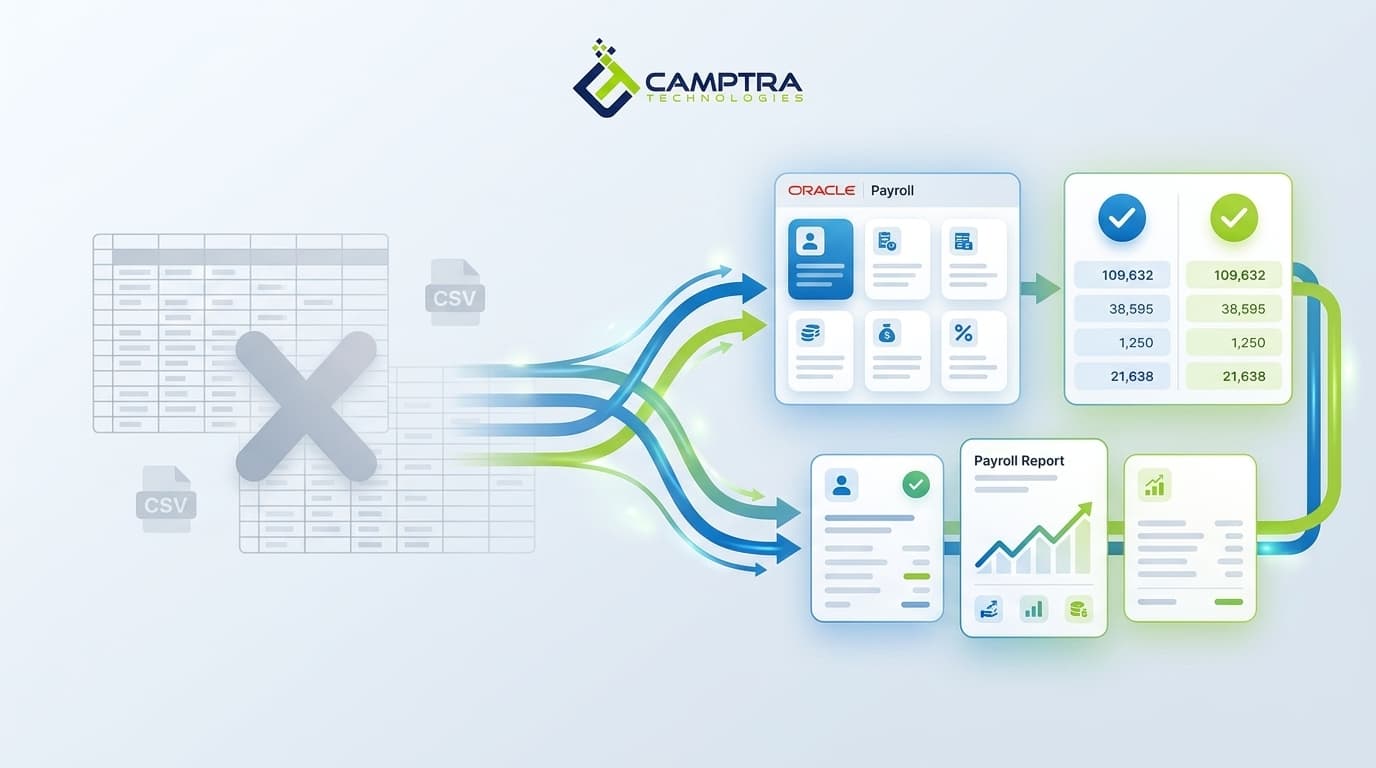
Top Alternatives to Manual Spreadsheet Reconciliation for Oracle Cloud to ADP Payroll Validation
If your team is still reconciling Oracle Cloud HCM data against ADP Workforce Now using spreadsheets, you know the drill. Every pay cycle brings a flood of exported CSV files, VLOOKUPs that break without warning, and late-night reviews to catch missing employees, salary gaps, or deduction errors before the payroll cutoff. It is fragile, time-consuming, and—for audit-heavy enterprises—a compliance risk waiting to happen.
Manual spreadsheet reconciliation is not just tedious; it is unsustainable at scale. A single typo or a forgotten row can cascade into overpayments, underpayments, or regulatory penalties. Yet many organizations stick with it because the alternatives feel unclear or costly.
This article is a buyer’s guide to the spectrum of alternatives to manual payroll reconciliation for Oracle-to-ADP validation. We will walk through the options—from custom scripts and integration middleware to purpose-built validation platforms—and examine the trade-offs in cost, accuracy, and ongoing maintenance. You will learn how each approach handles the core challenge: catching demographic and benefits mismatches before payroll runs, not after.
Whether you are looking to reduce manual effort, improve payroll accuracy, or produce audit-ready output, understanding these alternatives will help you choose the right path for your organization.
Spreadsheets feel like a safe, familiar fallback. But when you are reconciling employee demographics, salary changes, and benefit deductions between Oracle Cloud HCM and ADP Workforce Now, the manual approach introduces fragility at every step.
Consider what happens during a typical pay cycle. Your team exports employee records from Oracle, pulls a separate file from ADP, and then spends hours aligning columns, writing VLOOKUPs, and scanning for mismatches. A missing employee, a salary gap, or a deduction error can slip through. When it does, the downstream cost is not just a corrected paycheck—it is retroactive adjustments, compliance exposure, and lost trust from employees who were paid incorrectly.
For audit-heavy finance and HR teams, spreadsheets create another layer of risk. There is no version control, no audit trail, and no way to prove that every record was checked. If an auditor asks how you validated the data before payroll ran, the answer cannot be “we looked at it in Excel.”
The real problem is not the tool itself. It is that manual reconciliation is not repeatable at scale. As your organization grows, the number of records increases, the complexity of deductions multiplies, and the pressure to close payroll on time intensifies. Spreadsheets do not scale with that pressure. They break under it.
For teams with strong internal development resources, custom scripts written in Python, SQL, or similar languages offer a way to automate data extraction and comparison between Oracle Cloud HCM and ADP Workforce Now without purchasing third-party software. The appeal is straightforward: full control over the matching logic, no vendor lock-in, and a potentially lower upfront cost compared to commercial alternatives.
But that control comes with significant trade-offs. Custom scripts are brittle. When Oracle releases a quarterly update or ADP modifies its Data Bridge schema, the script often breaks. Someone on your team has to diagnose the failure, update the code, and re-test before the next payroll run. That someone is likely the same developer who built the script—and if they leave, institutional knowledge leaves with them.
Accuracy is another concern. Scripts typically compare raw data fields, but they don’t understand payroll context. A missing employee record, a salary gap, or a deduction error might not trigger a flag if the script’s logic doesn’t account for that specific scenario. And because custom scripts rarely produce audit-ready output, your team still ends up building reconciliation reports manually for compliance reviews.
Custom scripts work best for organizations with a dedicated integration team, low tolerance for vendor dependency, and the willingness to treat the reconciliation code as a continuously maintained product rather than a one-time build. For most enterprises running Oracle Cloud HCM and ADP Workforce Now, the maintenance burden and payroll risk outweigh the upfront savings.
Integration Platform as a Service (iPaaS) tools like Boomi, MuleSoft, and Workato sit a step above custom scripts. They provide pre-built connectors for both Oracle Cloud HCM and ADP Workforce Now, handling the heavy lifting of data movement between the two systems. Instead of writing and maintaining raw code, your team configures integration flows through a visual interface, which can reduce development time and make the solution more maintainable when personnel changes occur.
What iPaaS Tools Do Well
These platforms excel at orchestrating data flows at scale. They can schedule regular syncs, transform data formats, and apply basic validation rules—such as checking that employee IDs exist in both systems or that salary amounts fall within expected ranges. For organizations already using an iPaaS for other integration needs, extending it to cover Oracle-to-ADP reconciliation can feel like a natural fit. The same platform that connects your CRM to your ERP can also move employee records to ADP.
Where They Fall Short for Payroll Validation
The gap appears when you move beyond simple data movement into payroll-specific validation. iPaaS tools lack built-in rule engines designed for the nuances of payroll reconciliation. They cannot automatically detect that a missing employee record in ADP will cause a pay run to fail, or that a deduction code mapped incorrectly will produce a compliance issue. Building that logic yourself requires deep payroll domain knowledge and ongoing maintenance as tax rules, benefit plans, and deduction codes change. The platform handles the plumbing; you still have to write and maintain the validation rules.
When This Approach Makes Sense
Integration middleware is a viable alternative to spreadsheets if your team has the integration expertise to configure and maintain the flows, and if your validation requirements are relatively straightforward—for example, checking that headcounts match or that total salary amounts reconcile at a high level. But for organizations that need to catch nuanced demographic mismatches, benefit deduction errors, or salary gaps before payroll runs, the custom validation layer required on top of an iPaaS can become its own maintenance burden. The platform solves the data movement problem but leaves the payroll validation problem largely in your hands.
For organizations that need more than data movement—they need validation, exception visibility, and audit readiness—purpose-built payroll validation platforms offer the most complete alternative to manual spreadsheets. Unlike custom scripts or middleware, these platforms are designed specifically to compare payroll-impacting data between source systems and identify discrepancies before payroll runs.
How Purpose-Built Platforms Differ from Integration Tools
Integration middleware moves data. Purpose-built validation platforms inspect it. Camptra’s Third-Party Reconciliation Suite, for example, is built specifically for Oracle Cloud HCM to ADP Workforce Now reconciliation. It automates demographic and benefits reconciliation, checking for missing employees, salary gaps, deduction errors, and other critical mismatches that spreadsheets routinely miss. The platform does not just flag differences—it surfaces them in a structured, repeatable workflow that payroll, HRIS, and finance teams can act on before the payroll cutoff.
Real-Time Discrepancy Identification and Audit-Ready Output
Where spreadsheets require manual exports, VLOOKUPs, and error-prone cross-referencing, a purpose-built platform continuously validates data and presents exceptions in a single view. Camptra’s Payroll Recon Toolset transforms reconciliation from a post-cycle scramble into a continuous control system. Teams see exactly which employees have mismatched salary data, which deductions failed to sync, and where benefit elections differ between Oracle and ADP. The output is structured for audit review, eliminating the need to reconstruct a reconciliation trail from scattered spreadsheet versions.
Strengths and Trade-Offs
The primary strength of a purpose-built platform is that it is designed for the specific problem: Oracle-to-ADP payroll validation. No custom coding is required, and the platform is built to handle the complexity of large enterprise payroll environments with multiple legal entities, benefit plans, and deduction codes. The trade-off is vendor dependency and a subscription cost. But for audit-heavy enterprises where a single payroll error can trigger compliance exposure or employee dissatisfaction, that cost is offset by reduced risk and faster, more confident payroll cycles.
Best Fit for Large, Complex Payroll Environments
Purpose-built validation platforms are best suited for organizations that prioritize accuracy and audit readiness over low upfront cost. If your team spends more than a few days each cycle reconciling Oracle and ADP data, or if you have experienced a payroll error that required manual adjustments and retroactive corrections, a platform like Camptra’s Third-Party Reconciliation Suite provides a repeatable, defensible alternative to spreadsheets.
ADP Data Bridge and Native Oracle Tools
ADP Data Bridge is the standard interface for moving data from Oracle Cloud HCM into ADP Workforce Now. It handles the transfer of employee records, salary updates, and benefit elections. But data movement is not data validation. Data Bridge will push a record through even if a field contains a formatting error or a missing value—it does not compare what was sent against what was expected.
Oracle Cloud HCM’s built-in reporting and analytics can surface some discrepancies. You can build custom reports that flag, for example, employees whose salary in Oracle does not match the rate in ADP. But those reports require manual setup, manual scheduling, and manual review. There is no automated workflow that consolidates exceptions across demographics, benefits, and deductions into a single view. And there is no audit trail that tracks who reviewed each discrepancy or when it was resolved.
Strengths
These tools carry no additional vendor cost. They are already part of your Oracle and ADP subscriptions. For organizations with simple payroll structures—a single pay group, few benefit plans, and limited employee movement—native tools may be sufficient to catch the most obvious errors.
Trade-offs
The limitations become clear as complexity increases. Native tools cannot perform cross-system validation automatically. They do not reconcile benefit deductions against plan configurations. They do not flag missing employees or duplicate records across systems. And they produce no audit-ready output. Every exception requires a human to open two systems, compare values side by side, and decide whether to adjust Oracle, ADP, or both.
For audit-heavy enterprises, this manual review process creates risk. Spreadsheets and ad hoc reports are difficult to reproduce months later when an auditor asks for evidence of pre-payroll validation. Native tools are a starting point, but they are not a replacement for a structured reconciliation process.
Selecting the right alternative to manual spreadsheet reconciliation depends on your team’s technical capacity, compliance requirements, payroll complexity, and tolerance for risk. No single approach fits every organization, but a structured evaluation helps narrow the options.
Assess Your Team’s Technical Capacity
Custom scripts and in-house automation require dedicated developers who understand both Oracle Cloud HCM and ADP Workforce Now data structures. If your IT team is stretched thin or lacks deep payroll systems expertise, custom development introduces maintenance risk and delays. Integration middleware and iPaaS solutions reduce some coding burden but still demand technical staff to configure mappings, handle exceptions, and manage ongoing updates. Purpose-built platforms like Camptra’s Third-Party Reconciliation Suite require minimal IT support—payroll and HRIS analysts can operate them directly, freeing developers for other priorities.
Evaluate Compliance and Audit Requirements
Audit-heavy finance and HR teams need more than just data comparison—they need a defensible trail. Spreadsheets and custom scripts rarely produce the structured audit logs that external auditors expect. Integration middleware typically focuses on data movement, not validation output. Purpose-built validation platforms generate audit-ready reports that document every discrepancy identified, the data sources compared, and the resolution status. If your organization faces regular internal or external audits, this capability alone can justify the investment.
Consider Payroll Complexity and Volume
High-volume, multi-entity organizations with frequent employee changes, complex benefit deductions, and multiple pay groups cannot rely on manual spot-checking. The risk of missing a salary gap, a missing employee, or a deduction error scales with headcount and entity count. Automated validation platforms catch these mismatches at scale, comparing every record in Oracle Cloud HCM against every record in ADP Workforce Now before payroll runs. For simpler, low-volume environments, a well-maintained custom script or native tool may suffice—but the cost of a missed error often outweighs the platform investment.
Factor in Total Cost of Ownership
Custom scripts appear inexpensive upfront but carry hidden costs: developer time for initial build, ongoing maintenance when Oracle or ADP updates their APIs, and the opportunity cost of pulling technical staff away from other projects. Integration middleware has predictable licensing but often charges per connection or per transaction, which can escalate with data volume. Purpose-built platforms typically offer subscription pricing that includes updates, support, and pre-built validation logic. When you factor in the hours your team currently spends on manual reconciliation, the total cost of ownership for a platform often comes out lower—and the accuracy gains are immediate.
For enterprises that prioritize accuracy, compliance, and reducing manual effort, purpose-built platforms like Camptra’s Third-Party Reconciliation Suite provide the most complete alternative. They automate demographic and benefits reconciliation, catch mismatches before payroll cutoff, and deliver audit-ready output—without requiring your team to become integration specialists.
