

Employee Payroll Dispute Resolution Checklist for HR Teams

An employee payroll dispute resolution checklist is a structured framework that guides HR and payroll professionals through every step needed to address payroll discrepancies efficiently and compliantly. In practice, this means moving from the moment an employee reports a payment issue through intake, fact-finding, correction, and closure. The industry term for this process is payroll dispute management, and it carries real legal weight: delayed correction of a known pay error creates additional liability, including penalties and attorney fees. A consistent checklist protects both the employee and the organization.
1. What are the essential stages in an employee payroll dispute resolution checklist?
An effective payroll dispute resolution checklist includes four mandatory stages: Intake and Triage, Fact-Finding, Resolution, and Closure. Each stage has defined activities, owners, and documentation requirements. Skipping any stage creates gaps that surface later as compliance failures or recurring errors.
Stage 1: Intake and Triage

Every dispute enters through a single, consistent channel. The “one front door” approach funnels all payroll claims through one internal process to reduce discrimination claims and build organizational trust. At intake, you log the claim, assign a case number, and classify its urgency. A missed paycheck for a full-time employee is a P0 priority. A minor rounding discrepancy on a deduction is a P1.
Stage 2: Fact-Finding
You gather every relevant document and verify the numbers independently. This stage ends when you can confirm or deny the claim with evidence, not opinion.
Stage 3: Resolution
You correct the error, communicate the outcome to the employee, and execute any payment adjustments. Off-cycle payments apply when the next regular payroll cycle creates unacceptable delay.
Stage 4: Closure
You document the root cause, record the correction, and assign ownership for the process fix. Documentation captures before-and-after outcomes, effective dates, and approvals.
Pro Tip: Assign a named case owner at intake. Disputes without a single accountable owner stall between teams and generate follow-up complaints that are harder to defend.
2. How to conduct thorough fact-finding for payroll disputes
Fact-finding is the stage where most payroll dispute management processes break down. Teams pull incomplete records, skip recalculations, or rely on memory instead of audit trails. The result is a resolution that does not hold up to scrutiny.
Collect the following documents before drawing any conclusions:
- Timecards and attendance records for the disputed pay period
- The signed employment contract confirming pay rate, classification, and deduction agreements
- Pay stubs for the current and prior periods to identify what changed
- Deduction authorizations for benefits, garnishments, and voluntary withholdings
- Manager approvals for overtime, bonuses, or shift differentials
- System audit trails showing when data was entered, by whom, and whether it was modified
Once you have the documents, recalculate Gross Pay and Net Pay independently. Check for misclassification errors, where an employee is coded as exempt when they should be non-exempt. Review overtime calculations against the applicable federal or state standard. Look for data entry errors such as transposed hours or incorrect pay rates applied after a promotion.
Capturing audit-ready evidence artifacts that link the correction to its root cause and approval is critical for payroll-finance reconciliation and for mitigating future disputes. Without this, your finance team cannot reconcile general ledger differences caused by payroll exceptions.
Pro Tip: If your payroll system supports audit trail exports, pull them before contacting the employee. You want the facts before the conversation, not after.
3. Best practices for resolving payroll disputes promptly and fairly
Prompt correction is not just good practice. Never dismiss a payroll claim without investigation; treat every report as potentially valid to avoid legal liability. The resolution stage requires both technical execution and clear communication.
Follow these steps when executing a resolution:
- Confirm the finding in writing to the employee before making any system change. Explain what the error was, what caused it, and what correction will be made.
- Explain pay stub details and deductions line by line if the employee does not understand the change. Transparent communication on pay stub details is essential for dispute resolution and employee retention.
- Get written approval from the appropriate manager or payroll director before processing any balance adjustment.
- Execute the correction in the payroll system with the correct effective date. For material missed pay, process an off-cycle run rather than waiting for the next cycle.
- Escalate to mediation when internal resolution fails. Established mediation bodies provide a neutral process before the dispute reaches a regulatory body or court.
“Transparency in explaining payroll to employees is more critical to trust and retention than the speed of error correction. An employee who understands what happened and why is far less likely to escalate, even when the correction takes a few days.”
The approval step is where many teams cut corners under time pressure. Skipping it creates a situation where corrections are made without authorization, which creates its own audit exposure. Build the approval into your checklist as a hard gate, not an optional step.
4. Closure and prevention: How to document and prevent recurring payroll disputes
Closure is not the moment you process the correction. Closure is the moment you have documented the full record and assigned ownership for the process fix. Most payroll teams treat closure as a formality. That is the mistake that turns a one-time error into a recurring pattern.
For each resolved dispute, your documentation must answer three questions: Why did this happen? How was it corrected? Who authorized the correction? This “Why-How-Who” record supports finance reconciliation and audit readiness. Without it, your general ledger carries unexplained variances that auditors will flag.
| Documentation Element | Purpose | Owner |
|---|---|---|
| Root cause classification | Identifies error type for trending | Payroll analyst |
| Before-and-after pay values | Confirms correction accuracy | Payroll manager |
| Effective date of correction | Aligns payroll and GL records | Payroll director |
| Approval record | Provides audit trail | HR or finance lead |
| Process fix assignment | Prevents recurrence | Process owner |
Trending exceptions monthly and assigning ownership for fixes differentiates scalable payroll teams from those stuck in perpetual firefighting. When you see the same error type appearing across three consecutive pay periods, that is a process failure, not a coincidence.
Pro Tip: Build a simple exception log in your payroll system or a shared tracker. Review it at the start of each month. If any error type appears more than twice, it needs a process owner and a fix date, not just another correction.
Linking dispute resolution with prevention actions creates sustainable payroll operations and reduces the manual correction burden that leads to team burnout.
5. Common payroll exception types and decision frameworks for resolution actions
Not every payroll exception requires the same response. A decision framework classifies payroll exceptions into four action types: hold, override, reprocess, or off-cycle. Choosing the wrong action creates downstream problems in costing, tax, and general ledger reconciliation.
Priority triage guides the decision:
- P0 (material impact): Missed paycheck, significant underpayment, or incorrect tax withholding affecting the employee’s net pay by a material amount. These require same-day escalation and typically an off-cycle run.
- P1 (minor impact): Small rounding errors, minor deduction discrepancies, or benefit adjustments that can be corrected in the next regular cycle without hardship to the employee.
| Action | When to use | Key risk |
|---|---|---|
| Hold | Error identified pre-archive; correction possible before payroll runs | Delays payroll if not resolved quickly |
| Override | Post-archive correction to a specific element; does not require full reprocess | Requires careful audit trail documentation |
| Reprocess | Significant data error affecting multiple elements; full recalculation needed | Time-intensive; may affect other employees |
| Off-cycle run | Material missed pay or timing-sensitive correction | Higher processing cost; use only when justified |
Off-cycle runs should be reserved for material missed pay and timing-sensitive corrections. Using off-cycle runs for minor adjustments trains employees to expect immediate corrections for every issue, which creates unsustainable operational pressure.
Consistency and standardization across exception handling decisions prevent escalating compliance risks and inconsistent employee experience. When two employees with identical errors receive different resolution timelines, you have a discrimination exposure, not just a process gap.
Key takeaways
A structured four-stage payroll dispute resolution process, covering intake, fact-finding, resolution, and closure, is the most effective way to resolve employee payment issues compliantly and prevent recurrence.
| Point | Details |
|---|---|
| Use a single intake channel | Funneling all claims through one process reduces discrimination risk and builds trust. |
| Document with “Why-How-Who” | Every correction needs a root cause, approval record, and effective date for audit readiness. |
| Triage by material impact | Classify exceptions as P0 or P1 before choosing hold, override, reprocess, or off-cycle. |
| Trend exceptions monthly | Recurring error types signal process failures that need an assigned owner and a fix date. |
| Transparency beats speed | Explaining what happened and why reduces escalation more reliably than fast correction alone. |
What I’ve learned about payroll dispute resolution that most checklists miss
Most payroll dispute checklists focus on the mechanics: collect documents, recalculate, correct, close. That is necessary, but it is not sufficient. The teams I have seen handle disputes well share one habit that rarely appears in formal guidance. They treat the intake conversation as a trust-building moment, not just a data-gathering exercise.
When an employee reports a payment issue, they are often anxious and sometimes angry. How you receive that report shapes the entire resolution experience. A single intake channel, with a named owner and a clear acknowledgment timeline, signals that the organization takes the claim seriously. That signal matters more than most HR professionals realize. Employees who feel heard at intake are far less likely to escalate externally, even when the correction takes longer than expected.
The second thing most checklists miss is the connection between closure and prevention. I have reviewed payroll operations where the team closed hundreds of disputes per year with no trending, no root cause analysis, and no process fixes. They were efficient at correcting errors. They were terrible at stopping them. The exception trending and prevention strategy is what separates a reactive payroll function from a reliable one.
Technology matters here, but not in the way vendors usually frame it. The value of integrated payroll tools is not speed. It is the audit trail. When you can pull a complete record of every data change, every approval, and every correction in seconds, your fact-finding time drops dramatically. That is where tools like Camptra Technologies’ Payroll Recon Toolset create real operational value: not by replacing judgment, but by giving you the data to exercise it faster and with more confidence.
— Zach
How Camptra Technologies supports payroll dispute resolution
Enterprise payroll teams running Oracle Cloud face a specific challenge: reconciling millions of records across time and attendance, benefits, costing, tax, and general ledger before every payroll cutoff. Manual spreadsheet reviews cannot keep pace with that volume, and missed exceptions become disputes after the fact.
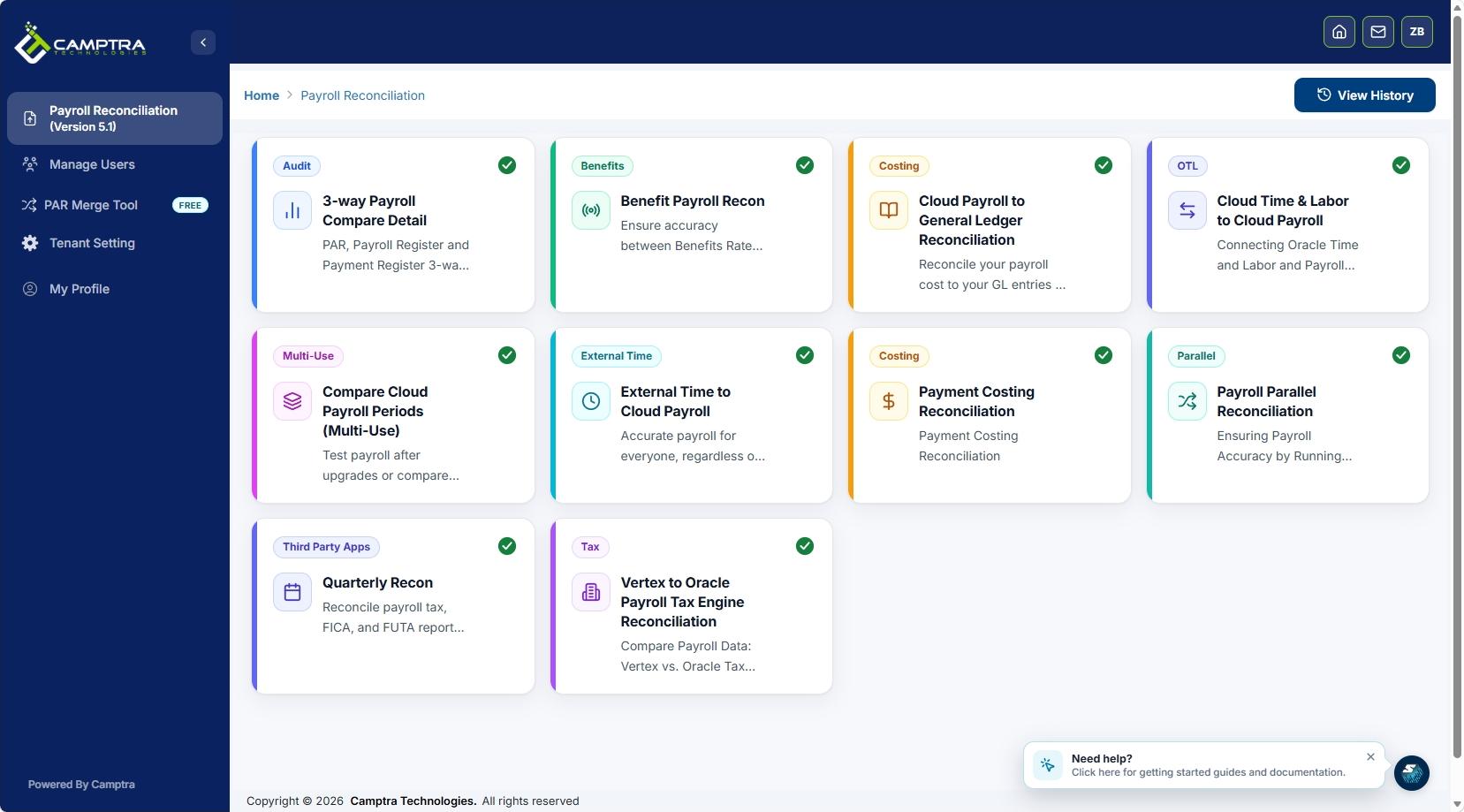
Camptra Technologies’ Payroll Recon Toolset automates large-scale reconciliation, surfaces variances before they reach employees, and produces the audit-ready documentation your fact-finding and closure stages require. Customers have reported reconciliation time reductions of up to 80%, giving payroll teams more time to resolve exceptions rather than prepare data. If your team is managing high-volume payroll in Oracle Cloud and wants a faster path to dispute prevention, request sandbox access to see the toolset in action.
FAQ
What is an employee payroll dispute resolution checklist?
An employee payroll dispute resolution checklist is a structured, four-stage process covering intake, fact-finding, resolution, and closure that guides HR and payroll teams through resolving payment discrepancies compliantly and consistently.
How long does an employer have to correct a payroll error?
Correction timelines vary by state and jurisdiction, but delayed correction of a known pay error creates additional liability including penalties and attorney fees, so prompt action after confirming the error is the standard best practice.
What documents are needed for payroll dispute fact-finding?
Fact-finding requires timecards, the signed employment contract, pay stubs for the disputed period, deduction authorizations, manager approvals, and system audit trails showing all data changes.
When should an employer use an off-cycle payroll run?
Off-cycle runs are appropriate for material missed pay and timing-sensitive corrections. They should not be used for minor deduction adjustments that can be resolved in the next regular payroll cycle.
How do you prevent recurring payroll disputes?
Regular audits and supervisor training reduce payroll errors before they reach employees. Trending exceptions monthly and assigning a process owner for each recurring error type builds the prevention loop that stops disputes from repeating.
Recommended
