

HR Payroll Collaboration Best Practices for 2026

HR payroll collaboration best practices are the coordinated workflows, shared responsibilities, and communication strategies that align HR, payroll, and finance teams to produce accurate, on-time payroll. Uncoordinated approval workflows drive 15%–20% of employee payroll disputes annually. That number is preventable. The fix is not a single tool or policy. It is a layered system of role clarity, structured calendars, shared metrics, and technology governance that keeps every team working from the same data toward the same deadline.
1. What are the core HR payroll collaboration best practices?
Effective HR and payroll teamwork starts with treating payroll as a cross-functional product, not a departmental output. Collaborative ownership upstream in HR reduces costly downstream corrections because fixing an error at the data entry stage costs a fraction of correcting it after payroll runs. When HR, payroll, and finance each own a defined slice of the process, accountability is clear and gaps shrink.
The foundational components of a reliable HR team payroll coordination workflow are:
- Role-based separation of duties. HR owns hire, termination, and status change accuracy. Payroll owns exception identification and calculation validation. Finance validates liabilities and general ledger postings.
- Structured payroll calendars. Every pay cycle needs named milestones: data input cutoff, calculation run, variance review, and multi-role sign-off.
- Layered approval controls. Approval workflows split into preparers, reviewers, and final authorizers eliminate single-point-of-failure errors that a solo operator would never catch.
- Documentation tied to approvals. Every exception, off-cycle correction, or variable pay change needs a linked record explaining who approved it and why.
Pro Tip: Build your approval thresholds around dollar amounts, not just job titles. Any off-cycle correction above a defined dollar value should require Finance Controller sign-off, regardless of who initiated it.
2. How to define roles and approval layers across HR, payroll, and finance
Shared governance with distinct checkpoints across the Payroll Administrator, HR Manager, and Finance Controller roles reduces control gaps and improves payroll accuracy. Each role owns specific validation tasks, and those tasks must not overlap in ways that allow one person to both prepare and approve the same transaction.

The Payroll Administrator prepares the payroll run, flags exceptions, and submits for review. The HR Manager confirms that all employee status changes, new hires, and terminations are reflected correctly before the calculation run. The Finance Controller validates that costing entries, tax liabilities, and net pay totals align with budget expectations before final approval.
This three-layer structure works because it mirrors audit-grade internal controls. Each checkpoint catches a different class of error. HR catches data errors. Payroll catches calculation errors. Finance catches liability errors. No single layer can catch all three.
3. How joint review meetings improve payroll accuracy
Recurring 30-minute joint HR-payroll review meetings before each pay cycle significantly reduce the volume of post-pay correction work. These pre-cycle huddles give HR and payroll a shared view of pending changes, open exceptions, and late submissions before the calculation run locks.
The agenda for these meetings should be fixed and short:
- Review all pending employee status changes not yet confirmed in the system.
- Confirm variable pay submissions, including bonuses, commissions, and overtime adjustments.
- Flag any late changes that will require off-cycle processing.
- Assign named owners to each open exception before the meeting ends.
Aligning KPIs across HR and payroll to shared measures like “first-pass payroll accuracy” shifts the culture from blame to collaborative problem-solving. When HR is measured on data submission timeliness and payroll is measured on error rate, the incentives pull in opposite directions. A shared accuracy metric closes that gap.
Pro Tip: Record the exception log from each pre-cycle meeting and review it at the next one. Patterns in recurring exceptions reveal process gaps that a one-time fix will not solve.
4. What role does technology integration play in HR payroll collaboration?
Technology integration is the mechanism that enforces governance at scale. Without it, even well-designed workflows collapse under volume. A control matrix defining source of truth and review gates for payroll-sensitive HRIS fields prevents erroneous data from reaching the payroll calculation engine.
Key technology integration practices include:
- Define the source of truth for every payroll-sensitive field. Salary, pay grade, work location, and tax withholding elections each need a designated owning system. Changes in a secondary system should never override the primary without a review gate.
- Automate exception routing. When a field value changes outside an approved threshold, the system should route an alert to the named reviewer automatically, not rely on someone noticing.
- Use shared visibility platforms. Real-time status dashboards let HR, payroll, and finance see where each record stands in the approval chain without emailing back and forth.
- Reduce siloed data entry. A common employee record system eliminates the scenario where HR updates a name change in one platform and payroll never sees it.
| Integration Feature | Collaboration Benefit |
|---|---|
| Control matrix for HRIS fields | Prevents unauthorized data changes from reaching payroll |
| Automated exception routing | Removes manual handoffs and reduces missed alerts |
| Shared status dashboards | Gives all teams real-time visibility into approval progress |
| Common employee record system | Eliminates duplicate data entry and version conflicts |
Camptra Technologies applies this model in Oracle Cloud environments, connecting payroll-impacting data across time and attendance, benefits, costing, tax, and general ledger processes. Teams using the Payroll Recon Toolset can surface variances across millions of records in minutes rather than spending hours preparing data for review.
5. How to design a payroll calendar that prevents last-minute errors
Best-in-class payroll operations use an eight-milestone payroll calendar that covers key inputs, calculation runs, variance checks, and multi-role sign-offs. The calendar is not just a schedule. It is a governance document that defines who hands off what, to whom, and by when.
Effective payroll calendars explicitly separate input cutoffs from approval cutoffs and protect review windows from being compressed by late changes. When input and approval deadlines collapse into the same window, reviewers rush, and errors survive to the final run.
The eight milestones that define a well-structured payroll calendar are:
- HR data input cutoff. All status changes, new hires, and terminations confirmed in the system.
- Variable pay submission deadline. Bonuses, commissions, and overtime submitted by department managers.
- Preliminary calculation run. Payroll processes the initial run for review.
- Variance analysis. Payroll compares current period results to prior period and flags outliers.
- HR review and sign-off. HR confirms employee data accuracy against the calculation output.
- Payroll Manager approval. Payroll validates exceptions and approves the run for Finance.
- Finance Controller review. Finance validates liabilities, costing, and net pay totals.
- Final approval and submission. Authorized approver releases payroll for processing.
Separating milestones 1 and 2 from milestones 5 through 7 creates a protected review window. That window is where errors get caught. Compressing it is the single most common cause of post-pay corrections.
6. What specific practices reduce common pitfalls in HR payroll collaboration?
The most frequent pitfalls in HR and payroll coordination are not technical failures. They are process failures: inconsistent data formats, undefined exception ownership, and terminology gaps between teams.
Language differences and inconsistent terms between HR and payroll teams lead directly to calculation errors. A simple example: HR defines “start date” as the first day of orientation, while payroll uses it as the first day of paid work. That one-day difference creates retroactive pay calculations that neither team anticipated.
Practices that prevent these pitfalls include:
- Assign named exception owners. Every open exception at payroll cutoff should have one person responsible for resolving it. “The team will handle it” is not an owner.
- Standardize terminology in a shared glossary. Define terms like “effective date,” “start date,” “termination date,” and “pay period end” in writing, and make the glossary accessible to both HR and payroll.
- Review and update SOPs quarterly. Workflows that worked for a team of 500 employees break at 2,000. Build a quarterly review into the calendar.
- Use layered controls, not checklists. A checklist tells you what to do. A layered control system prevents you from proceeding until it is done. The difference is enforcement, not intention.
The payroll-to-HRIS integration governance guide framework reinforces this point: governance is not a document you file. It is a set of enforced rules that make the wrong action harder than the right one.
Key Takeaways
Effective HR payroll collaboration requires layered role accountability, structured calendars with protected review windows, shared KPIs, and technology governance that enforces data integrity at every handoff.
| Point | Details |
|---|---|
| Layered approval controls | Split roles into preparers, reviewers, and authorizers to eliminate single-point errors. |
| Eight-milestone payroll calendar | Separate input cutoffs from approval deadlines to protect review windows. |
| Shared KPIs across teams | Align HR and payroll on first-pass accuracy metrics to shift culture from blame to collaboration. |
| Terminology standardization | Define key terms in a shared glossary to prevent retroactive calculation errors. |
| Technology governance | Use a control matrix to define data ownership and automate exception routing across systems. |
What I’ve learned about HR payroll collaboration after years of watching it break
Most teams I have worked with do not fail because they lack process documentation. They fail because their processes are designed for a world where everyone follows the rules perfectly. The moment a manager submits variable pay two days late, or HR forgets to close a termination record before the input cutoff, the whole workflow depends on someone noticing. That is not a process. That is hope.
The teams that get this right share two traits. First, they treat the payroll calendar as a contract, not a suggestion. Every milestone has a named owner and a consequence for missing it. Second, they measure collaboration explicitly. When I have seen organizations adopt a shared “first-pass payroll accuracy” KPI, the dynamic between HR and payroll changes within two or three pay cycles. People stop protecting their own metrics and start solving the shared problem.
Technology matters, but it is the third priority, not the first. I have seen well-governed manual workflows outperform poorly governed automated ones. The automation amplifies whatever process you put into it. If the process has gaps, the automation runs faster through those gaps.
The most underrated practice is the pre-cycle huddle. Thirty minutes before a calculation run, with HR, payroll, and finance in the same room or call, catches more errors than any post-pay audit. It is cheap, repeatable, and it builds the kind of cross-team trust that makes every subsequent cycle easier.
— Zach
How Camptra Technologies supports payroll collaboration at scale
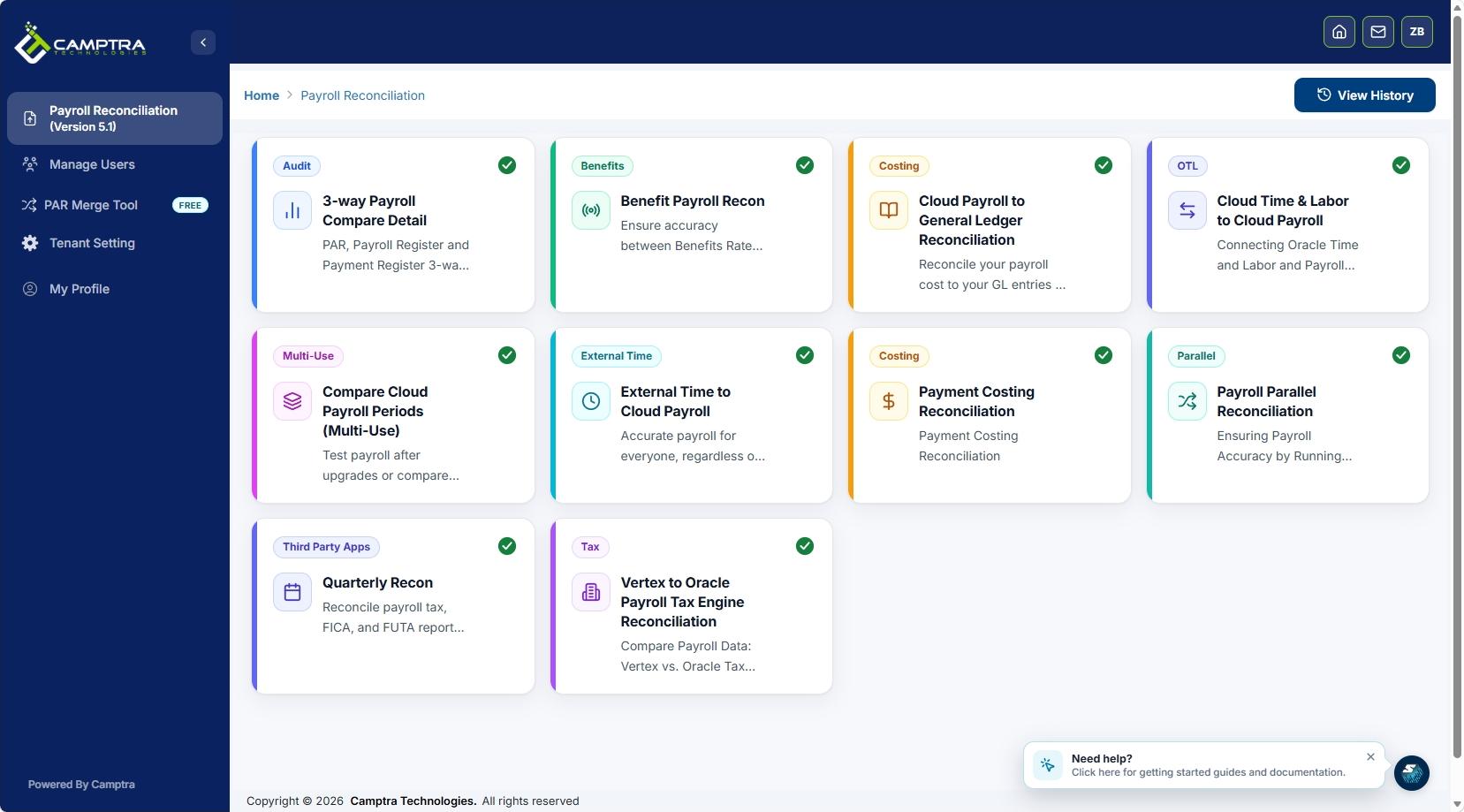
Enterprise payroll teams running Oracle Cloud face a specific challenge: the volume of data that needs reconciliation before cutoff is too large for spreadsheet-based reviews. Camptra Technologies built the Payroll Recon Toolset to address exactly that problem. The tool connects payroll-impacting data across time and attendance, benefits, costing, tax, and general ledger processes, and surfaces variances before they become downstream audit issues.
Customers have reported reconciliation time reductions of up to 80%, giving payroll, HRIS, and finance teams more time to resolve exceptions rather than prepare data. For organizations that want to see what that looks like in practice, the Camptra case studies library includes real-world examples across healthcare, nonprofit, and public transit environments.
FAQ
What are HR payroll collaboration best practices?
HR payroll collaboration best practices are the structured workflows, role-based approval controls, shared calendars, and communication routines that align HR, payroll, and finance teams to produce accurate payroll. They include layered approvals, pre-cycle review meetings, shared KPIs, and technology governance.
How do HR and payroll teams reduce payroll disputes?
Uncoordinated approval workflows drive 15%–20% of payroll disputes annually. Structured approval layers with named roles for preparers, reviewers, and authorizers, combined with pre-cycle review meetings, are the most direct way to reduce that number.
Why does terminology standardization matter for payroll accuracy?
Inconsistent terms between HR and payroll create retroactive calculation errors. Defining terms like “start date” and “effective date” in a shared glossary prevents both teams from working from different assumptions.
What is a payroll control matrix?
A payroll control matrix defines which system owns each payroll-sensitive field, what level of change triggers automated processing versus manual review, and who is responsible for exception handling. It is the governance foundation for any HRIS-to-payroll integration.
How many milestones should a payroll calendar include?
Best-in-class payroll calendars include eight milestones covering HR data input, variable pay submission, calculation runs, variance analysis, HR review, payroll approval, finance validation, and final submission. Separating input cutoffs from approval deadlines is the critical design principle.
Recommended
- Oracle Payroll Activity Center and Multiuse Reconciliation: A Complementary Approach for Modern Payroll Teams | Camptra Technologies
- Blog | Camptra Technologies | Camptra Technologies
- Modernizing Oracle Cloud Payroll: Automated Reconciliation for a 105,000-Employee Healthcare Network | Camptra Case Study | Camptra Technologies
