

Payroll reconciliation is defined as the systematic process of matching payroll data across registers, general ledger entries, bank payments, and tax filings to confirm that every figure is accurate and complete. For payroll professionals and team leaders, this process is the primary control that prevents overpayments, underpayments, tax penalties, and audit failures. Done correctly, it produces a clear, defensible record that satisfies both internal finance teams and external auditors. Done poorly, or skipped entirely, it creates downstream errors that compound across every subsequent pay cycle.
What are the core steps in the payroll reconciliation process?
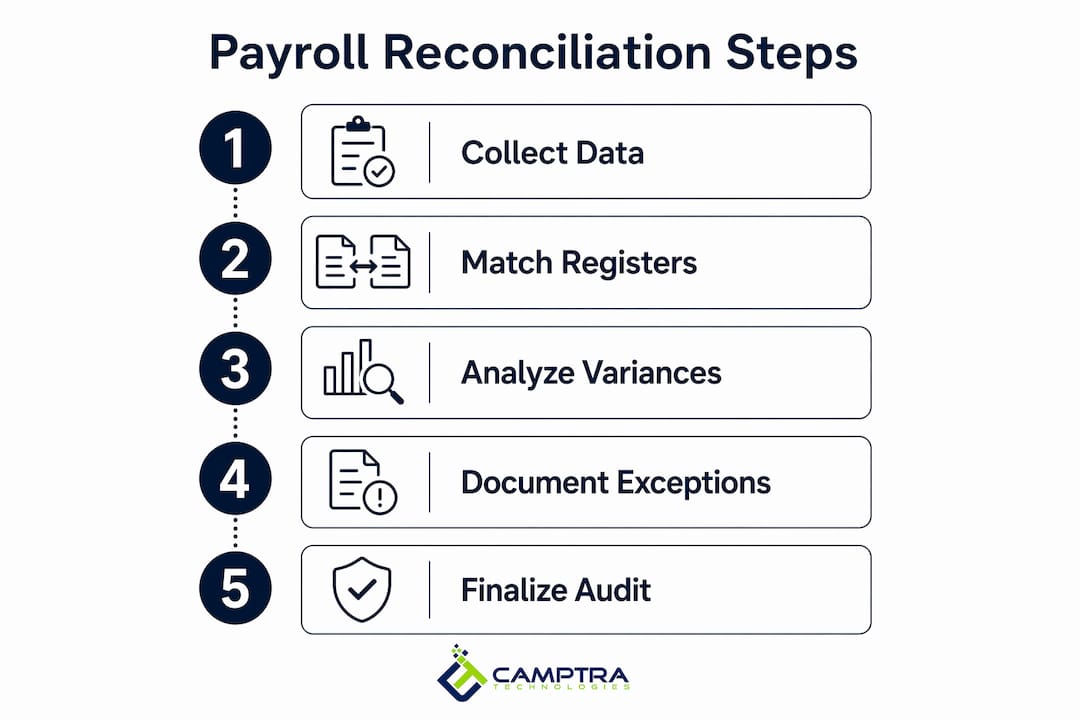
Effective payroll reconciliation requires performing four key checks each cycle: gross-to-net, payroll-to-ledger, payroll-to-bank, and payroll-to-tax-filing. Each check targets a different failure point, and skipping any one of them leaves a gap that auditors will find.
The standard sequence runs as follows:
- Gross-to-net reconciliation. Verify that Gross Pay minus all deductions (taxes, benefits, garnishments, and retirement contributions) equals Net Pay for every employee. Any mismatch here signals a calculation error or a missing deduction.
- Payroll-to-ledger reconciliation. Confirm that payroll journal entries posted to the general ledger match the final payroll register totals. This is where payroll accruals reconciliation workflow matters most, since accrued wages must align with the period they cover, not the date they are paid.
- Payroll-to-bank reconciliation. Match the total net pay disbursed against the bank funding amount. Differences here often trace back to voided checks, returned ACH transactions, or timing errors on direct deposit files.
- Payroll-to-tax-filing reconciliation. Confirm that tax liabilities calculated in the payroll system match the amounts remitted to federal, state, and local agencies. Mismatches at this stage carry the highest penalty risk.
Pro Tip: Set a 5% materiality threshold for variance analysis at the department or jurisdiction level. Variances exceeding 5% should trigger immediate investigation before funds clear, not after.
Sequencing these checks matters as much as performing them. Running payroll-to-bank before payroll-to-ledger, for example, can produce an “apples to oranges” comparison if journal entries have not yet posted. Control points, such as a pre-archive sign-off and a post-archive review, enforce the correct order and prevent teams from certifying incomplete data.

How are payroll reconciliation exceptions identified and managed?
Payroll reconciliation exceptions are any variances, anomalies, or transactions that fall outside expected parameters during a reconciliation check. Common examples include:
- Off-cycle payments made outside the standard pay run
- Manual corrections to Gross Pay or Net Pay after the payroll archive
- Missing benefit deductions due to enrollment timing gaps
- System mismatches between the HRIS headcount and the payroll register headcount
- Balance adjustments that were not approved through the standard change-control process
Exception logs as formal audit evidence are the standard for documenting these items. Each entry should capture the exception type, the affected employee or cost center, the dollar amount, the approver, and the resolution date. Auditors prioritize these logs precisely because they reveal whether your team caught and resolved issues in real time or discovered them after the fact.
The critical discipline here is integration. Exceptions must be integrated within the core reconciliation workflow, not tracked in a separate spreadsheet that gets reconciled later. When exceptions live outside the main workflow, they get buried, forgotten, or resolved without proper authorization.
Pro Tip: Assign a single owner to the exception log each pay cycle. That person is responsible for ensuring every open item has a documented resolution before payroll certifies. This single accountability point prevents exceptions from aging across multiple cycles.
Technology-enabled exception reporting changes the dynamic from reactive to proactive. Instead of discovering a missing deduction after the bank file has been sent, automated variance detection flags the anomaly during the pre-archive stage, when correction is still possible without an off-cycle run.
What audit evidence is required for payroll reconciliation?
Auditors expect a specific set of documents to verify that reconciliation controls were actually exercised, not just planned. The table below outlines the core documents, their purpose, and the audit risk if they are missing.
| Document | Purpose | Audit risk if missing |
|---|---|---|
| Final payroll register | Source of record for all pay and deductions | Cannot verify gross-to-net accuracy |
| Payroll journal entries | Confirms ledger alignment | General ledger balances cannot be validated |
| Bank reconciliation | Matches disbursements to funding | Undetected overpayments or funding gaps |
| Tax filing timestamps | Proves timely remittance | Penalty exposure for late or incorrect filings |
| Liability roll forwards | Tracks accrued liabilities period over period | Accruals reconciliation workflow breaks down |
| Exception logs | Documents off-cycle items and corrections | Unapproved transactions appear uncontrolled |
Pre-established sign-off policies are equally important. A payroll register signed by the payroll manager and countersigned by finance creates a two-person control that auditors recognize as a strong compensating control. Without it, even accurate numbers look uncontrolled.
System-generated reports strengthen audit readiness in a way that manual spreadsheets cannot. A spreadsheet can be edited after the fact. A system-generated report with a timestamp and a locked archive cannot. Secure digital storage of these reports, organized by pay period and retained according to your jurisdiction’s record-keeping requirements, means auditors can verify controls without asking your team to reconstruct data from memory.
Headcount reconciliation deserves specific attention here. What is headcount reconciliation in payroll? It is the process of confirming that the number of employees paid in a given cycle matches the active headcount in the HRIS. A single terminated employee who remains in the payroll run represents both a financial error and a control failure. Catching it requires comparing the payroll register against the HRIS active employee list before the archive is finalized.
How does automation improve the payroll reconciliation workflow?
Fragmented HR and finance systems are the leading cause of payroll reconciliation failure. When time and attendance data lives in one system, payroll in another, and the general ledger in a third, manual rekeying between them creates errors at every handoff. Integration between these systems structurally reduces reconciliation errors before a human ever reviews the output.
Automated transaction matching applies consistent logic every period, removing the manual variation that comes from different team members applying different judgment calls. This consistency directly improves period-end close efficiency and produces a more defensible audit trail.
For Oracle Cloud Payroll teams, the oracle cloud payroll workflow adds a specific technical layer. Oracle Cloud payroll interlock rules prevent rolling back or reconciling processes that have already been interlocked by later-dated events. This means reconciliation actions must be sequenced carefully. Running a reversal after a dependent process has been completed will trigger a system block, requiring manual intervention to resolve. Understanding these interlocks is not optional for teams managing payroll exception handling in Oracle Cloud.
The practical difference between manual and automated reconciliation shows up most clearly at scale. A team reconciling 500 employees can manage with spreadsheets, at significant risk. A team reconciling 50,000 employees cannot. Camptra Technologies customers have reported reconciliation time reductions of up to 80% after moving from spreadsheet-driven processes to automated reconciliation. That reduction reflects not just speed but the elimination of the preparation work that consumes most of a manual reconciliation cycle.
New hire payroll reconciliation is one area where automation delivers outsized value. What is new hire payroll reconciliation? It is the verification that a new employee’s first paycheck reflects the correct start date, pay rate, benefit elections, and tax withholding setup. Errors here are common because new hire data flows through multiple systems before it reaches the payroll run. Automated pre-payroll checks catch setup errors before the first payment is made, avoiding the need for retroactive corrections.
Key Takeaways
Payroll reconciliation requires four core checks each cycle, formal exception logs, complete audit documentation, and system integration to produce results that are accurate, defensible, and audit-ready.
| Point | Details |
|---|---|
| Four core reconciliations | Run gross-to-net, payroll-to-ledger, payroll-to-bank, and payroll-to-tax-filing every cycle without exception. |
| Materiality thresholds | Investigate variances exceeding 5% at department or jurisdiction level before funds clear. |
| Exception log discipline | Document every off-cycle payment and correction in the core workflow, not a separate spreadsheet. |
| Audit documentation | Maintain payroll registers, journal entries, bank reconciliations, tax timestamps, and exception logs as a complete set. |
| Automation at scale | Automated reconciliation removes manual variation and reduces cycle time, with documented reductions of up to 80%. |
What I’ve learned from watching manual reconciliation break at scale
Payroll teams that rely on spreadsheets are not making a technology choice. They are making a risk choice. I have seen highly competent payroll professionals spend three days per cycle preparing data for a reconciliation that should take three hours. The preparation is the problem. When your reconciliation process starts with exporting, reformatting, and stitching together files from four different systems, you have already introduced errors before you have checked a single number.
The teams that handle reconciliation well share one habit: they define their materiality threshold before the cycle starts, not after they see the variances. Defining materiality thresholds before the cycle begins means your team investigates the right variances and documents why smaller ones were accepted. That documentation is what turns a reconciliation from a number-checking exercise into an actual control.
Exception handling is where most teams lose discipline. The off-cycle payment gets processed, the correction gets made, and the exception log gets updated “later.” Later becomes never. When an auditor asks why a $14,000 off-cycle payment was made in october, “we fixed it” is not an answer. A timestamped exception log entry with an approver name and a resolution note is. Build the exception log into the workflow, not as an afterthought.
The shift from reactive to proactive reconciliation is the real value of automation. Pre-payroll variance analysis, running before the archive, means your team resolves issues when correction is still cheap. Post-payroll corrections are expensive in time, in off-cycle runs, and in audit exposure. The payroll reconciliation tools that deliver the most value are the ones that move your control point earlier in the cycle, not just faster at the end.
— Zach
How Camptra Technologies supports enterprise payroll reconciliation
Payroll teams managing high-volume Oracle Cloud environments need more than a checklist. They need a tool that connects payroll, time and attendance, benefits, costing, tax, and general ledger data in one place and surfaces variances before cutoff.
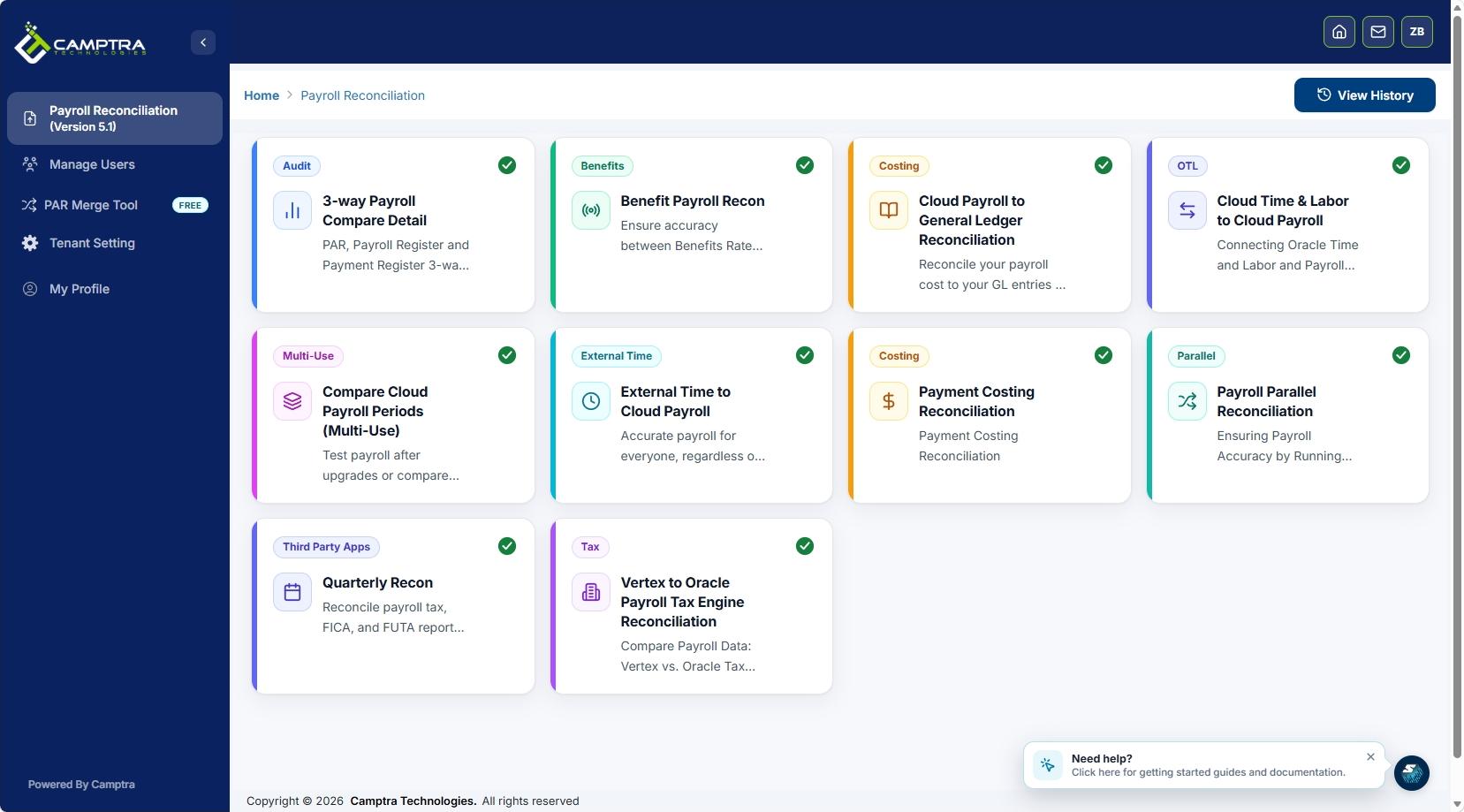
Camptra Technologies built the Payroll Recon Toolset specifically for this environment. The tool automates exception logging, runs pre-payroll variance analysis, and integrates directly with Oracle Cloud payroll workflows so your team spends time resolving issues, not preparing data. A regional healthcare provider eliminated 32-hour manual audit cycles using Camptra’s automated reconciliation. You can review additional case studies to see documented results across industries, or request sandbox access to test the toolset against your own payroll data before committing.
FAQ
What is payroll reconciliation?
Payroll reconciliation is the process of matching payroll data across internal records and external filings to confirm accuracy and completeness. It covers gross-to-net calculations, general ledger alignment, bank disbursements, and tax remittances each pay cycle.
What are payroll reconciliation exceptions?
Payroll reconciliation exceptions are variances or transactions that fall outside expected parameters, such as off-cycle payments, manual corrections, missing deductions, or headcount mismatches. Each exception must be documented in a formal exception log with an approver and resolution date.
What is headcount reconciliation in payroll?
Headcount reconciliation is the process of confirming that the number of employees paid in a cycle matches the active headcount in the HRIS. It catches terminated employees who remain in the payroll run and new hires whose setup is incomplete.
How does Oracle Cloud payroll handle reconciliation workflow?
Oracle Cloud payroll uses interlock rules that prevent reversals or reconciliation actions when a dependent downstream process already exists. Teams must sequence reconciliation steps carefully to avoid system blocks that require manual resolution.
Why does manual payroll reconciliation fail at enterprise scale?
Manual reconciliation fails because fragmented systems require manual data rekeying at every handoff, which introduces errors before any checking begins. Spreadsheet-driven processes also lack the timestamped, locked audit trail that auditors require to verify controls independently.
