

Payroll’s Role in the Financial Close Process

Payroll is defined as the single largest variable in most organizations’ monthly close, and its accuracy determines whether financial statements are trustworthy or not. Payroll often represents 30–40% of total operating costs, making it one of the most material line items finance teams must reconcile before books close. Yet payroll and finance teams frequently operate in silos, treating the role of payroll in the financial close process as an afterthought rather than a structured discipline. The result is late journal entries, unrecorded liabilities, and audit exposure that could have been prevented with the right operating model.
What is the role of payroll in the financial close process?
Payroll’s role in the financial close is to deliver accurate, complete, and timely data that integrates directly into the general ledger (GL) and supports reliable financial statements. This is not simply about paying employees correctly. It covers Gross Pay, Net Pay, tax withholdings, benefit deductions, employer contributions, and accrued wages, all of which must be recorded in the right period and the right accounts.
Finance involvement provides forecasting, variance monitoring, and reconciliation discipline that transforms raw payroll data into audit-ready financial outcomes. Without that discipline, payroll processed correctly at the operational level can still produce inaccurate financials. The gap between a clean payroll run and clean books is where most organizations lose control.

The impact of payroll on financial reporting extends across the income statement, balance sheet, and cash flow statement simultaneously. Labor costs hit operating expenses. Accrued wages and tax liabilities appear on the balance sheet. Payroll cash disbursements flow through the cash flow statement. Each of these requires a separate reconciliation touchpoint before the close is complete.
Four reconciliations that drive payroll accuracy in financial close
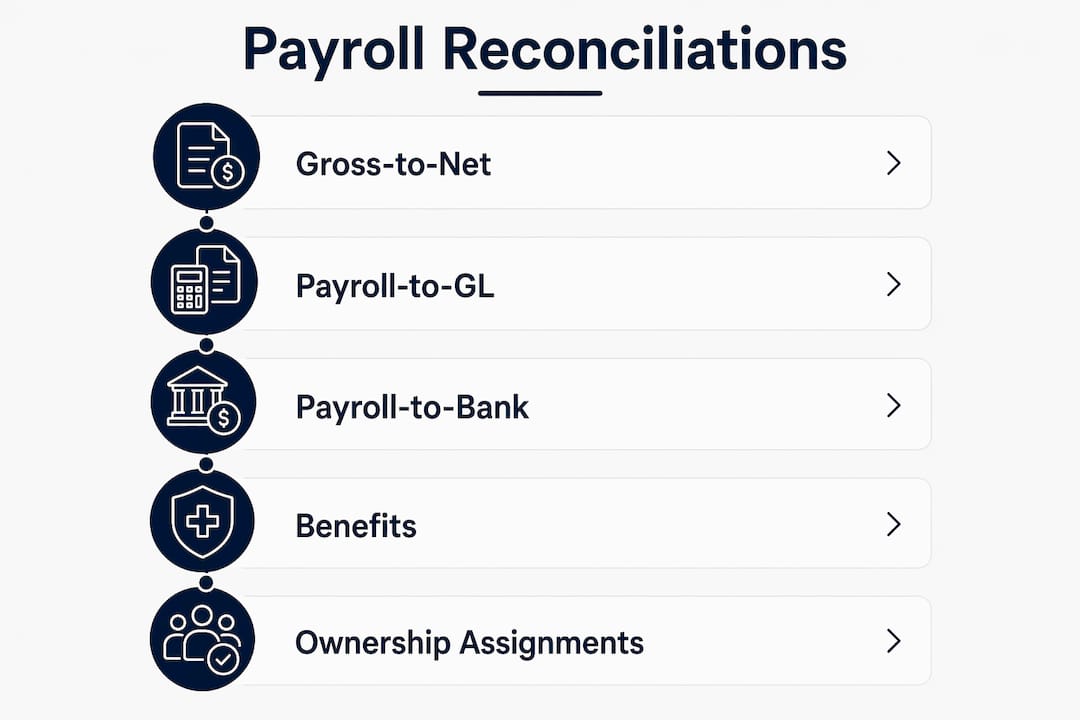
Organizations must perform four key reconciliations each cycle: gross-to-net, payroll-to-GL, payroll-to-bank, and payroll-to-tax-filing. Each one catches a different category of error, and skipping any one of them creates liability drift that compounds over time.
| Reconciliation Type | Objective | Typical Timing |
|---|---|---|
| Gross-to-net | Verify deductions, taxes, and net pay calculations are correct | Immediately post payroll run |
| Payroll-to-GL | Confirm payroll journal entries match payroll register totals | Days 1–3 of close cycle |
| Payroll-to-bank | Match net pay disbursements to bank statement outflows | Days 1–5 of close cycle |
| Payroll-to-tax-filing | Reconcile tax deposits and filings to payroll tax liabilities | Days 3–7 of close cycle |
Standard close procedures sequence payroll reconciliation immediately after the final pay run, typically within the first seven days of the close cycle. That sequencing matters because downstream close tasks, such as accrual entries and variance analysis, depend on confirmed payroll figures.
Ownership of each reconciliation must be explicitly assigned. Gross-to-net typically belongs to payroll operations. Payroll-to-GL reconciliation sits at the intersection of payroll and accounting, and both teams need visibility into it. Payroll-to-bank and payroll-to-tax-filing often fall to accounting or treasury, but payroll must provide the source data on time.
Pro Tip: Build a reconciliation ownership matrix at the start of each fiscal year. List each of the four reconciliation types, name the owner, name the reviewer, and define the deadline relative to the pay run date. Post it where both payroll and finance teams can access it.
Common pitfalls that break payroll’s role during close
Treating payroll reconciliation as a monthly cleanup rather than a repeatable operating model is the most common operational failure finance and payroll teams make. When reconciliation is reactive, errors accumulate across pay periods and surface only when auditors ask questions.
The following pitfalls appear repeatedly across organizations of all sizes:
-
Late payroll data handoffs. Finance cannot begin close tasks without final payroll figures. When payroll teams deliver data days after the pay run, the entire close schedule shifts.
-
Deferred wage accruals. Failure to accrue wages for pay periods straddling month-end causes materially misstated expenses. Proper accrual accounting records labor costs in the period the work was performed, not when the check clears.
-
Recording only net payroll cash. Recording only net payroll cash withdrawals, ignoring gross wages and liabilities, understates payroll expense and hides tax and benefit liabilities on the balance sheet.
-
No defined exception management process. When a variance appears in the payroll-to-GL reconciliation, teams without a defined escalation path spend days chasing phantom variances instead of resolving them.
-
Unclear handoff ownership. Without documented responsibility for each deliverable, both teams assume the other handled it.
Each of these failures has a direct corrective action. Establish a payroll close calendar with hard deadlines for each pay run. Require wage accrual entries as a standing close task, not an optional one. Book gross payroll entries with full liability detail every cycle. Define an exception log format and assign a single owner to clear it before the close is certified.
Pro Tip: Create a payroll close checklist that mirrors your month-end close checklist. Each item should have a named owner, a due date, and a completion status. Review it in your pre-close meeting, not after the fact.
How the payroll ledger connects payroll runs to financial statements
The payroll ledger is the detailed, transaction-level record that sits between individual payroll runs and the summarized journal entries posted to the GL. The payroll ledger tracks detailed employee-level payroll transactions that roll up to summarized GL entries, supporting audit trails and compliance reviews.
Understanding this flow is the foundation of payroll accuracy in financial close. The path from payroll run to financial statement moves through four stages:
| Stage | What Happens | Who Owns It |
|---|---|---|
| Payroll run | Gross Pay, deductions, and Net Pay calculated per employee | Payroll operations |
| Payroll ledger | Employee-level detail captured, including earnings codes, taxes, and benefit deductions | Payroll operations |
| General ledger | Summarized journal entries posted by account, cost center, and period | Accounting |
| Financial statements | Labor costs, liabilities, and cash flows reflected in income statement and balance sheet | Finance |
Structured payroll ledgers reduce manual interventions and support automated reconciliation, which directly improves financial close efficiency. When the chart of account mapping between the payroll ledger and the GL is consistent and documented, automated reconciliation tools can match records without manual review.
Balance sheet reviews often reveal payroll bookkeeping errors, such as uncleared liabilities or duplicate tax postings, before income statement variances appear. That means reviewing the balance sheet payroll accounts, including accrued wages, payroll tax payable, and benefit withholding payable, at every close is not optional. It is the earliest warning system you have.
Pro Tip: Map every payroll earnings code and deduction code to a specific GL account at the start of each year. Document it. Any unmapped code that appears mid-year is a signal to investigate before it creates a misposting.
Best practices for payroll and finance collaboration during close
The handoff between payroll and finance is where most close delays originate. A close handoff SOP ensures finance receives complete payroll data, posting support, and exception visibility to begin closing without reconstructing payroll figures from scratch.
A well-designed handoff package from payroll to finance includes:
-
Final payroll register. The complete, post-archive payroll register for each pay run in the period, broken down by earnings type, deduction, and tax.
-
Payroll journal entry support. A reconciliation of the payroll register to the proposed journal entries, showing how gross pay, employer taxes, and benefit costs map to GL accounts.
-
Liability detail. A schedule of all outstanding payroll liabilities, including accrued wages, tax deposits due, and benefit remittances pending.
-
Exception log. A list of any variances, adjustments, or balance adjustments made during the period, with explanations and resolution status.
-
Accrual calculation. The wage accrual entry for any pay period straddling month-end, with the calculation methodology documented.
Designing a repeatable payroll-to-accounting operating model with defined baselines and ownership prevents the monthly cleanup crisis that derails close timelines. Finance teams that receive a complete, documented handoff package can post entries and begin variance analysis on day one of the close, rather than spending days reconstructing what payroll actually ran.
Technology plays a direct role here. Camptra’s Payroll Recon Toolset connects timekeeping, payroll, benefits, and GL data in real-time, enabling payroll and finance teams to reconcile millions of records in minutes rather than days. For Oracle Cloud users, that level of integration means the payroll reconciliation process no longer depends on manual exports and spreadsheet matching.
Pro Tip: Schedule a 30-minute pre-close sync between payroll and finance leads three days before the close starts. Use it to confirm the handoff package is complete, flag any known exceptions, and align on the journal entry posting schedule.
Key Takeaways
Payroll’s role in the financial close process is to deliver accurate, complete, and period-correct data that finance can post, reconcile, and defend without reconstruction.
| Point | Details |
|---|---|
| Payroll cost materiality | Payroll represents 30–40% of operating costs, making it one of the most material close items. |
| Four required reconciliations | Gross-to-net, payroll-to-GL, payroll-to-bank, and payroll-to-tax-filing must all complete each cycle. |
| Accrual timing is non-negotiable | Wages for periods straddling month-end must be accrued in the correct period to avoid misstated financials. |
| Payroll ledger as audit foundation | The payroll ledger connects employee-level detail to GL entries and supports every audit inquiry. |
| Handoff SOP drives close speed | A documented handoff package from payroll to finance eliminates reconstruction delays and clarifies ownership. |
Why payroll integration is a financial discipline, not an admin task
Most organizations I have worked with treat payroll as an HR or operations function that happens to touch accounting. That framing is the root cause of most close problems I see. Payroll is a financial discipline. It produces the largest recurring expense entry in most organizations, and it touches every major financial statement simultaneously.
The teams that close fastest are not the ones with the most sophisticated software. They are the ones where payroll and finance leads talk to each other before the close starts, not after a variance surfaces. They have documented ownership for every reconciliation step. They run the same process every month, and they improve it incrementally rather than reinventing it under deadline pressure.
The uncomfortable truth is that most payroll-related audit findings are not caused by payroll errors. They are caused by accounting errors that payroll data would have caught if anyone had looked at the payroll ledger carefully. Uncleared liabilities, duplicate tax postings, and unmapped earnings codes sit on the balance sheet for months before someone notices. A structured payroll-to-GL reconciliation process catches all of them in the first week of close.
Invest in the operating model first. Technology accelerates a good process. It cannot fix a broken one.
— Zach
Camptra’s Payroll Recon Toolset for faster financial close
Finance and payroll teams running Oracle Cloud face a specific challenge: the volume of payroll transactions makes manual reconciliation impractical at scale. Camptra built the Payroll Recon Toolset to solve exactly that problem.
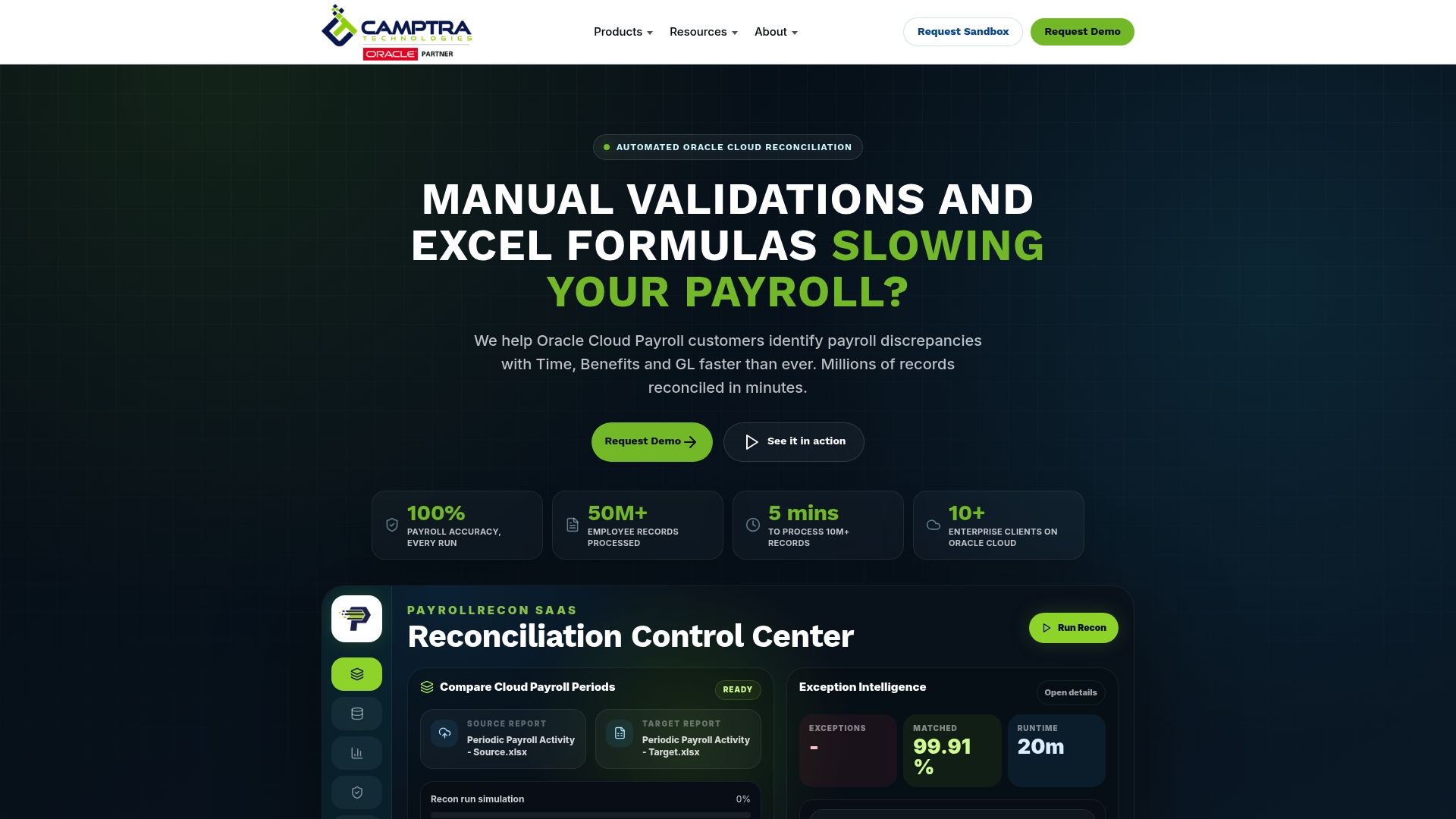
The toolset automates validation across timekeeping, payroll, benefits, and GL data in real-time, reducing reconciliation time by up to 80% and achieving 100% payroll accuracy. For teams preparing for audits or trying to reduce payroll financial close time, the Payroll Recon Toolset provides the audit trail, exception visibility, and GL mapping consistency that manual processes cannot deliver at enterprise scale. You can also request a demo to see how the toolset fits your close cycle.
FAQ
What is the role of payroll in the financial close process?
Payroll’s role is to deliver accurate, period-correct labor cost data that integrates into the general ledger and supports reliable financial statements. It covers Gross Pay, Net Pay, tax liabilities, and benefit costs, all of which must be reconciled before books close.
How does payroll affect financial reporting accuracy?
Payroll affects the income statement through labor costs, the balance sheet through accrued wages and tax liabilities, and the cash flow statement through disbursements. Recording only net cash payroll instead of gross wages and liabilities understates expenses and hides liabilities.
When should payroll reconciliation happen during the close cycle?
Standard close procedures schedule payroll reconciliation immediately after the final pay run, typically within the first seven days of the close cycle. Completing it early allows finance to post journal entries and begin variance analysis without delay.
What should a payroll close handoff package include?
A complete handoff package includes the final payroll register, journal entry support, outstanding liability detail, an exception log, and the wage accrual calculation for any pay period straddling month-end.
How does the payroll ledger support financial audits?
The payroll ledger captures employee-level earnings, deductions, and tax detail that rolls up to summarized GL entries. It provides the audit trail auditors need to trace financial statement figures back to individual payroll transactions.
Recommended
