
The strongest pclnxai.com alternatives for enterprise HR data observability and payroll automation in 2026 fall into two distinct categories: broad HCM platforms like ADP Workforce Now, Rippling, and Papaya Global, and purpose-built reconciliation tools designed for cross-system data validation. Choosing between them depends on whether your team needs general workforce management or genuine payroll data observability across time and attendance, benefits, costing, and general ledger systems. Most software directories list 40+ competitors for PCLnXAI, but the majority are generalist payroll platforms, not true observability tools.
Here is a quick orientation across the main categories:
-
Broad HCM and payroll platforms: ADP Workforce Now, Rippling, Papaya Global, Paylocity, BambooHR, Paycom, Dayforce, SAP SuccessFactors, HR Plus (formerly Zenefits)
-
Global and multinational payroll: Papaya Global, CloudPay, Activpayroll, BIPO Payroll, Payslip, KeyPay
-
Mid-market and SMB payroll: Payroll City, SmoothPay, Payroo, CheckMark Payroll, Payroll Mate, kpi.com Payroll, Pocket HRMS, Zoho Payroll
-
Specialized payroll automation: Adaptive Payroll, EPAY HCM, Brain Payroll, Warp, Brightmine, Pendylum Payroll, Codapay
-
Data observability and reconciliation: Sentry, Actian Data Observability, Splunk IT Service Intelligence, Deductive AI, Camptra Technologies
-
Compliance and HR governance: Mitratech Mineral, ADP SmartCompliance, Brightmine, I-9 HQ™ for Employer Services by Equifax, Compligo, KnowBe4 Compliance Plus, OnBlick, SHRM, BLR’s HR Hero, CIPD HR-inform, GoSaaS Training Compliance Management
-
Niche and regional tools: Denali Payroll, Paie-Roll, SaachiHRMS, Ahalts, QkrPayroll, PayCub, PayCheck, PaySoftR, Payroll OnDemand, System Nexgen HRMS & Payroll, PayDay, Banyon Payroll, Finity, Datacom Datapay, OneAdvanced Payroll, Info-Tech Payroll Software, Perfect Payroll Management System
What are the best pclnxai.com alternatives for enterprise use?
Enterprise HR and payroll teams searching for pclnxai.com similar sites quickly discover that platform suitability depends heavily on whether the need is general HCM or true data observability. The table below covers the primary featured alternatives across the key comparison dimensions.
| Platform | Primary Focus | Payroll Automation | Audit and Reconciliation | Enterprise Scalability | Best For |
|---|---|---|---|---|---|
| ADP Workforce Now | General HCM | High | Moderate | High | Broad enterprise HR and payroll |
| Rippling | HR, IT, and payroll | High | Moderate | High | All-in-one employee management |
| Papaya Global | Global payroll | High | Moderate | High | International payroll compliance |
| Paylocity | Payroll and HR | High | Moderate | High | Mid-to-large enterprise payroll |
| BambooHR | HRIS and employee experience | Moderate | Low | Moderate | Growing businesses needing HRIS |
| Paycom | Payroll and HR automation | High | High | High | Advanced payroll automation |
| Dayforce | HCM and workforce management | High | Moderate | High | Unified workforce management |
| SAP SuccessFactors | Enterprise HCM | High | Moderate | Very High | Large enterprise HCM |
| Adaptive Payroll | Payroll processing | Moderate | Moderate | Moderate | Industry-specific payroll |
| EPAY HCM | Workforce and payroll | High | Moderate | Moderate | Automated payroll and timekeeping |
| Sentry | Data observability | Moderate | High | High | Payroll data governance |
| Actian Data Observability | Data observability | Low | High | High | Data integrity across systems |
| Splunk IT Service Intelligence | Data analytics | Low | High | Very High | Enterprise data observability |
| Deductive AI | AI-driven data analytics | Moderate | High | High | Advanced payroll data analysis |
| Brightmine | Payroll reconciliation | High | Very High | High | High-volume audit-ready payroll |
| Warp | Payroll reconciliation | High | High | Moderate | Finance-focused payroll accuracy |
| CloudPay | Global payroll | High | Moderate | High | Globally distributed payroll |
| Activpayroll | Global payroll outsourcing | High | Moderate | High | Complex global payroll |
| Payslip | Global payroll and payments | High | Moderate | High | Cross-border payroll |
| BIPO Payroll | Cloud HR and payroll | High | Moderate | Moderate | Multi-market regional payroll |
| KeyPay | Cloud payroll | High | Moderate | Moderate | Flexible industry payroll |
| Mitratech Mineral | Compliance management | Low | High | High | Corporate compliance and risk |
| ADP SmartCompliance | Compliance automation | Moderate | High | High | Payroll tax and compliance |
| I-9 HQ™ for Employer Services, by Equifax | Employment verification | Low | High | High | Employment authorization compliance |
| Compligo | Compliance management | Low | High | Moderate | Risk and compliance oversight |
| KnowBe4 Compliance Plus | Compliance training | Low | Moderate | High | Compliance training programs |
| Zoho Payroll | Cloud payroll | Moderate | Low | Low | Small and mid-sized businesses |
| Pocket HRMS | Cloud HR and payroll | Moderate | Low | Moderate | Mid-market enterprises |
| Payroll Mate | Desktop payroll | Low | Low | Low | Cost-conscious payroll |
| CheckMark Payroll | Payroll and tax | Moderate | Moderate | Low | Tax-compliant payroll |
| Payroll City | Payroll and HR | Moderate | Low | Moderate | Small-to-mid enterprises |
| Denali Payroll | Payroll with audit tools | Moderate | High | Moderate | Auditor-ready payroll |
| Banyon Payroll | Payroll management | Moderate | High | Moderate | Reliable payroll processing |
| Pendylum Payroll | Payroll and HR | Moderate | Moderate | Moderate | Mid-sized enterprise payroll |
| Brain Payroll | Payroll automation | High | Moderate | High | High-volume payroll operations |
| SaachiHRMS | Integrated HRIS | Moderate | Moderate | Moderate | End-to-end HRIS |
| Finity | Payroll and HR suite | Moderate | Moderate | Moderate | Comprehensive workforce management |
| Datacom Datapay | Cloud payroll | High | Moderate | High | Enterprise payroll processing |
| Codapay | Payroll processing | Moderate | Moderate | Moderate | Payroll operations efficiency |
| Payroll OnDemand | Cloud payroll | Moderate | Low | Moderate | Subscription-based payroll |
| System Nexgen HRMS & Payroll | Integrated HRMS | High | Moderate | Moderate | Complete HRIS and payroll |
| OnBlick | HR compliance | Low | Moderate | Moderate | Immigration and HR compliance |
| HR Plus (formerly Zenefits) | HR and benefits | Moderate | Low | Moderate | SMB HR and benefits |
| SHRM | HR knowledge and standards | Low | Low | High | HR compliance guidance |
| BLR’s HR Hero | HR compliance resources | Low | Low | Moderate | HR legal compliance |
| CIPD HR-inform | HR guidance | Low | Low | Moderate | UK-focused HR compliance |
| GoSaaS Training Compliance Management | Training compliance | Low | Moderate | Moderate | Training compliance tracking |
| Zendesk for Customer Service | Customer service platform | Low | Low | High | HR service desk operations |
| Info-Tech Payroll Software | Payroll suite | Moderate | Moderate | Moderate | Integrated payroll management |
| Perfect Payroll Management System | Payroll compliance | Moderate | Moderate | Moderate | Complex payroll requirements |
| Ahalts | Payroll and HR | Moderate | Low | Low | Integrated payroll and HR tools |
| Paie-Roll | Payroll and HR | Low | Low | Low | SMB payroll expansion |
| SmoothPay | Cloud payroll | Low | Low | Low | Simple payroll processing |
| QkrPayroll | Payroll service | Moderate | Low | Low | Flexible payroll management |
| Payroo | SMB payroll | Low | Low | Low | Small business payroll |
| PayCub | Compliance payroll | Moderate | Moderate | Low | Compliance-driven payroll |
| PayCheck | Payroll management | Moderate | Low | Low | Payroll accuracy |
| PaySoftR | Industry payroll | Moderate | Low | Low | Flexible payroll management |
| PayDay | Payroll processing | Moderate | Low | Low | Flexible payroll schedules |
| kpi.com Payroll | Cloud payroll and HR | Low | Low | Low | Small and mid-sized businesses |
| Warp | Data automation | High | High | Moderate | Finance payroll accuracy |
Several of these platforms deserve closer attention based on their enterprise positioning.
ADP Workforce Now is the most widely deployed platform in this comparison, covering payroll, benefits, time and attendance, and compliance in a single cloud environment. Its predictive analytics layer gives HR teams data-driven workforce insights, and its compliance tools are updated continuously for US federal and state requirements. For enterprises already in the ADP ecosystem, Workforce Now is the natural anchor.
Rippling takes a different approach by uniting HR, IT, and payroll in one system. Its automation across employee onboarding, device management, and payroll runs is genuinely broad. Teams that want a single platform to manage the full employee lifecycle from hire to offboard will find Rippling’s depth hard to match.

Papaya Global is the go-to for multinational payroll, with pricing around $20 per employee per month and coverage across dozens of countries. Its compliance engine handles local statutory requirements automatically, which reduces the manual overhead that plagues enterprises running payroll across multiple jurisdictions.
Paycom stands out for its payroll automation depth and its compliance and audit features. Its Beti tool lets employees verify their own payroll data before processing, which catches errors at the source rather than during post-run reconciliation.
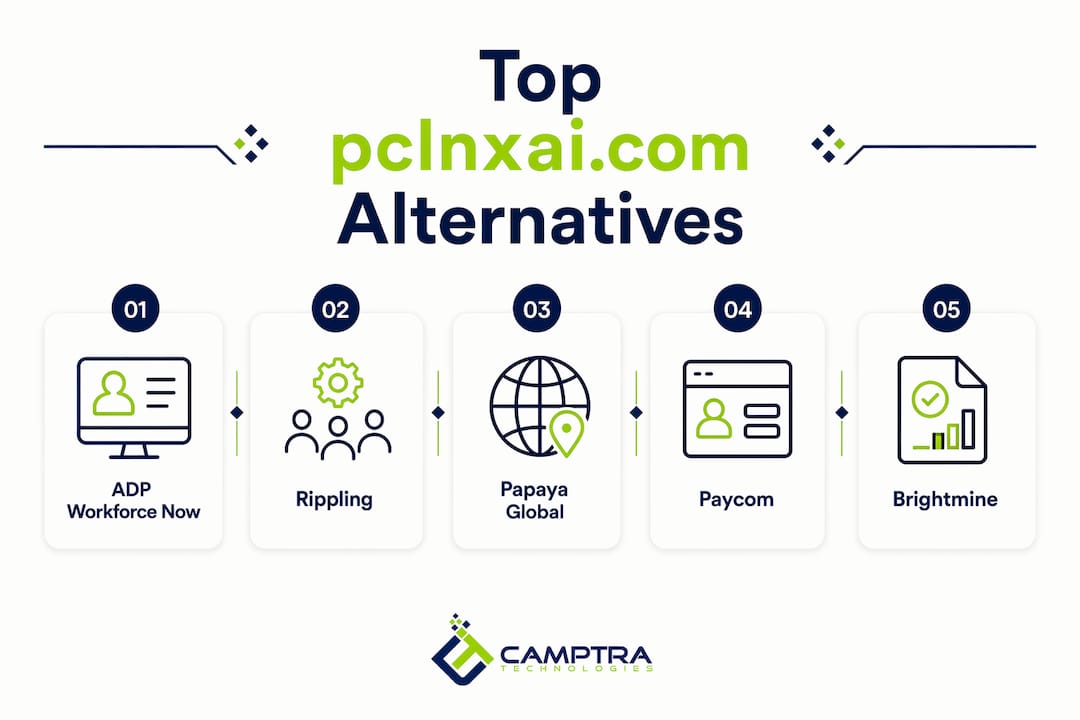
Brightmine is worth calling out specifically for high-volume, audit-ready payroll environments. Its machine learning exception detection identifies variances before they reach the general ledger, which puts it closer to a true observability tool than most generalist HCM platforms.

Sentry, Actian Data Observability, Splunk IT Service Intelligence, and Deductive AI each approach the observability problem from a data engineering angle rather than a payroll-first angle. They are powerful for enterprises with dedicated data teams, but they require significant configuration to apply specifically to payroll reconciliation workflows.
For compliance-focused teams, Mitratech Mineral, ADP SmartCompliance, I-9 HQ™ for Employer Services by Equifax, and Compligo address the governance layer that payroll platforms often underserve. These tools automate statutory updates, employment verification, and audit documentation rather than payroll calculations themselves.
Thinner-profile tools like Paie-Roll, SmoothPay, Payroo, kpi.com Payroll, and PayDay are straightforward payroll processors suited to SMBs. They lack the enterprise audit depth or cross-system integration that large organizations typically require.
How to evaluate and choose the right alternative platform
Specialized observability tools differ fundamentally from generalist HCM suites, and conflating the two is the most common mistake enterprise teams make during platform selection. A platform that processes payroll accurately is not the same as one that validates payroll data across time and attendance, benefits, costing, and GL systems before a run closes.
Use these criteria to structure your evaluation:
- Audit-readiness: Does the platform produce reconciliation documentation that satisfies internal audit and external compliance requirements without manual assembly?
- Automated exception detection: Can the system surface variances in real time, or does it require manual comparison of exported reports?
- Integration depth: Does it connect natively with your time and attendance, benefits, costing, and GL systems, or does it rely on flat-file imports?
- Regional and multinational compliance: If you operate across US states or internationally, does the platform handle multicountry payroll compliance automatically, or does it require manual statutory updates?
- Scalability: Can the platform process millions of payroll records per cycle without performance degradation?
- Data security standards: Does the vendor hold SOC 2 Type II certification? Does the platform support GDPR and HIPAA compliance requirements for your workforce data?
Questions to ask vendors directly:
- What is your data latency between payroll system updates and exception surfacing?
- How does your platform handle balance adjustments and archive eligibility validation?
- What is your implementation timeline for an enterprise with 10,000+ employees?
- How do you handle GL posting validation before payroll cutoff?
A common pitfall is selecting a broad HCM suite because it includes a “reconciliation” module, then discovering that module only compares two exported files rather than performing cross-system validation. Unsynchronized payroll and HR systems generate data noise that manual comparison cannot reliably catch at scale.
Pro Tip: Validate reconciliations before GL posting, not after. Catching a Gross Pay variance or a Net Pay discrepancy post-archive forces a correction cycle that delays financial close and creates audit exposure. Build pre-archive validation into your platform selection criteria from the start.
Camptra’s Payroll Recon Toolset as a specialized reconciliation alternative
For Oracle Cloud Payroll environments specifically, Camptra Technologies’ Payroll Recon Toolset addresses a gap that generalist HCM platforms leave open: automated, cross-system reconciliation across payroll, time and attendance, benefits, costing, tax, and general ledger data in a single workflow.
Most of the platforms in the comparison table above process payroll. Camptra’s toolset validates it. That distinction matters operationally because automated exception surfacing can reduce reconciliation time significantly, replacing spreadsheet-heavy manual reviews with a process that surfaces variances before they reach the GL.
The toolset’s core capabilities include:
- Pre-archive and post-archive validation: Catches Gross Pay, Net Pay, and balance adjustment discrepancies before the payroll archive closes, not after.
- Cross-system data reconciliation: Connects payroll, time and attendance, benefits, costing, and GL data to identify mismatches that single-system tools miss.
- Automated exception identification: Surfaces variances by employee, element, or cost center so teams can focus on resolution rather than data preparation.
- Audit-ready documentation: Produces reconciliation outputs that satisfy internal audit requirements and support financial close without manual assembly.
- Oracle Cloud native integration: Built specifically for Oracle Cloud Payroll, which means no custom middleware or flat-file workarounds.
Enterprise teams that have already selected a payroll platform like ADP Workforce Now, Dayforce, or Oracle Cloud Payroll often find that adding a dedicated reconciliation layer resolves the audit exposure and manual overhead that their primary platform does not address. Camptra’s toolset is designed to sit alongside those platforms, not replace them.
A regional healthcare provider using Oracle Cloud and UKG, for example, used Camptra’s toolset to automate their payroll reconciliation and eliminate 32-hour manual audit cycles. That kind of operational impact is not achievable by switching payroll platforms. It requires a dedicated validation layer.
For teams managing payroll migrations, the toolset also supports reconciliation during OPTE migrations, where data integrity risks are highest and manual validation is least reliable.
Statistic callout: Customers using Camptra’s Payroll Recon Toolset have reported substantial reconciliation time reductions, replacing multi-day spreadsheet reviews with automated exception surfacing before payroll cutoff.
Key Takeaways
Selecting the right platform from the full range of pclnxai.com alternatives requires distinguishing between general payroll processing and true cross-system data observability, because most enterprise teams need both layers working together.
| Point | Details |
|---|---|
| Generalist vs. specialized tools | Most pclnxai.com alternatives are HCM or payroll platforms, not true data observability tools. |
| Observability requires cross-system integration | Effective payroll data validation connects payroll, time and attendance, benefits, costing, and GL data automatically. |
| Pre-GL validation reduces audit risk | Catching Gross Pay and Net Pay variances before archive closes prevents correction cycles and delayed financial close. |
| Multinational compliance adds complexity | Platforms without built-in regional compliance create manual overhead for enterprises operating across multiple jurisdictions. |
| Camptra Technologies for Oracle Cloud teams | Camptra’s Payroll Recon Toolset automates reconciliation for Oracle Cloud Payroll, with significant reported time reductions. |
The case for a dedicated validation layer
The conventional wisdom in enterprise HR technology says that the right HCM platform solves your payroll problems. After watching how large organizations actually operate, I think that framing leads teams to the wrong purchase decision more often than not.
Payroll accuracy and payroll data observability are not the same problem. A platform that calculates pay correctly can still leave your team chasing phantom variances across disconnected systems every pay period. The reconciliation work happens after the payroll engine finishes, and most HCM platforms treat it as an afterthought. A module that compares two exported spreadsheets is not observability. It is a slightly automated version of the same manual process your team was already doing.
The deeper issue is that switching payroll platforms rarely solves reconciliation problems. The root cause is usually data fragmentation across time and attendance, benefits, costing, and GL systems, and that fragmentation follows you to the new platform. Teams that add a dedicated pre-GL validation layer see the improvement immediately because they are solving the actual problem rather than replacing the environment around it.
There is also a cost argument that gets underestimated. The staff time consumed by manual reconciliation, the audit risk from undetected variances, and the delayed financial close from post-archive corrections are all real costs that do not appear on a software licensing invoice. They show up in overtime, audit findings, and finance team frustration. A purpose-built reconciliation tool addresses those costs directly.
My practical advice: evaluate your payroll platform and your reconciliation layer as separate decisions. Choose your HCM or payroll engine based on workforce management breadth, compliance coverage, and integration with your HR ecosystem. Then evaluate your observability and validation layer separately, based on exception detection capability, cross-system integration depth, and audit documentation quality. For Oracle Cloud Payroll environments, that second evaluation should include Camptra Technologies’ toolset on the shortlist. For data integrity standards in ERP contexts more broadly, 2026 ERP audit-readiness standards are raising the bar on what cross-system validation needs to deliver.
Camptra Technologies: a proven reconciliation layer for Oracle Cloud payroll teams
If you run Oracle Cloud Payroll and your team still spends days preparing data before each reconciliation review, the platforms compared above will not solve that problem on their own. Camptra Technologies’ Payroll Recon Toolset is built specifically for that environment, connecting payroll, time and attendance, benefits, costing, tax, and GL data to surface exceptions before cutoff rather than after.
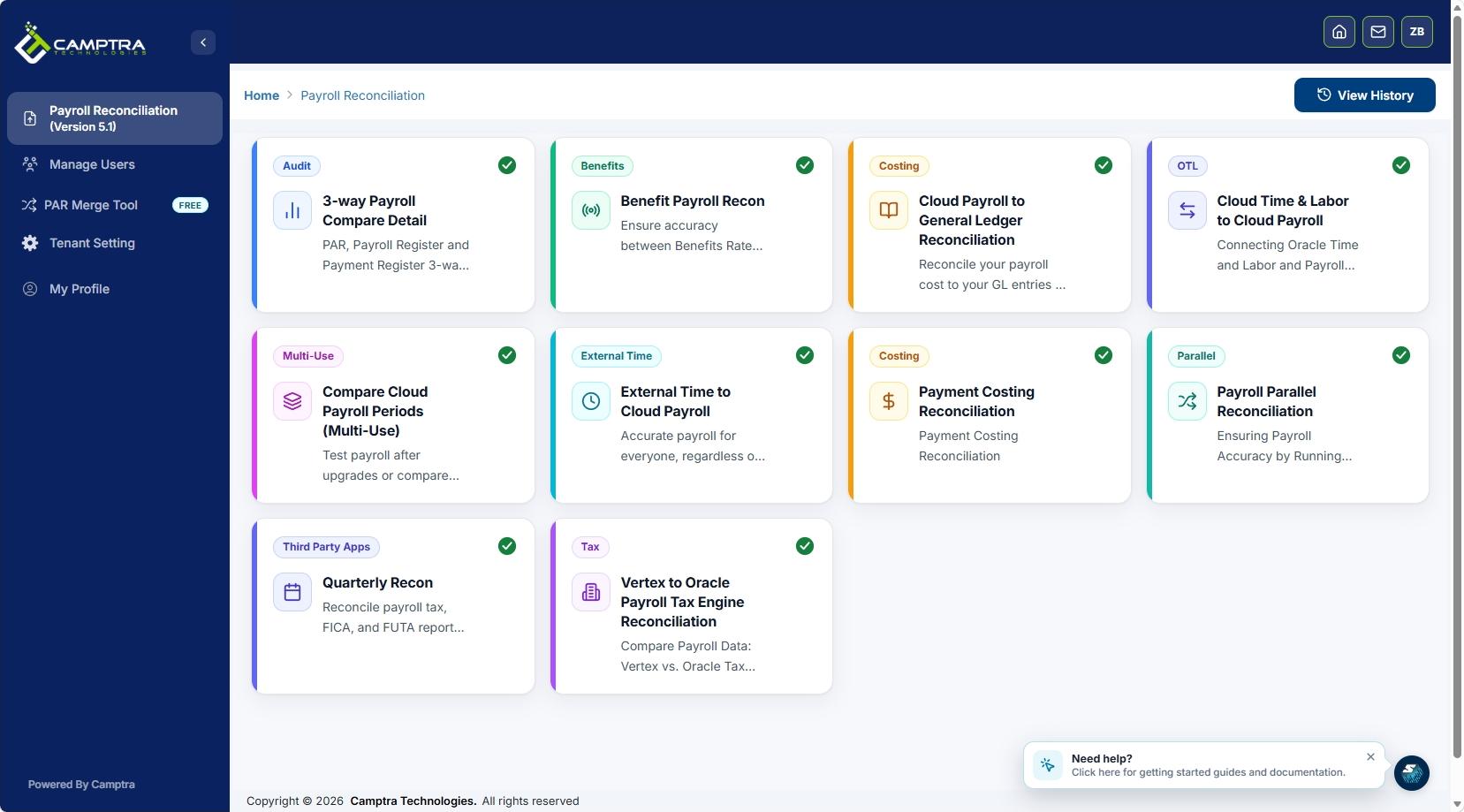
The operational impact is concrete. Enterprise teams have used Camptra’s toolset to eliminate 32-hour manual audit cycles, achieve earlier financial closes, and give payroll, HRIS, finance, and audit teams a shared view of reconciliation status before the archive closes. You can review the full details in Camptra’s enterprise case studies, including the healthcare system that reduced payroll audit time and achieved its earliest financial close on record. If you want to see how it performs against your own payroll data, request sandbox access and run a reconciliation cycle in your own Oracle Cloud environment.
FAQ
What is the difference between pclnxai.com and general HCM platforms?
PCLnXAI is a unified HR data observability platform focused on cross-system reconciliation and exception detection, while general HCM platforms like ADP Workforce Now or Rippling primarily handle payroll processing, benefits, and workforce management.
Which pclnxai.com alternatives are best for enterprise audit-readiness?
Brightmine, Paycom, Denali Payroll, Banyon Payroll, and Camptra Technologies’ Payroll Recon Toolset offer the strongest audit and reconciliation features among the top alternatives, with Camptra’s toolset specifically designed for Oracle Cloud Payroll environments.
How do I know if I need a specialized observability tool or a general payroll platform?
If your team spends significant time manually reconciling payroll data across time and attendance, benefits, costing, and GL systems, you need a dedicated observability layer. A general payroll platform processes pay; a specialized tool validates data integrity across all connected systems before the GL is affected.
What security certifications should I require from pclnxai.com alternatives?
SOC 2 Type II is the baseline certification for enterprise payroll and HR platforms in the US market. For organizations handling protected health information, HIPAA compliance is also required, and GDPR applies to any platform processing data for employees in the European Union.
Can Camptra Technologies work alongside my existing payroll platform?
Yes. Camptra’s Payroll Recon Toolset is designed as a reconciliation layer that sits alongside Oracle Cloud Payroll rather than replacing it, connecting payroll, time and attendance, benefits, costing, tax, and GL data to surface variances before payroll cutoff.
Recommended
- HR Payroll Collaboration Best Practices for 2026 | Camptra Technologies
- Scaling Payroll Efficiency: How a California-Based Nonprofit Optimized Oracle Cloud Payroll with Automated Reconciliation | Camptra Case Study | Camptra Technologies
- Modernizing Oracle Cloud Payroll: Automated Reconciliation for a 105,000-Employee Healthcare Network | Camptra Case Study | Camptra Technologies
- Leading Regional Healthcare Provider Automates Oracle & UKG Payroll Reconciliation to Eliminate 32-Hour Manual Audit Cycles | Camptra Case Study | Camptra Technologies
