

How do organizations benchmark payroll accuracy?
The standard formula is straightforward: (Total Payroll Transactions – Transactions Containing Errors) / Total Payroll Transactions × 100. Any transaction requiring a correction, reissue, off-cycle payment, or retroactive adjustment counts as an error. The industry target sits above 99% at the transaction level for payroll accuracy rate, calculated as (Total Payroll Transactions – Transactions Containing Errors) / Total Payroll Transactions × 100.
- Off-cycle payment rate: off-cycle payments divided by total transactions × 100 (target: under 2%)
- Cost per payroll transaction: total payroll admin costs divided by checks issued (target: under $10)
- Overtime as a percentage of total pay: total overtime divided by gross payroll × 100 (target: under 5%)
- Payroll-to-revenue ratio: total payroll cost divided by total revenue × 100 (target: 15%–35% depending on industry)
- Error resolution cycle time: average days from error discovery to resolution (target: 1–2 business days)
Common error categories to track include incorrect hours, missed deductions, tax miscalculations, duplicate payments, and misapplied pay rates. Tracking by error type and root cause, not just total count, is what separates a monitoring program from a genuine benchmarking practice.
Table of Contents
- Why the First-Time Right metric reveals what accuracy rates hide
- How a layered control system reduces payroll errors at every stage
- How Camptra’s Payroll Recon Toolset strengthens accuracy in Oracle Cloud environments
- What real enterprise deployments show about reconciliation impact
- How to set up an ongoing payroll accuracy monitoring program
- Audit preparation and compliance considerations for payroll benchmarks
- Camptra Technologies: built for Oracle Cloud Payroll teams that need audit-ready accuracy
- Key Takeaways
- FAQ
Why the First-Time Right metric reveals what accuracy rates hide
A 99% payroll accuracy rate can still mean 250 employees in a 25,000-person organization receive an incorrect paycheck. The final number looks clean because manual intervention fixed the problems before payday. What it hides is the rework.
First-Time Right (FTR) is a binary metric: a payroll cycle either completes from start to finish without rework, reruns, or downstream corrections, or it does not. Unlike a percentage accuracy rate, FTR exposes the hidden manual labor required to achieve a clean outcome. A payroll run qualifies as First-Time Right only when input data is complete and validated, calculations run without manual overrides, and no off-cycle corrections follow.
89% of organizations use automated payroll comparison tools, yet only 35% measure FTR performance. That gap reveals how many teams are flying blind on process reliability.
FTR also forces cross-functional accountability. Managers own accurate time submissions. Benefits teams own clean data files. Payroll cannot absorb the cost of upstream failures indefinitely. One organization that applied an FTR mindset in a PayrollOrg and UKG webinar example increased FTR performance from 84% to 91% within a single year.
How a layered control system reduces payroll errors at every stage
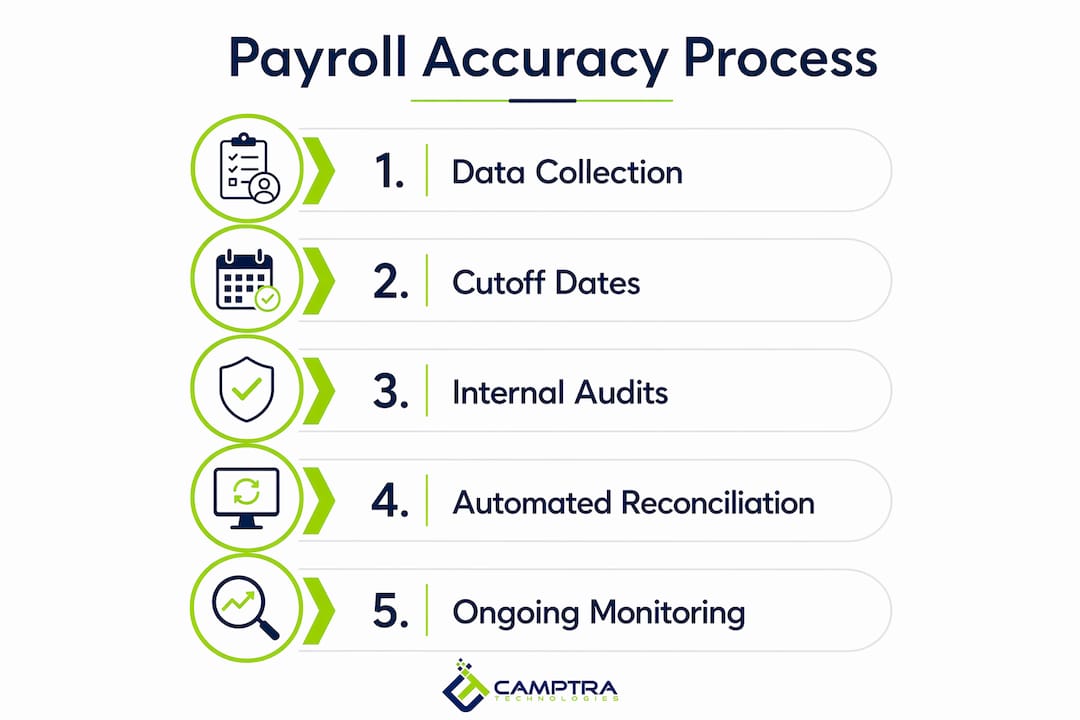
Payroll accuracy does not come from a single checkpoint. It comes from a layered control system built across four stages, each with defined ownership and specific failure points.
| Control stage | Primary owner | Key error risks |
|---|---|---|
| Data collection | HR Manager | Unapproved timesheets, stale employee records, missed terminations |
| Calculation verification | Payroll Administrator | Incorrect hours, overtime misclassification, tax configuration errors |
| Pre-approval auditing | Payroll Administrator | Gross pay variances outside ±5% threshold vs. prior period |
| Post-run reconciliation | Finance Controller | GL coding errors, funding account mismatches, liability miscalculations |
Payroll cutoff dates anchor the entire system. Standardizing cutoff dates at least two business days before calculation begins reduces error exposure and creates a defensible validation window. Late changes are a leading driver of duplicate adjustments, contributing significantly to payroll inaccuracies when informal exceptions are allowed.
The most common root cause of payroll errors is inaccurate or incomplete input data, with 50.61% of payroll professionals citing HR data input errors as a primary driver. High-performing teams address this upstream, running pre-calculation validation checkpoints on HR system data, timekeeping records, and tax configurations before the payroll engine ever runs.
IRS penalty exposure can vary for late tax deposits tied to payroll errors. A quarterly internal audit sampling 10%–15% of employee records provides statistically meaningful oversight without disrupting normal operations.
How Camptra’s Payroll Recon Toolset strengthens accuracy in Oracle Cloud environments
Manual, spreadsheet-heavy reconciliation cannot scale with enterprise payroll volumes. Camptra’s Payroll Recon Toolset automates validation by connecting payroll-impacting data across time and attendance, benefits, costing, tax, and the general ledger in a single reconciliation workflow. Teams reconcile millions of records in minutes rather than hours.
The practical benefits for Oracle Cloud Payroll teams include:
- Exception-first visibility: automated variance reporting flags pay changes exceeding defined thresholds, so teams focus manual review on outliers rather than every transaction
- Pre-cutoff confidence: exceptions surface before payroll is archived, not after, eliminating the scramble to reverse processed runs
- GL alignment: automated journal entries align payroll data with accounting and statutory reporting, reducing manual transfer work between payroll and finance
- Audit trail standardization: reconciliation workflows are documented and repeatable, giving internal and external auditors a clear, structured record
Pro Tip: Set your variance threshold at ±5% on individual Gross Pay compared to the prior comparable period. Automated tools like Camptra’s Payroll Recon Toolset can apply this threshold across millions of records simultaneously, surfacing only the exceptions that warrant human review.
For teams managing Oracle Cloud Payroll costing reconciliation, the shift from reactive correction to preventive validation is where measurable accuracy gains begin.
What real enterprise deployments show about reconciliation impact
Two case studies illustrate what automated benchmarking and reconciliation deliver in practice.
A California nonprofit running Oracle Cloud Payroll reduced payroll audit time by up to 80% after deploying Camptra’s automated reconciliation tool. The team also achieved faster financial close cycles, with exceptions identified and resolved before cutoff rather than discovered during month-end review.
A public transit authority needed to satisfy both federal compliance requirements and union contract accuracy obligations simultaneously. After modernizing payroll visibility with Camptra’s tool, the organization gained the structured audit trail and exception tracking required for regulatory reporting, without adding headcount to the reconciliation process.
Both cases share a common pattern: the accuracy gains came not from working harder on the same manual process, but from replacing spreadsheet reviews with automated exception detection that surfaces the right problems at the right time.
How to set up an ongoing payroll accuracy monitoring program
A monitoring program that runs once a quarter is an audit. One that runs every cycle is a control. The distinction matters for enterprise teams managing high-volume Oracle Cloud Payroll operations.
Build your program in four steps:
- Establish a baseline. Run the accuracy formula for the last three payroll cycles. Document errors by type and root cause, not just total count. This baseline is your starting benchmark.
- Define your KPI targets. Set specific thresholds for accuracy rate, FTR performance, off-cycle payment rate, and error resolution cycle time. Tie each target to a review frequency: operational KPIs after every cycle, strategic KPIs monthly or quarterly.
- Automate variance detection. Configure automated reports to flag Gross Pay changes outside your defined threshold before each payroll run. Manual line-by-line review cannot scale; threshold-based exception detection can.
- Assign ownership and document handoffs. The Payroll Administrator owns data integrity and exception review. The HR Manager owns new hire, termination, and adjustment accuracy. The Finance Controller owns liability validation. Gaps in handoffs are where errors survive all three checkpoints.
Review your benchmark targets annually and adjust for business growth, system changes, and workforce complexity. Pairing HR and payroll collaboration practices with a structured monitoring cadence closes the upstream data quality gaps that drive most payroll errors. For HR teams managing hiring pipelines that feed directly into payroll, faster and compliant hiring workflows reduce the new-hire data errors that routinely surface at the payroll input stage.
Audit preparation and compliance considerations for payroll benchmarks
Payroll benchmarks are not just operational metrics. They are the documentation an auditor examines when assessing whether your payroll controls are adequate.
For IRS compliance, the critical exposure is the failure-to-deposit penalty, which ranges from 2% to 15% depending on how late the deposit is. Accurate payroll benchmarking reduces this risk by ensuring tax calculations are validated before each run, not corrected after. Maintain a payroll error log that captures error type, root cause, and corrective action for every cycle. That log is the primary evidence an auditor uses to distinguish a one-off mistake from a systemic control failure.
For internal audits, a quarterly sample of 10%–15% of employee records provides meaningful coverage. Audit for correct pay rates, accurate deductions, and proper tax withholding. For external audits, the same structured reconciliation workflow that supports daily accuracy monitoring also produces the documentation trail auditors require, provided it is standardized and repeatable rather than rebuilt from scratch each cycle.
The Oracle Payroll Activity Center offers native visibility into payroll run status, but enterprise teams managing complex costing, benefits, and GL reconciliation typically need a dedicated reconciliation layer to produce audit-ready documentation at scale.
Camptra Technologies: built for Oracle Cloud Payroll teams that need audit-ready accuracy
Enterprise payroll teams running Oracle Cloud Payroll face a specific problem: the volume of data that needs reconciliation before cutoff is too large for spreadsheets and too complex for generic reporting tools.
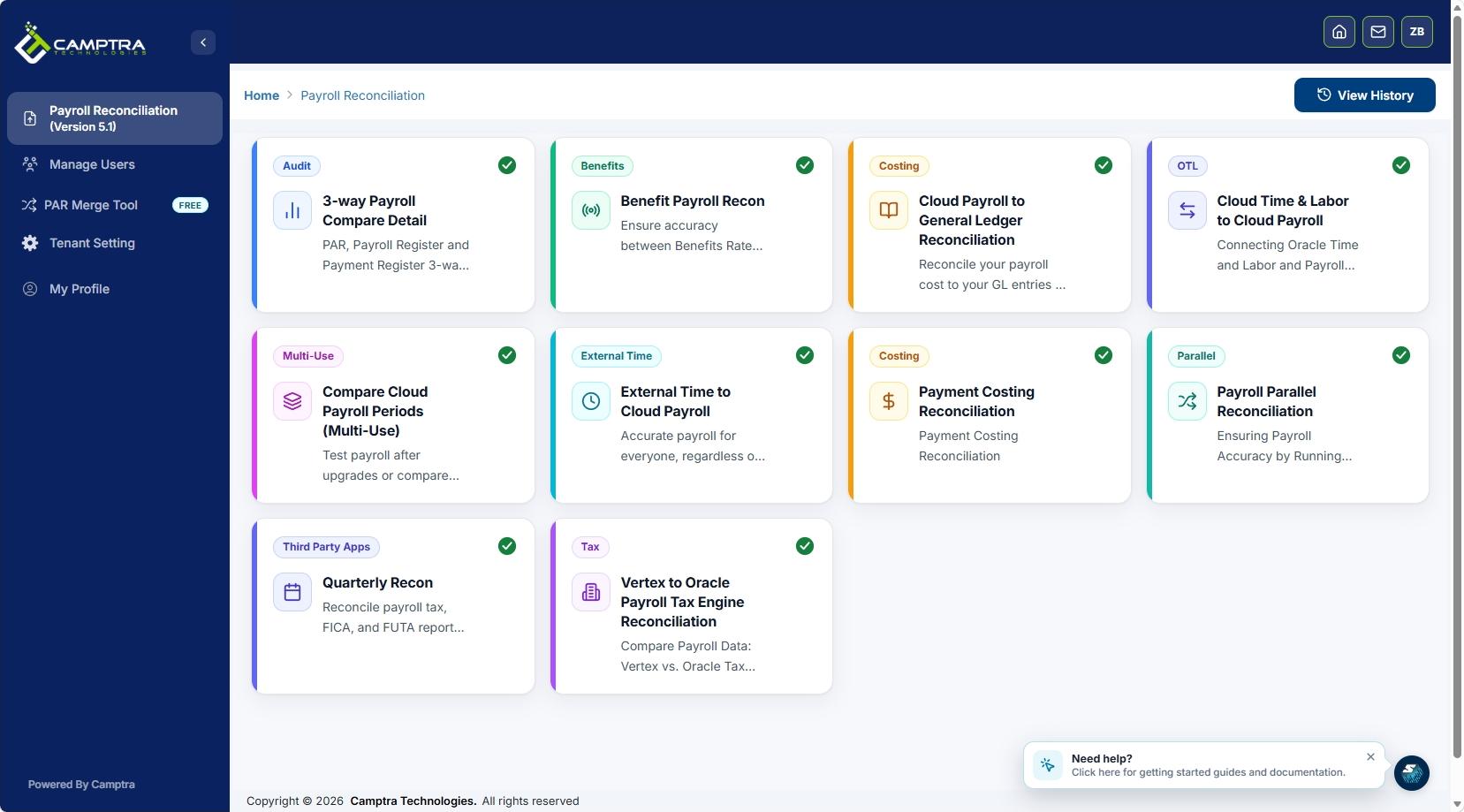
Camptra Technologies built the Payroll Recon Toolset specifically for this environment. It connects time and attendance, payroll, benefits, costing, tax, and GL data in one automated workflow, surfaces exceptions before archive, and produces the standardized documentation your finance and audit teams require. Customers have reported reconciliation time reductions of up to 80%, freeing teams to resolve exceptions rather than prepare data. If you run Oracle Cloud Payroll at scale and want to see what automated reconciliation looks like in your environment, request sandbox access to the Payroll Recon Toolset.
Key Takeaways
Benchmarking payroll accuracy requires both a precise formula and process metrics like FTR to reveal the full cost of payroll errors, and automation is what makes both sustainable at enterprise scale.
| Point | Details |
|---|---|
| Core accuracy formula | (Total Payroll Transactions – Transactions Containing Errors) / Total Payroll Transactions × 100; industry target is above 99% at the transaction level. |
| FTR adoption gap | 89% of organizations use automated comparison tools, but only 35% measure First-Time Right performance. |
| Layered control ownership | Payroll, HR, and Finance each own distinct checkpoints; gaps in handoffs are where errors survive all three stages. |
| Audit documentation | A payroll error log capturing type, root cause, and corrective action is the primary evidence auditors use to assess control adequacy. |
| Camptra Technologies | Camptra’s Payroll Recon Toolset automates Oracle Cloud Payroll reconciliation, with customers reporting up to 80% reduction in reconciliation time. |
FAQ
What formula do organizations use to benchmark payroll accuracy?
The standard formula is (Total Payroll Transactions – Transactions Containing Errors) / Total Payroll Transactions × 100. Any transaction requiring a correction, reissue, or retroactive adjustment counts as an error; the industry target is above 99% at the transaction level.
What is First-Time Right (FTR) and why does it matter?
FTR is a binary metric measuring whether a payroll cycle completes without rework, reruns, or downstream corrections. It reveals hidden manual intervention that traditional accuracy percentages mask, making it a more reliable indicator of process health.
How often should payroll accuracy be audited internally?
A quarterly internal audit sampling 10%–15% of employee records provides statistically meaningful oversight without disrupting normal payroll operations.

How does automated reconciliation improve payroll accuracy benchmarking?
Automated tools connect data across time, attendance, benefits, costing, tax, and GL systems, flagging exceptions before payroll is archived. Camptra’s Payroll Recon Toolset delivers this for Oracle Cloud Payroll teams, with customers reporting up to 80% reduction in reconciliation time.
What are the most common sources of payroll errors to monitor?
HR data input errors are the leading cause, cited by 50.61% of payroll professionals. Incorrect hours, overtime misclassification, tax configuration errors, and missed termination entries follow closely.
Recommended
- HR Payroll Collaboration Best Practices for 2026 | Camptra Technologies
- From Uncertainty to Confidence: Why We Built the Oracle Cloud Benefits Payroll Reconciliation Tool | Camptra Technologies
- Scaling Payroll Efficiency: How a California-Based Nonprofit Optimized Oracle Cloud Payroll with Automated Reconciliation | Camptra Case Study | Camptra Technologies
- Bridging the Gap Between Payroll and Finance: The Oracle Cloud Payroll Costing Reconciliation Tool | Camptra Technologies
