

Payroll cost accuracy in financial reporting is not a back-office concern. It is the foundation on which every income statement, balance sheet liability, and budget forecast either holds or cracks. When payroll figures are wrong, the downstream effects touch compliance filings, audit trails, and the strategic decisions your CFO makes with incomplete data.
Three metrics tell you where you stand:
- Payroll Accuracy Rate (PAR): error-free payrolls as a percentage of total runs processed. Industry leaders target a Payroll Accuracy Rate of 99.95% or above; anything lower signals a process or system gap.
- Total Payroll Variance Rate: actual payroll minus budgeted payroll, divided by budgeted payroll, multiplied by 100. Persistent variance in a specific department or jurisdiction usually points to a rate table error or mapping misconfiguration.
- Manual Adjustment Ratio: off-cycle and manual checks as a percentage of total transactions. A
signals upstream failures in HR data entry or system configuration, not just payroll execution.
Finance and payroll are not separate workflows; for example, many firms invest in specialized website design for accountancy firms to streamline client-facing solutions that support integrated financial processes. When they operate from different data sources, every handoff between systems creates a reconciliation gap. Getting payroll cost accounting right requires treating these two functions as one continuous process.
How finance drives payroll cost accuracy
Finance’s role in payroll accuracy goes well beyond reviewing a journal entry after the fact. The finance function owns the control environment: it defines how payroll expenses are classified, which accounts receive which costs, and how liabilities roll forward from one period to the next.

When finance and payroll operate on siloed systems, the reconciliation burden compounds with every pay run. Only 13% of organizations run payroll and finance on a fully unified platform, while nearly 38% rely on disconnected systems that require manual verification before every run. That fragmentation forces payroll teams to manually confirm that compensation changes, headcount updates, and benefit deductions align across systems before funds clear.
The closing timeline tells the story clearly. Organizations using combined HR and finance platforms finalize month-end close in about 3 days, compared to 8–10 days for teams working across fragmented systems. The difference is not effort. It is structural: when data flows automatically, there is nothing to manually reconcile.
Finance teams that take ownership of payroll accuracy typically do three things:
- Define a shared mapping specification that aligns payroll elements to chart-of-accounts buckets before any journal entry is posted.
- Enforce a fixed baseline rule: reconciliation runs only against finalized payroll output, never against previews or draft entries.
- Maintain stable journal entry design and consistent posting cadence so period-over-period comparability is preserved without archaeology.
Five reasons payroll accuracy matters for financial reporting
-
Legal and tax compliance. Payroll errors create direct exposure under IRC §6656 and equivalent state provisions. A misapplied tax rate or failed reciprocity agreement produces underpayment conditions that surface only when a tax agency runs its own reconciliation at audit. Correcting a multi-period mapping error requires amended filings back to the point of origin, a remediation process that is expensive relative to the original mistake.
-
Employee trust and retention. Nearly one-third of employees have found errors in their paychecks, and the financial stress those mistakes cause makes employees almost five times more likely to report distraction at work. Payroll accuracy is not just a finance metric. It directly affects engagement and retention.
-
Reliable financial statements. Misclassified payroll periods, missing accruals, and inconsistent posting methods produce income statements that do not reflect actual labor costs. When a pay period spans month-end without a proper accrual, expenses land in the wrong period, and the resulting financial report misstates both the income statement and the balance sheet.
-
Accurate budgeting and forecasting. Finance teams use payroll data to build headcount models, project benefit costs, and forecast cash requirements. If the underlying payroll figures contain leakage or classification errors, every downstream model inherits those errors. Payroll leakage affects 64% of organizations, with at least 1% of total payroll spend lost each month to errors, overpayments, and reconciliation failures.
-
Reduced operational cost. Nearly half of organizations spend six or more hours each month correcting payroll errors, essentially treating error correction as a standing job function. Organizations with higher leakage rates experience substantial annual losses due to payroll inaccuracies. That is not a rounding error. It is a budget line.
How CFOs use HR and payroll systems to reduce risk
CFOs who treat HR and payroll integration as a finance control, rather than an IT project, consistently report better outcomes across accuracy, audit readiness, and close efficiency. The logic is straightforward: when HR, payroll, and finance draw from the same dataset, the conditions for discrepancy are structurally reduced.
A single unsynchronized benefit election change in a fragmented environment can produce an incorrect Net Pay calculation, an incorrect withholding amount, and a GL entry that does not match the payroll register. All three errors trace back to one upstream data gap. A unified platform eliminates that gap entirely.
“When both functions operate on the same software platform, accuracy improves, visibility increases, and payroll teams spend less time fixing problems.” — Paylocity State of Payroll, 2026
CFOs also use payroll transparency as a trust-building mechanism. Payroll self-service tools that give employees on-demand access to earnings and deduction data reduce pay queries, lower the volume of off-cycle corrections, and free payroll staff for higher-value work. In fragmented environments, more than 40% of employees cite faster error correction and paycheck accuracy as the primary drivers of their confidence in their employer.
Key benefits finance leaders report from integrated HR-payroll platforms:
- Elimination of cross-system syncing and duplicate data entry before each pay run.
- Pre-payroll variance analysis that flags exceptions above a defined threshold before funds clear.
- System-generated reconciliation reports and exception logs that satisfy audit documentation requirements without manual reconstruction.
- Reduced payroll leakage through automated detection of overpayments, duplicate payments, and incorrect deductions.
Advanced reconciliation insights from Camptra’s Payroll Recon Toolset
Automation does not just speed up reconciliation. It changes what reconciliation can catch. Manual, spreadsheet-driven processes cannot keep pace with the jurisdictional complexity of enterprise-scale payroll operations, and they rarely produce the clean audit trail an examiner expects when asking how withholding amounts were determined for a specific work location.
Camptra’s Payroll Recon Toolset connects and analyzes payroll-impacting data across time and attendance, payroll, benefits, costing, tax, and general ledger processes. Instead of preparing data for review, teams surface variances and resolve exceptions, reconciling millions of records in minutes rather than days.
Customers have reported reconciliation time reductions of up to 80%, which translates directly into earlier financial close and stronger audit readiness. For Oracle Cloud Payroll environments managing high-volume, multi-state payrolls, that speed matters most at the moments of highest risk: pre-archive validation, post-archive review, and period-end GL reconciliation.
The tool’s data integration across payroll, benefits, costing, and GL eliminates the lag that creates reconciliation variance in fragmented environments. Exceptions are surfaced before payroll cutoff, not after filing. That distinction determines whether a variance becomes a corrected entry or an amended return.
Pro Tip: Set your reconciliation baseline from finalized payroll register exports only. Reconciling against preview outputs or draft journal entries is the single most common source of phantom variances that consume hours to resolve and explain nothing about actual payroll accuracy.
For teams evaluating Oracle Cloud payroll reconciliation capabilities, Camptra’s approach to exception detection before cutoff is worth examining alongside your current pre-archive workflow.
How to reconcile payroll data with general ledger accounts
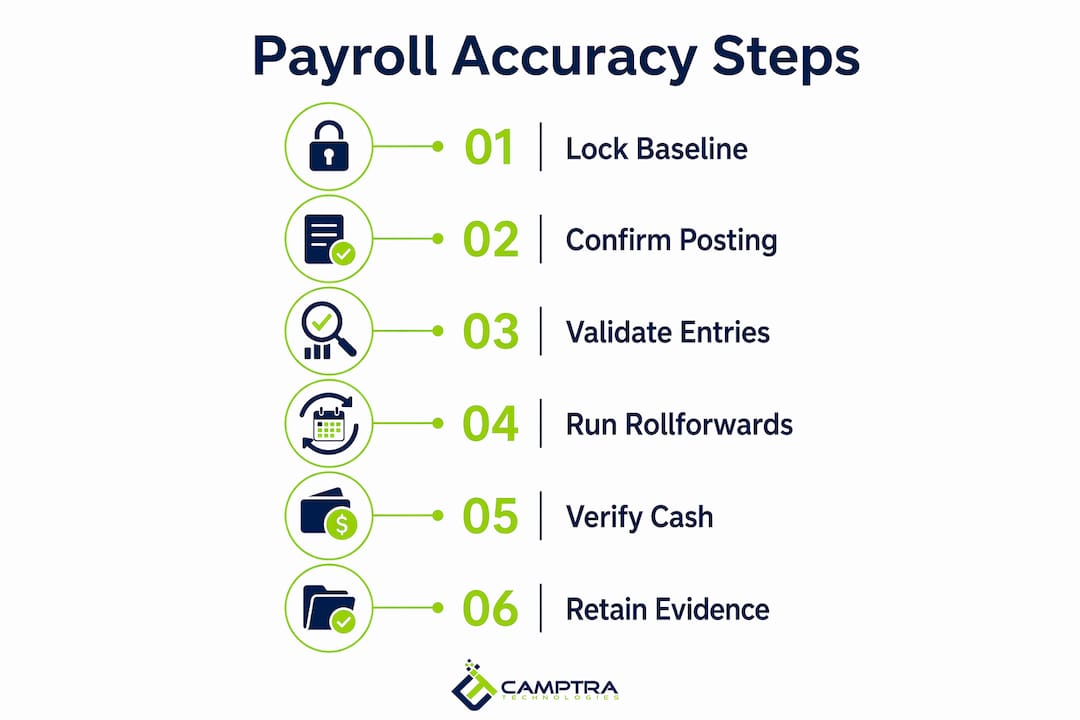
Payroll-to-GL reconciliation fails most often not because of arithmetic, but because the process lacks a defined baseline and a consistent posting structure. Here is a repeatable path that holds up under audit.

Step 1: Lock the baseline. Export finalized payroll register totals for every pay run in the period. Include Gross Pay, employer taxes, Net Pay, benefit deductions, and garnishments. Never post a journal entry from preview totals.
Step 2: Confirm the posting method. Verify that the journal entry structure used this period matches prior periods. One month summarized, the next partially allocated, and the next with exceptions handled differently produces a reconciliation that “ties” at the top line but cannot be compared period over period.
Step 3: Validate the journal entry against the baseline. Tie out in two buckets. First, expense buckets: gross wages to wage expense, employer taxes to payroll tax expense, employer benefits to benefits expense. Second, liability buckets: net pay payable, employee withholdings, and employer obligations. Each bucket must tie independently.
Step 4: Run liability rollforwards. For each major liability category, the formula is: beginning balance plus additions from payroll, minus payments and remittances, equals expected ending balance. If you cannot explain the ending balance using this structure, the liability number is not trustworthy. Spot checks on liabilities are not a substitute for governed rollforwards.
Step 5: Verify cash settlement. Confirm that net pay disbursements, tax remittances, and benefit payments align with payroll obligations and the timing rules your team uses. Clearing accounts are valid control points when payroll cash timing differs from posting timing, provided debits and credits net out cleanly.
Step 6: Retain evidence. A reviewer must be able to trace payroll source reports to the posted journal entry without reconstructing the month. Ignoring payroll accruals for pay periods crossing month-end is one of the most common audit findings. Automating daily accrual calculations by wage rate ensures expenses land in the correct period every time.
Key Takeaways
Payroll cost accuracy in financial reporting requires integrated systems, governed reconciliation workflows, and consistent journal entry design to produce financial statements that hold up under audit.
| Point | Details |
|---|---|
| Accuracy benchmark | Industry leaders target a Payroll Accuracy Rate of 99.95% or above; anything lower signals a process or system gap. |
| Integration advantage | Organizations on combined HR and finance platforms close month-end in about 3 days versus 8–10 days for fragmented systems. |
| Leakage cost | 64% of organizations lose at least 1% of total payroll spend each month to errors, overpayments, and reconciliation failures. |
| Reconciliation discipline | Liability rollforwards, not spot checks, are the control that prevents mystery payables and silent balance drift. |
| Automation impact | Camptra Technologies customers have reported reconciliation time reductions of up to 80%, enabling earlier financial close and stronger audit readiness. |
FAQ
What is a good payroll accuracy rate?
Industry leaders target 99.95% or above. Rates below that threshold indicate process gaps, system misconfigurations, or data quality issues that require root-cause investigation.
What is the formula for payroll accuracy?
Payroll Accuracy Rate is calculated as the number of error-free payrolls divided by total payrolls processed, multiplied by 100. Tracking it alongside root-cause data shows where in the process errors originate, not just that they occurred.
How do you ensure payroll accuracy?
Enforce a fixed reconciliation baseline using finalized payroll register exports, maintain consistent journal entry design across periods, run liability rollforwards monthly, and use pre-payroll variance analysis to catch exceptions before funds clear.
What payroll accuracy metrics do finance teams track?
Finance teams track three core metrics: Payroll Accuracy Rate, Total Payroll Variance Rate (actual minus budgeted payroll divided by budgeted, times 100), and Manual Adjustment Ratio. Each metric targets a different failure point in the payroll-to-GL workflow.
