

Payroll reconciliation is defined as the process of verifying that payroll register totals match bank disbursement files and general ledger postings to confirm accuracy before funds leave the organization. When this process breaks down, the financial consequences compound quickly. 33% of employers experience payroll discrepancies every quarter, and undetected variances can accumulate to thousands of dollars in unexplained balances annually. That exposure is why payroll reconciliation financial risk reduction belongs at the center of every finance team’s control framework, not at the edge of it. Sarbanes-Oxley Section 404 (SOX 404) requires publicly traded companies to document reconciliation processes and provide evidence of management review. Meeting that standard starts with treating reconciliation as a repeatable operating model, not a periodic cleanup task.
What prerequisites and tools support payroll reconciliation for risk reduction?
Effective reconciliation requires more than a checklist. It requires a control environment built before the first pay run closes.
Variance thresholds and control baselines
The industry-recommended variance threshold is 0.05% of Gross Pay per pay run. Variances below that level are absorbed or noted; anything above triggers a formal investigation workflow. That threshold is not arbitrary. It reflects the point at which an unexplained difference is large enough to signal a systemic error rather than a rounding artifact. Your organization may adjust this figure based on headcount, pay frequency, or risk appetite, but you need a documented threshold before you can manage exceptions consistently.
Stable mapping between payroll outputs and general ledger accounts is equally critical. When cost center codes or chart of accounts structures shift without a corresponding update to your posting logic, every subsequent reconciliation starts with a flawed baseline. Lock your GL mapping at the start of each fiscal year and document any mid-year changes with effective dates.
Internal controls that prevent downstream errors
Structural controls like segregation of duties and role-based access reduce financial risk far more reliably than trust-based manual oversight. No single person should be able to add an employee, approve payroll, and release the bank file. A dual-approval rule with a cooling-off period for employee bank detail changes is one of the most effective input-stage controls available. It stops misdirected payments before they ever reach the reconciliation step.
Pro Tip: Document your control narratives in a format that satisfies SOX 404 evidence requirements. A spreadsheet showing who reviewed what and when is not sufficient. You need timestamped approvals, exception logs, and a clear audit trail linking each control to its owner.

| Control area | Minimum requirement |
|---|---|
| Variance threshold | 0.05% of Gross Pay triggers formal review |
| Segregation of duties | Separate preparer, approver, and bank release roles |
| GL mapping | Documented and version-controlled per fiscal year |
| Bank detail changes | Dual approval with cooling-off period |
| Audit evidence | Timestamped logs meeting SOX 404 documentation standards |
How do you perform payroll reconciliation step by step?
A standard three-way reconciliation covering the payroll register, bank file, and general ledger takes 60–120 minutes per pay run when chart of accounts and cost centers are stable. That benchmark assumes you are working from a clean baseline. If your baseline drifts, that time expands significantly.
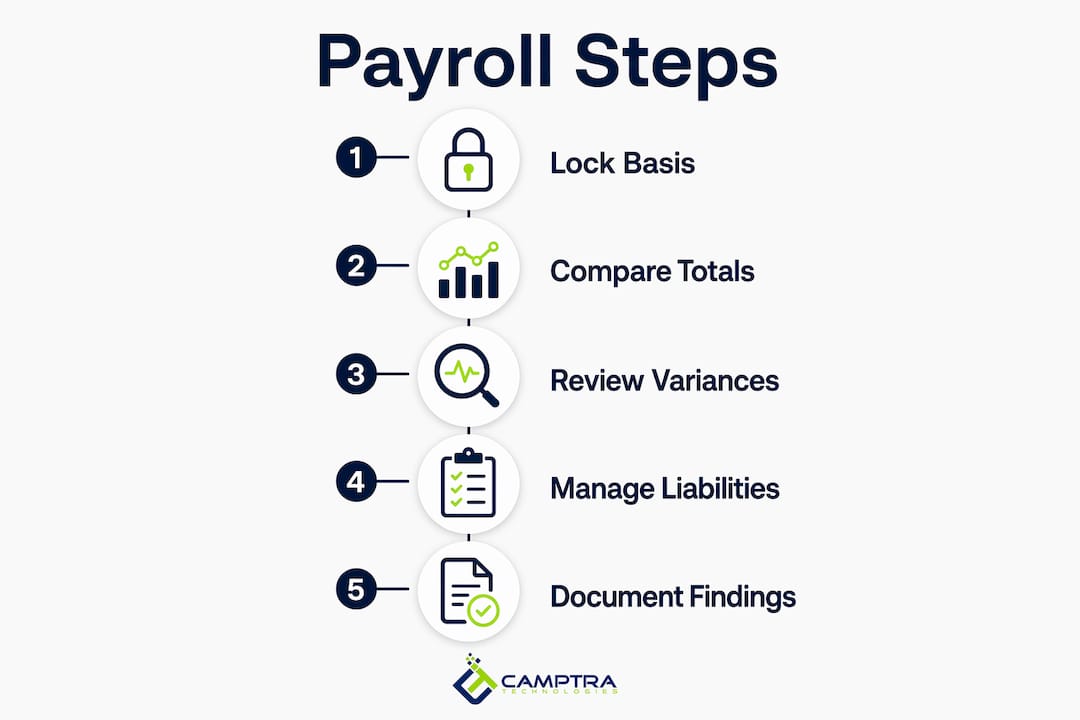
Step 1: Lock the comparison basis
Before comparing any numbers, lock the final payroll register. Do not begin reconciliation against a register that is still open for corrections. Post-archive figures in Oracle Cloud Payroll are your authoritative source. Any adjustment made after archive creates a version control problem that will cost you more time to untangle than it saves.
Step 2: Compare register totals against the bank file and GL
Match Gross Pay, Net Pay, and employer liability totals from the payroll register against the bank payment file and the corresponding GL postings. Work at the summary level first. Chasing individual line items before you have confirmed the totals match is one of the most common mistakes teams make. It wastes time and creates false leads.
Step 3: Isolate and classify variances
When a variance exists, start with buckets, not transactions. Separate the variance into logical categories: new hires, terminations, rate changes, benefit adjustments, tax updates, and timing differences. Assign a root-cause family to each bucket before drilling into individual records. This approach surfaces the actual driver in a fraction of the time that transaction-level hunting requires.
- Confirm the comparison basis is locked (register vs. bank vs. GL).
- Calculate the total variance at the summary level.
- Segment the variance into root-cause buckets.
- Assign ownership for each bucket to a named team member.
- Document findings in a variance memo distinguishing explained variances from fixed ones.
- Escalate any unexplained variance above the 0.05% threshold for formal review.
Step 4: Manage liability accounts with rollforward schedules
Liability accounts for taxes withheld, garnishments, and benefits require rollforward schedules to remain trustworthy. The formula is straightforward: Beginning Balance plus Additions minus Payments equals Ending Balance for each liability bucket. Any account that cannot be reconciled through a rollforward is considered unreliable for audit purposes. Spot checks alone will not detect liability drift until the balance is already materially wrong.
Pro Tip: Prepare your variance memo before the pay run closes, not after. Distinguishing “explained” variances (timing differences, approved adjustments) from “fixed” variances (errors corrected mid-cycle) gives auditors a clear picture and reduces review time significantly.
| Reconciliation step | Key output |
|---|---|
| Lock payroll register | Confirmed post-archive totals |
| Three-way comparison | Summary-level variance amount |
| Bucket classification | Root-cause family per variance |
| Rollforward schedule | Explainable ending balance per liability |
| Variance memo | Documented explained vs. fixed variances |
What common pitfalls should payroll professionals watch for?
Most reconciliation failures trace back to four root causes: baseline drift, journal entry structure inconsistency, unmanaged clearing accounts, and untreated recurring variances. Each one is preventable with the right operating model.
Baseline drift and threshold miscalibration
Baseline drift happens when your comparison reference point changes without documentation. A mid-year reorganization that moves cost centers without updating GL mapping is a classic trigger. The reconciliation appears to balance, but the underlying data is misclassified. Threshold miscalibration creates a different problem. A threshold set too tight generates alert fatigue. A threshold set too loose lets material errors pass undetected. Review your variance threshold at least annually against actual error patterns.
Clearing account mismanagement
Clearing accounts are meant to be temporary. When transactions sit in a clearing account past the pay period close, they become “mystery” balances that no one owns. Assign a named owner to every clearing account and set a hard rule: any balance older than one pay cycle requires a written explanation.
Reconciliation is not a number-matching exercise. It is a control process. When you treat it as the former, you fix symptoms. When you treat it as the latter, you prevent them. The difference shows up in your audit findings.
- Recurring variances: If the same variance appears in three consecutive pay runs, it is a systemic issue, not a one-time event. Escalate it.
- Timing differences: A payroll posting date that falls outside the GL period creates a legitimate timing difference. Document it explicitly so auditors do not flag it as an unexplained variance.
- JE structure changes: Any change to journal entry templates must be version-controlled and approved before the next pay run. Undocumented JE changes are a leading cause of audit deficiencies.
- Ownership gaps: Every reconciliation control needs a named owner and a backup. Controls without owners fail silently.
Pro Tip: Set a monthly control review meeting with payroll, finance, and HRIS. Review open exceptions, recurring variances, and any control that fired more than twice in the period. Recurring issues that stay unresolved are the ones that become audit findings.
How do you measure and sustain payroll reconciliation effectiveness?
Reconciliation effectiveness is measurable. Finance teams that track payroll reconciliation KPIs for finance departments can identify control degradation before it becomes an audit issue.
KPIs that signal control health
- Variance rate per pay run: Total unexplained variance as a percentage of Gross Pay. Target: below 0.05%.
- Time to resolve discrepancies: Average hours from variance identification to documented resolution. Shorter cycles indicate better root-cause discipline.
- Recurring variance rate: Percentage of variances that appear in more than one consecutive pay run. Any recurring rate above zero warrants investigation.
- Audit findings per cycle: Number of reconciliation-related findings raised by internal or external audit. Trending this metric over time reveals whether controls are improving.
- Exception volume per 1,000 employees: Normalizes exception counts across headcount changes, making trend analysis meaningful.
Technology and governance working together
Automating reconciliation reduces error rates and reconciliation time by 60–70% compared to manual methods. That efficiency gain matters, but automation without governance creates a false sense of control. Automated tools surface exceptions faster. Human reviewers still need to classify, investigate, and resolve them. The teams that sustain the lowest financial risk profiles are the ones that use technology for detection and human judgment for resolution.
Per-cycle reconciliation catches 80–90% of potential errors before they become audit issues, compared to year-end reconciliation alone. That gap is the clearest argument for moving away from periodic cleanup toward a continuous control model. When you reconcile every pay run, you contain errors to a single cycle. When you reconcile quarterly or annually, you inherit every prior cycle’s unresolved issues.
| KPI | Target benchmark |
|---|---|
| Variance rate | Below 0.05% of Gross Pay |
| Time to resolve | Decreasing trend cycle over cycle |
| Recurring variance rate | 0% (any recurrence triggers escalation) |
| Audit findings | Decreasing trend year over year |
| Exception volume | Stable or declining per 1,000 employees |
Key Takeaways
Payroll reconciliation financial risk reduction requires per-cycle controls, documented variance thresholds, and structured root-cause investigation to prevent errors from compounding into audit findings.
| Point | Details |
|---|---|
| Reconcile every pay run | Per-cycle reconciliation catches 80–90% of errors before they reach audit. |
| Set a variance threshold | 0.05% of Gross Pay is the recommended trigger for formal investigation. |
| Use rollforward schedules | Liability accounts without rollforwards produce unreliable balances. |
| Automate detection, not judgment | Automation cuts reconciliation time by 60–70%; human review resolves root causes. |
| Track KPIs continuously | Variance rate, resolution time, and recurring exceptions reveal control health. |
Reconciliation as a control model, not a closing task
I have seen finance teams treat payroll reconciliation as something you do after the close, like a final check before filing. That framing is the source of most of the audit findings I have observed over the years. By the time you are reconciling at month-end, you are already managing the consequences of four or more pay runs that ran without a control gate.
The shift that changes outcomes is treating reconciliation as an operating model. That means locking baselines before each run, classifying variances by root-cause family rather than chasing individual transactions, and owning every exception through to resolution. It also means accepting that automation is a detection tool, not a replacement for judgment. The teams I have seen reduce their audit findings most consistently are not the ones with the most sophisticated tools. They are the ones with the clearest ownership structures and the most disciplined variance documentation.
The uncomfortable truth about payroll reconciliation is that most of the risk lives in the process design, not in the data. Fix the process, and the data follows. Camptra Technologies’ approach to reconciliation module capabilities reflects exactly that principle: surface exceptions fast, give teams the context to resolve them, and build an audit trail that holds up under scrutiny.
— Zach
Camptra Technologies’ Payroll Recon Toolset for Oracle Cloud teams
Finance and payroll teams running Oracle Cloud Payroll face a specific challenge: reconciling millions of records across time and attendance, benefits, costing, tax, and general ledger data before every payroll cutoff. Spreadsheet-based reviews cannot scale to that volume without introducing the very errors you are trying to prevent.
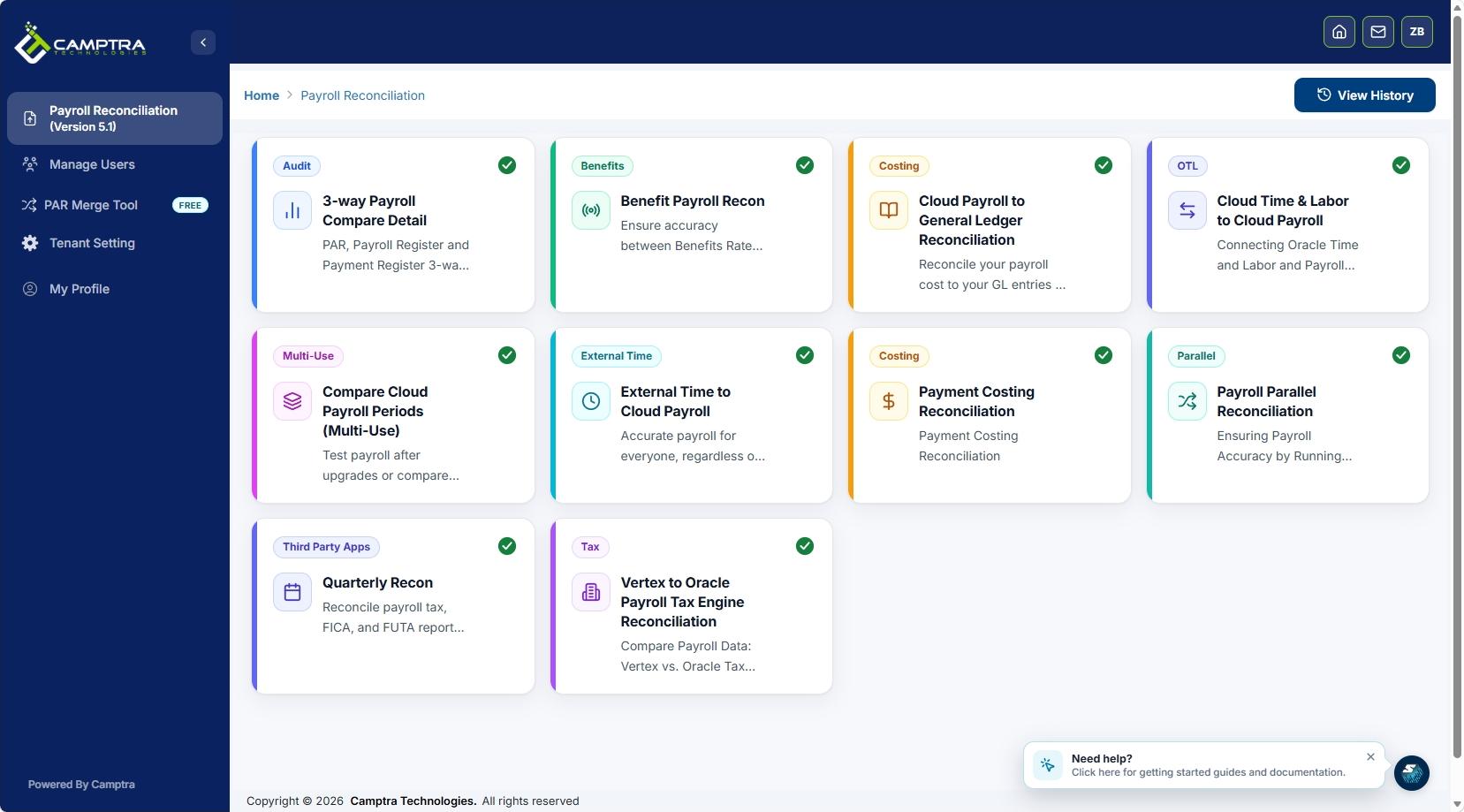
Camptra Technologies’ Payroll Recon Toolset automates large-scale reconciliation, surfaces variances by root-cause category, and maintains a complete audit trail. Customers have reported reconciliation time reductions of up to 80%. The healthcare case study details how one organization achieved its earliest financial close on record after implementing Camptra’s toolset. You can also review additional case studies to see how other enterprise teams have reduced audit time and improved reporting accuracy.
FAQ
What is payroll reconciliation financial risk reduction?
Payroll reconciliation financial risk reduction is the practice of using structured reconciliation controls to prevent payroll errors from creating financial exposure, compliance failures, or audit findings. It treats reconciliation as a continuous control process rather than a periodic cleanup task.
How often should payroll reconciliation be performed?
Reconciliation should be performed every pay run. Per-cycle reconciliation catches 80–90% of errors before they become audit issues, compared to year-end reconciliation alone.
What variance threshold should trigger a payroll investigation?
The industry-recommended threshold is 0.05% of Gross Pay per pay run. Variances above this level require a formal root-cause investigation and documented resolution.
What are the key KPIs for payroll reconciliation?
The most useful KPIs are variance rate as a percentage of Gross Pay, time to resolve discrepancies, recurring variance rate, and audit findings per cycle. Tracking these metrics over time reveals whether your controls are improving or degrading.
How does SOX 404 apply to payroll reconciliation?
SOX 404 requires publicly traded companies to document reconciliation processes, provide evidence of execution, and demonstrate management review. Untracked reconciliation workflows create material weakness risk during external audits.
