

A payroll variance is defined as the difference between your company’s actual payroll costs and the expected or budgeted payroll costs for a given period, expressed as: Actual Payroll Cost minus Expected Payroll Cost = Payroll Variance. Every payroll run produces some variance. The question is whether that variance reflects a legitimate operational change or a processing error you need to fix. Payroll errors cost an average of $291 per incident to correct, and 21% of employees lose trust in their employer after experiencing payroll problems. For HR and finance professionals, understanding payroll variance analysis is not optional. It is the foundation of accurate financial reporting, audit readiness, and employee confidence.
What is a payroll variance and what causes it?
A payroll variance is the gap between what you planned to pay and what you actually paid. The industry term for the broader practice of identifying and resolving these gaps is payroll reconciliation. Both terms describe the same discipline from different angles: variance is the measurement, reconciliation is the process.
Six root-cause families explain most payroll variances: timing differences, mapping drift, population mismatches, Gross Pay composition changes, corrections, and manual journal entries. Understanding which family a variance belongs to determines how you investigate and fix it.

Not all variances signal errors. Many payroll variances reflect legitimate operational changes, such as a mid-cycle hire, a retroactive salary adjustment, or a benefit election change during open enrollment. Treating every variance as an error wastes investigation time and creates alert fatigue.
| Cause category | Typical signature | Investigation approach |
|---|---|---|
| Timing differences | Variance reverses in the next cycle | Confirm pay period boundaries match between systems |
| Pro-ration (new hire/termination) | Partial-period pay on one employee record | Verify hire/termination date and pro-ration rule applied |
| Retroactive adjustments | Lump-sum catch-up payment in current period | Trace back to the originating pay period and approval |
| Benefit election changes | Deduction amount shifts mid-year | Cross-reference benefits enrollment data against payroll deductions |
| Mapping drift | Earnings code routes to wrong cost center | Audit element-to-costing mapping in Oracle Cloud configuration |
| Manual journal entries | GL balance differs from payroll register | Identify journal source and confirm it was authorized |
Pro Tip: Before you investigate a variance at the transaction level, confirm that your comparison is apples to apples. Scope, timing, and the comparison basis must match between your payroll register and your budget or prior period. Fixing those three variables first eliminates the majority of phantom variances before you spend time chasing individual records.
How to calculate payroll variance and interpret results
The standard payroll variance formula is straightforward: Actual Payroll Cost minus Expected Payroll Cost equals Payroll Variance. A positive result means you spent more than budgeted. A negative result means you spent less.
Payroll professionals use two additional calculations to put variance in context.
- Dollar variance: Actual Cost minus Expected Cost. Example: $1,250,000 actual minus $1,200,000 expected equals a $50,000 unfavorable variance.
- Percentage variance: (Actual Cost minus Expected Cost) divided by Expected Cost, multiplied by 100. Using the same example: ($50,000 divided by $1,200,000) multiplied by 100 equals 4.17%.
- Favorable vs. unfavorable classification: A favorable variance means actual cost came in below budget. An unfavorable variance means actual cost exceeded budget. Neither label implies the variance is correct or incorrect. A favorable variance caused by missing overtime payments is still an error.
- Macro vs. micro scope: A macro variance compares total payroll cost to total budget. A micro variance isolates a single employee, earnings element, or department. Macro analysis flags where to look. Micro analysis reveals why the gap exists.
The percentage variance calculation matters most for setting investigation thresholds. A $50,000 variance on a $50 million payroll is 0.10% and may warrant review. The same $50,000 on a $500,000 payroll is 10% and demands immediate attention. Absolute dollar amounts without percentage context can mislead your prioritization.
Best practices for managing payroll variances
Effective variance management runs on three reconciliation horizons: per-cycle, monthly, and year-end. Each horizon has distinct validation goals. Per-cycle reconciliation catches processing errors before payroll is finalized. Monthly reconciliation confirms that Gross Pay, Net Pay, and deductions align with the general ledger. Year-end reconciliation validates tax balances, W-2 accuracy, and benefit cost totals against annual budgets.
Industry best practice sets the variance investigation threshold at 0.05% of gross payroll. Variances above that threshold trigger manual review. Variances below it are documented and carried forward. This threshold balances control against the cost of investigation.
A repeatable variance review workflow looks like this:
- Confirm scope and timing. Verify that the pay period dates, employee population, and pay elements match between your payroll register and your comparison baseline.
- Run a headcount check. Compare active employee counts between the current period and the prior period. A population mismatch explains many dollar variances before you touch a single transaction.
- Segment by pay type. Separate Regular Pay, Overtime, Bonuses, and Deductions. A variance concentrated in one segment narrows the investigation significantly.
- Apply your threshold. Flag variances above 0.05% of gross payroll or above 10–15% at the segment level for manual review.
- Document root cause and resolution. Record whether the variance was a legitimate change or an error, and confirm the fix was applied before archive.
- Confirm GL alignment. Verify that payroll costing entries in Oracle Cloud match the payroll register totals before the financial close.
Pro Tip: Variance management also carries direct compliance implications. Unresolved payroll discrepancies can constitute wage and hour violations under federal and state labor law. Documenting your investigation and resolution steps protects the organization during audits and regulatory reviews.
Consistent protocols matter as much as the threshold itself. Teams that run the same checklist every cycle build pattern recognition over time. They spot anomalies faster because they know what normal looks like.
Tools and techniques for payroll variance analysis
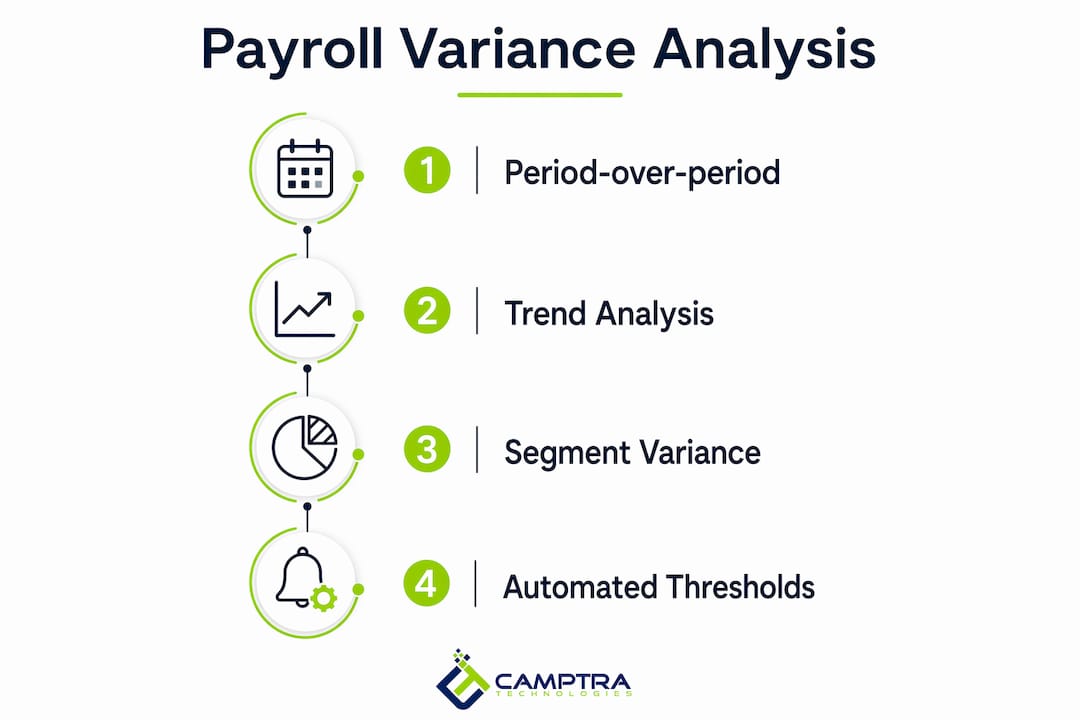
Payroll variance analysis uses four core techniques. Each serves a different detection purpose, and the strongest programs combine all four.
| Technique | What it detects | Best timing |
|---|---|---|
| Period-over-period comparison | Sudden cost shifts between cycles | Every pay cycle |
| Segmentation analysis | Variances concentrated in one department, pay type, or location | Monthly |
| Trend analysis | Slow-moving changes across multiple periods | Quarterly |
| Employee-level audit | Individual record errors, duplicate payments, or missing deductions | Pre-archive, post-archive |
Trend analysis across multiple periods catches creeping issues that single-period checks miss entirely. Tax withholding drift and benefits deduction mismatches often grow slowly over several months before they become material. A one-cycle comparison shows you nothing. A six-cycle trend line shows you everything.
Segment-level variances above 10–15% or company-wide variances above 0.05% of gross payroll require attention. Segmentation by department, cost center, or pay element type lets you isolate the source of a company-wide variance in minutes rather than hours.
Automated variance thresholds reduce alert fatigue while keeping material discrepancies in front of the right people. Rule-based exception checks, such as flagging any employee whose Net Pay changed by more than 20% from the prior cycle, surface the records that need human review without requiring manual sorting of the entire payroll register.
For Oracle Cloud Payroll teams, the payroll costing reconciliation layer adds a critical control point. Costing variances between the payroll register and the general ledger often originate from element-to-cost-center mapping errors that automated checks catch before the financial close.
Key Takeaways
Payroll variance analysis is the discipline that separates reactive payroll teams from those who control costs, pass audits, and maintain employee trust.
| Point | Details |
|---|---|
| Core formula | Actual Payroll Cost minus Expected Payroll Cost equals Payroll Variance; always calculate percentage variance for context. |
| Not all variances are errors | Legitimate operational changes like mid-cycle hires and retroactive adjustments produce expected variances. |
| Three reconciliation horizons | Per-cycle, monthly, and year-end reviews each serve distinct validation goals and catch different error types. |
| Investigation threshold | Set manual review triggers at 0.05% of gross payroll company-wide and 10–15% at the segment level. |
| Trend analysis is non-negotiable | Single-period checks miss slow-moving issues; run trend analysis quarterly to catch tax and deduction drift. |
Why payroll variance analysis is a strategic skill, not a back-office task
I have watched payroll professionals treat variance investigation as a monthly chore to get through before the financial close. That framing is the wrong one, and it costs organizations more than they realize.
Root-cause closure transforms variance investigation from reactive work into process improvement. The goal is not to resolve the same variance twelve times a year. The goal is to identify why it keeps appearing and fix the underlying configuration, mapping, or workflow that generates it. Teams that operate with that mindset shrink their variance backlog over time instead of running the same investigation loop every cycle.
The professionals who master variance analysis become strategic partners in financial planning, not just processors. When you can explain to a CFO exactly why payroll cost increased by $180,000 in a given month, broken down by overtime growth in two departments and a benefits rate change, you are contributing to workforce cost decisions, not just closing the books.
The other thing I have seen underestimated is the cultural cost of unresolved variances. 53% of employees consider leaving their jobs if payroll errors persist. That is a retention risk that shows up in recruiting costs, not payroll costs. Finance teams rarely see that connection. Payroll professionals who make it visible earn a seat at the table.
My honest advice: build your threshold, document your protocol, and close root causes permanently. The teams that do this consistently are the ones who finish their financial close early, pass audits without scrambling, and spend their time on analysis instead of data preparation.
— Zach
How Camptra Technologies automates payroll variance reconciliation
Payroll variance analysis at enterprise scale requires more than a well-designed spreadsheet. Camptra Technologies built the Payroll Recon Toolset specifically for Oracle Cloud Payroll teams that need to reconcile millions of records per cycle without manual data preparation.
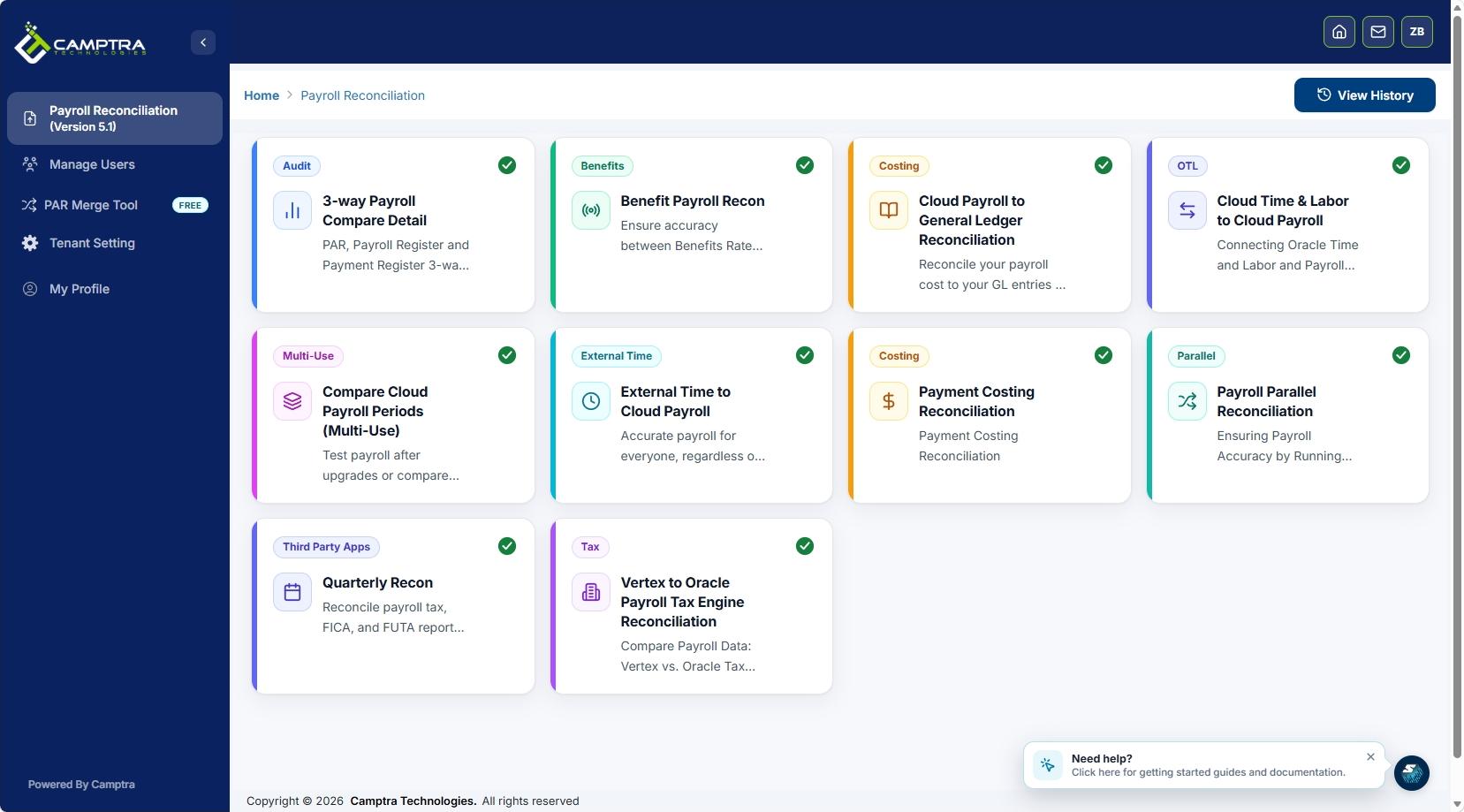
The toolset connects time and attendance, payroll, benefits, costing, tax, and general ledger data in one environment. Teams surface variances, apply threshold rules, and investigate exceptions before payroll is archived. Customers have reported reconciliation time reductions of up to 80%. The healthcare system case study shows what that looks like in practice: faster audit cycles and an earlier financial close. You can also review the full case studies library to see results across industries. To test the toolset in your own Oracle Cloud environment, request sandbox access and run a reconciliation against your actual payroll data.
FAQ
What is the payroll variance definition?
A payroll variance is the difference between actual payroll costs and expected or budgeted payroll costs, calculated as Actual Cost minus Expected Cost. A positive result is an unfavorable variance; a negative result is a favorable variance.
How do you calculate payroll variance as a percentage?
Divide the dollar variance by the expected payroll cost, then multiply by 100. For example, a $10,000 variance on a $1,000,000 expected payroll equals a 1.0% variance.
What are the most common reasons for payroll variance?
The six most common causes are timing differences, mapping drift, population mismatches, Gross Pay composition changes, retroactive corrections, and manual journal entries. Many of these reflect legitimate operational changes rather than processing errors.
What threshold should trigger a payroll variance investigation?
Industry best practice sets the investigation threshold at 0.05% of gross payroll at the company level and 10–15% at the segment level. Variances below these thresholds are documented and carried forward rather than manually reviewed every cycle.
Why does payroll variance analysis matter for compliance?
Unresolved payroll variances can constitute wage and hour violations under federal and state labor law. Documenting variance investigations and resolutions creates an audit trail that protects the organization during regulatory reviews and internal audits.
