

Automated three-way reconciliation — matching carrier invoices against your payroll deduction register and HRIS enrollment records — is the most effective approach to stopping premium leakage, protecting payroll tax accuracy, and cutting reconciliation time. The immediate next step: connect those three data feeds, run pre-invoice eligibility checks before each billing cycle closes, and adopt a dedicated reconciliation tool that produces exception workflows and audit-ready outputs. For Oracle Cloud Payroll teams, Camptra’s Payroll Recon Toolset is purpose-built for exactly that workflow.
Table of Contents
- What is benefits reconciliation and why does it put your payroll at risk?
- The gold standard: three-way match plus a continuous reconciliation loop
- Which data sources do you need to connect first?
- What features should you require from a reconciliation tool?
- Step-by-step implementation checklist for automated benefits reconciliation
- KPIs and benchmarks to measure reconciliation success
- Common pitfalls and how to avoid them
- How Camptra’s Payroll Recon Toolset handles benefits reconciliation for Oracle Cloud
- Key Takeaways
- The case for treating reconciliation as a control, not a chore
- Validate Camptra’s Payroll Recon Toolset against your Oracle environment
- FAQ
What is benefits reconciliation and why does it put your payroll at risk?
Benefits reconciliation, also called premium reconciliation, is the monthly process of comparing carrier invoices against HRIS enrollment records and payroll deduction reports. The goal is simple: confirm that what you’re paying carriers matches what employees are enrolled in and what payroll is actually deducting.
When those three numbers diverge, the consequences reach further than most teams expect. Incorrect pre-tax deductions distort taxable wages, which flows directly into miscalculated Social Security, Medicare, and federal income tax withholdings. That cascade can require amended 941-X filings, W-2 corrections, and IRS penalty exposure. For payroll reporting accuracy, deduction accuracy isn’t a back-office detail — it’s a compliance control point.
The most common billing errors to watch for:
- Terminated employees still billed by the carrier after their coverage end date
- Active employees missing from the carrier invoice entirely
- Employees enrolled in the wrong coverage tier (single vs. family, for example)
- COBRA participants billed at incorrect rates or dropped prematurely
- Voluntary benefit deductions not reflected in the payroll register
Beyond tax risk, benefits audits protect employee trust. When payroll deductions don’t match what an employee enrolled in, the resulting confusion erodes confidence in HR and payroll alike.
The gold standard: three-way match plus a continuous reconciliation loop
A two-way comparison — carrier invoice against payroll deductions only — commonly misses enrollment-origin discrepancies. The three-way match adds HRIS enrollment data as the authoritative source of truth, so you can distinguish between a payroll coding error and a carrier billing error. That distinction determines who fixes it and how fast.
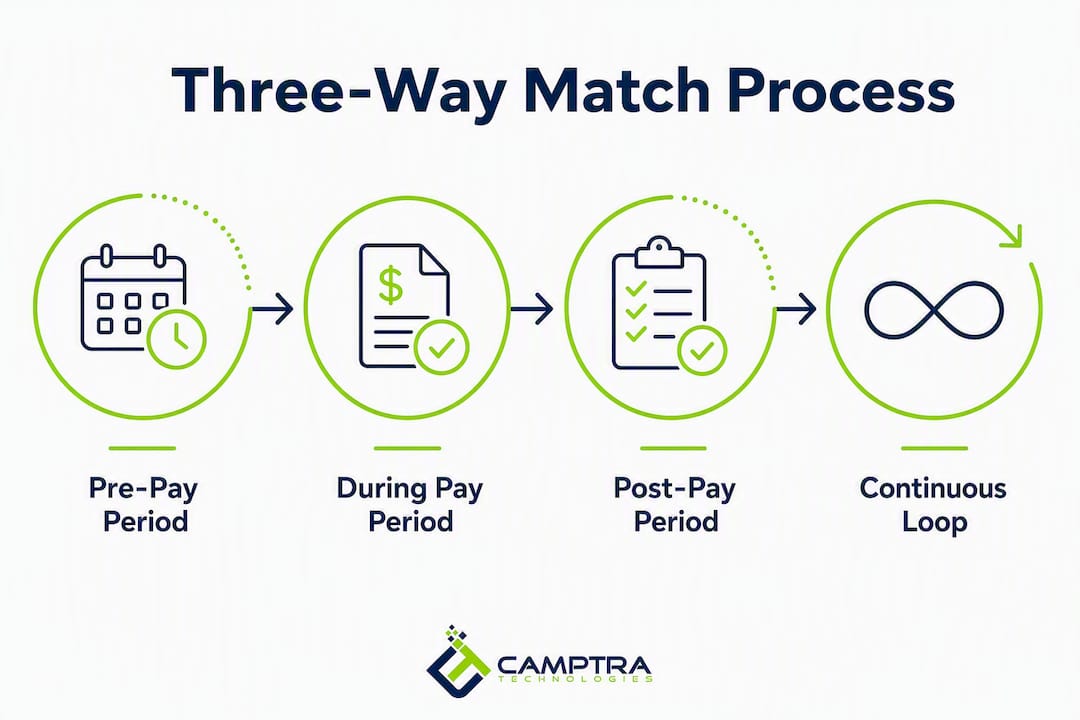
The continuous loop model, supported by ADP’s payroll reconciliation guidance, runs checks at three points:
Before the pay period: Compare HRIS enrollment records against the carrier’s eligibility file. Flag new hires not yet added, terminations not yet removed, and tier changes not yet transmitted.
During the pay period: Validate mid-cycle events — leaves of absence, qualifying life events, retroactive enrollment changes — against both the deduction register and the carrier file.

After the pay period: Confirm that deductions posted in payroll match the approved enrollment data and that the carrier invoice reflects the same population. Capture the audit trail before the next cycle opens.
Waiting until month-end to run this check compresses all three stages into a single reactive scramble. Pre-invoice validation, by contrast, shifts the work upstream — catching discrepancies before the carrier invoice closes and before an overpayment is already in transit.
Which data sources do you need to connect first?
The core feeds for effective benefits deduction reconciliation are:
- HRIS enrollment records: The authoritative source for plan elections, effective dates, dependent coverage, and tier assignments
- Payroll deduction register: The actual deductions posted per employee per pay period, including pre-tax and post-tax splits
- Carrier eligibility/billing files: The carrier’s view of who is covered and at what premium, typically transmitted as EDI 834 files or via API
- Time and attendance: Required for variable-hour employees where benefit eligibility depends on hours worked
- General ledger: Confirms that benefit liability postings match deduction totals; critical for GL reconciliation and finance reporting
Integration patterns at enterprise scale: API connections offer real-time sync but require more initial configuration. EDI/834 files via SFTP are the carrier-side standard and remain the most widely supported format. Nightly batch feeds work for stable, high-volume environments but introduce a 24-hour lag that can obscure same-day enrollment events.
Prioritize in this order: Start with high-cost medical plans (largest premium exposure), then high-volume carriers (most billing lines to reconcile), then carriers with the shortest invoice lead times (least room for manual correction). Dental, vision, and voluntary benefits can follow once the medical reconciliation cycle is stable.
What features should you require from a reconciliation tool?
For Oracle Cloud Payroll teams, the feature bar is higher than for general HR platforms. Your tool needs to speak Oracle’s data model natively, not just accept a CSV export.
Required capabilities:
- Three-way matching engine that compares carrier files, payroll deduction registers, and HRIS enrollment simultaneously
- Pre-invoice eligibility comparison to flag discrepancies before the billing cycle closes
- Exception workflows with root-cause flags (carrier error vs. HRIS error vs. payroll coding error)
- Audit-ready reporting with exportable evidence that carriers will accept for credit requests
- Automated EDI/834 transmission and API support for carrier connections
- Configurable rule engine for plan tiers, deduction codes, and coverage categories
For Oracle Cloud specifically, require automated field mapping with AI-assisted logic for Oracle HCM and Oracle Cloud Payroll schemas. Manual field mapping across Oracle’s data model is where implementations stall.
Step-by-step implementation checklist for automated benefits reconciliation
| Phase | Owner | Key Actions |
|---|---|---|
| Discovery | Payroll + HRIS Lead | Inventory all benefit plans, carriers, and current data feeds; document deduction codes |
| Mapping | IT/Integration + Benefits | Map plan codes, employee IDs, effective dates, and deduction amounts across all three sources |
| Pilot | Payroll + Benefits | Select one high-cost medical carrier; run pre-invoice comparison; measure exceptions |
| Validation | Payroll + Finance | Run parallel validation against existing payroll; test edge cases (LOAs, mid-cycle hires) |
| Iteration | All stakeholders | Resolve mapping gaps; refine exception workflow; confirm audit output format |
| Full Roll-out | Payroll Director | Onboard remaining carriers; activate continuous loop cadence; set SLAs for exception resolution |
| Post-rollout Audit | Finance + Audit | Review first full cycle; confirm GL postings align; document findings for audit trail |
Numbered pilot checklist:
- Select the carrier with the highest monthly premium spend as your pilot
- Pull a sample payroll deduction extract and HRIS enrollment snapshot for the same pay period
- Request the carrier’s eligibility file for the same period in EDI 834 or API format
- Run the three-way pre-invoice comparison and log every exception by type
- Measure time-to-resolution per exception and total reconciliation hours
- Collect feedback from payroll, benefits, and finance before expanding to additional carriers
For Oracle Cloud teams, reconciliation steps specific to Oracle environments should guide your field mapping decisions during the discovery phase.
KPIs and benchmarks to measure reconciliation success
Track these metrics from the first pilot cycle:
- Exceptions detected pre-invoice (%): The share of discrepancies caught before the carrier invoice closes — the primary leading indicator
- Premium leakage prevented ($): Dollar value of billing errors caught and corrected before payment
- Reconciliation time saved (hours/month): Baseline manual hours versus post-automation hours
- Time-to-resolution per exception: Average hours from exception flag to confirmed resolution
- W-2 corrections avoided: Tracks the downstream compliance benefit of accurate deductions
For ROI calculations: multiply reclaimed staff hours by your fully-loaded hourly cost, add the dollar value of premium leakage recovered, and factor in the cost of a W-2 correction (amended filing fees, staff time, and potential IRS penalty exposure). The financial risk reduction case typically closes quickly once those three numbers are on the same spreadsheet.
Report exceptions rates and leakage figures monthly to payroll and finance leadership. Audit stakeholders need the audit trail outputs quarterly at minimum.
Common pitfalls and how to avoid them
Most reconciliation failures trace back to the same handful of mistakes:
- Bad field mappings: Plan codes in the HRIS don’t match plan codes in the carrier file, so the matching engine produces false positives. Validate mappings before the first live run, not after.
- Siloed ownership: HR manages enrollment, payroll manages deductions, and neither team owns the carrier invoice. Assign a single reconciliation owner with authority across all three.
- Month-end-only cadence: Waiting until the invoice arrives means you’re already 30–45 days into an overpayment window. Pre-invoice eligibility validation closes that window before it opens.
- Assuming carrier files are clean: Carriers make errors. Terminated employees billed, wrong tier assignments, and missing new hires appear regularly in carrier invoices.
- One-and-done mentality: Reconciliation is an ongoing control, not a project. Teams that treat it as a one-time cleanup revert to leakage within two billing cycles.
Pro Tip: Automate your EDI/834 transmissions to carriers on a defined schedule tied to your HRIS enrollment cut-off. Manual file pulls introduce timing gaps that are the single most common source of “phantom” discrepancies — variances that exist only because the carrier file and the HRIS snapshot were pulled at different moments.
Change management matters as much as the technology. Align cut-off times between HR, payroll, and carriers before go-live. Define SLAs for exception resolution (24–48 hours for high-dollar exceptions is a reasonable starting target). Train HR and payroll teams on the exception workflow specifically — they don’t need to audit the full roster, only the flagged records. That shift in mindset is what makes HR and payroll collaboration sustainable at scale.
How Camptra’s Payroll Recon Toolset handles benefits reconciliation for Oracle Cloud
Camptra’s Payroll Recon Toolset is built specifically for Oracle Cloud Payroll environments, which means it connects to Oracle HCM and Oracle Cloud Payroll data models natively rather than through generic CSV imports. The tool runs three-way matching across carrier eligibility files, payroll deduction registers, and HRIS enrollment data, surfaces exceptions with root-cause flags, and produces audit-ready outputs that support both internal audit reviews and carrier credit requests.
| Capability | What it does for your team |
|---|---|
| AI-assisted field mapping | Maps Oracle HCM plan codes and deduction elements to carrier file fields automatically, reducing setup time |
| Pre-invoice eligibility comparison | Flags discrepancies before the carrier invoice closes, preventing overpayments rather than chasing credits |
| Exception workflows | Routes each exception to the right owner (payroll, HRIS, or carrier) with root-cause context |
| Audit-ready outputs | Produces standardized evidence that carriers accept for credit requests and auditors accept as control documentation |
| Parallel validation | Supports reconciliation runs alongside Oracle upgrades or migrations to confirm data integrity |
Customers report substantial reduction in reconciliation time, with faster exception detection and stronger audit readiness as the two most cited operational improvements. The tool is available on the Oracle Marketplace, which simplifies procurement and compatibility validation for Oracle Cloud customers.
Key Takeaways
Automated three-way reconciliation — carrier invoice, payroll deduction register, and HRIS enrollment — run as a continuous pre/intra/post-pay-period loop is the most effective method to stop premium leakage and protect payroll tax accuracy.
| Point | Details |
|---|---|
| Three-way match is the standard | Comparing only two sources misses enrollment-origin discrepancies; all three feeds are required. |
| Continuous cadence beats month-end | Reconciling before, during, and after each pay period closes the overpayment window. |
| Compliance risk is real | Deduction errors cascade into incorrect taxable wages, W-2 errors, and potential IRS penalty exposure. |
| Measure exceptions pre-invoice first | The share of discrepancies caught before the invoice closes is the leading KPI for reconciliation maturity. |
| Camptra Technologies for Oracle teams | Camptra’s Payroll Recon Toolset delivers three-way matching, AI-assisted mapping, and significant time reduction for Oracle Cloud Payroll environments. |
The case for treating reconciliation as a control, not a chore
The conventional framing of benefits reconciliation as a monthly administrative task undersells what it actually is: a financial control that sits at the intersection of payroll accuracy, tax compliance, and carrier contract management. Teams that treat it as a chore run it reactively, catch errors late, and spend most of their time preparing data rather than resolving problems.
The more useful frame is this: reconciliation is your earliest warning system for payroll data integrity. When your HRIS enrollment, payroll deductions, and carrier billing diverge, something upstream broke — a termination wasn’t transmitted, a tier change didn’t sync, a new hire missed the enrollment window. Finding that break before the invoice closes is categorically different from finding it on a W-2 correction in February.
What most articles understate is the change management dimension. The technology is the easier half. The harder half is getting HR, payroll, and benefits teams to agree on cut-off times, exception ownership, and resolution SLAs before the first live run. Organizations that skip that alignment step end up with a tool that surfaces exceptions nobody has authority to resolve. The process design has to precede the automation, not follow it.
Validate Camptra’s Payroll Recon Toolset against your Oracle environment
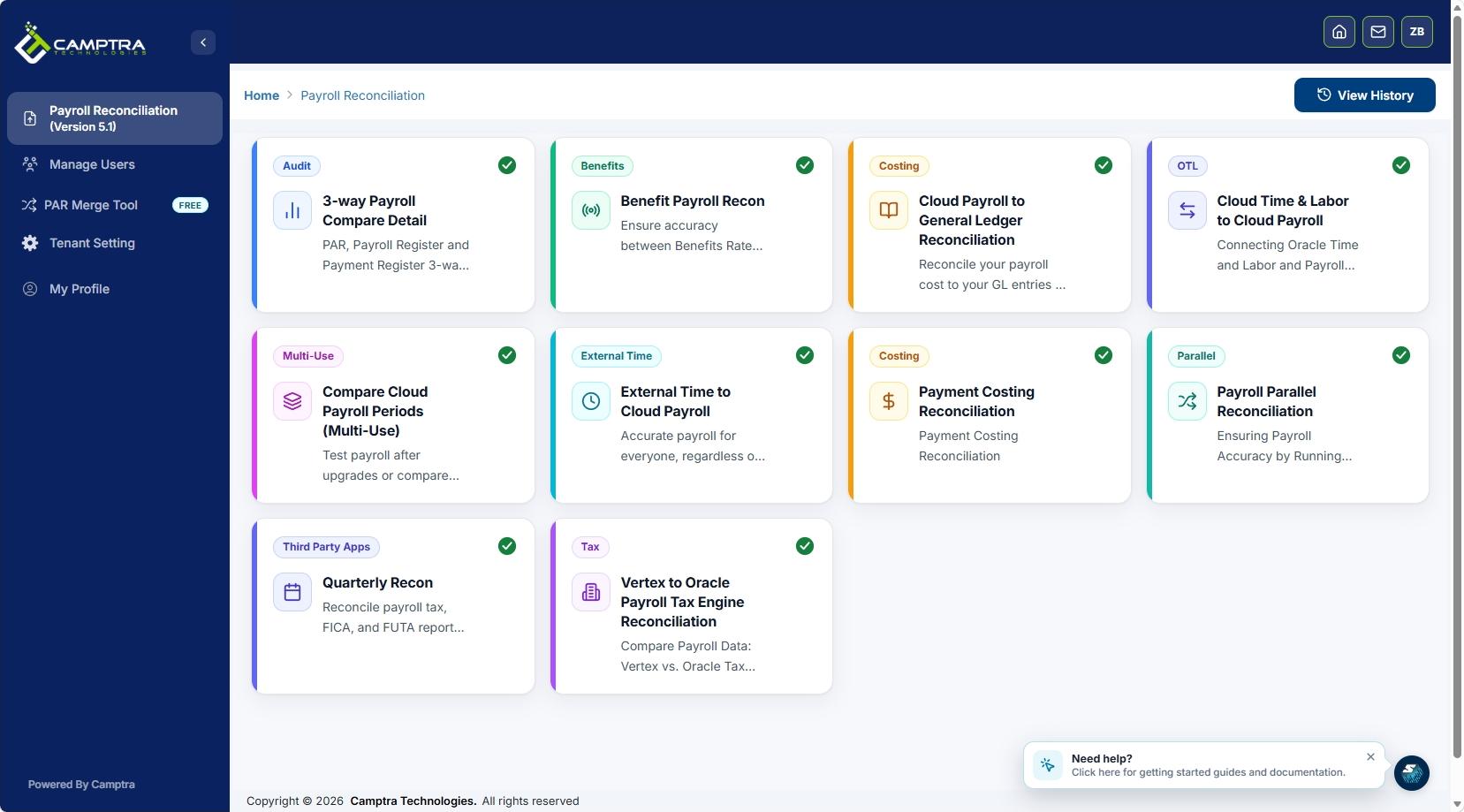
The fastest way to know whether Camptra’s Payroll Recon Toolset fits your Oracle Cloud Payroll environment is to test it against your actual data. Before requesting sandbox access, prepare three things: a sample carrier eligibility file (EDI 834 or API format), a payroll deduction extract for the same period, and a list of the two or three benefit plans with the highest monthly premium spend. That’s enough to run a meaningful pre-invoice comparison and see exactly how exceptions surface and route.
Camptra’s sandbox environment lets your payroll and HRIS teams validate field mapping, test exception workflows, and confirm audit output formats before any production commitment. For teams currently managing reconciliation in spreadsheets, the gap between what you’re doing now and what a purpose-built tool produces is visible within the first test run. Request sandbox access to start that validation, or review the full feature capabilities to prepare your procurement checklist.
FAQ
What is the recommended frequency for benefits reconciliation?
Monthly reconciliation is the widely accepted minimum, but leading practice in 2026 calls for continuous checks before, during, and after each pay period to catch discrepancies before the carrier invoice closes.
What are the three sources in a three-way benefits reconciliation match?
The three sources are the carrier eligibility/billing file, the payroll deduction register, and the HRIS enrollment records. Comparing all three is necessary because two-way comparisons regularly miss enrollment-origin discrepancies.
How does benefits reconciliation affect W-2 reporting?
Incorrect benefit deductions distort taxable wages, which can produce inaccurate W-2s, require amended 941-X filings, and create IRS penalty exposure. Accurate pre-tax deduction management is a direct compliance control.
Which benefit plans should you reconcile first?
Start with high-cost medical plans, followed by high-volume carriers and those with the shortest invoice lead times. Dental, vision, and voluntary benefits can follow once the medical reconciliation cycle is stable.
How does Camptra’s Payroll Recon Toolset support benefits reconciliation?
Camptra’s Payroll Recon Toolset runs three-way matching natively within Oracle Cloud Payroll environments, surfaces exceptions with root-cause flags, and produces audit-ready outputs. Customers report significant reconciliation time reductions.
