

A repeatable payroll-to-general-ledger reconciliation operating model built on final-run baselines, a stable journal entry structure, liability rollforwards, and a documented variance-investigation workflow produces audit-ready payroll numbers every cycle without last-minute scramble. Most practitioners anchor to a low materiality threshold per item, and that discipline, applied consistently, is what separates a defensible close pack from a spreadsheet full of unexplained differences.
If you are responsible for payroll-to-GL reconciliation this week, start here:
- Lock final-run exports before posting any journal entry. Never reconcile against a draft or mid-calculation run; the comparison basis must be the archived, final payroll register.
- Confirm your JE template maps to stable account codes. A single mapping change mid-period creates phantom variances that waste investigation time.
- Run a liability rollforward for each payroll liability account (FICA, federal income tax withholding, state withholding, benefits payable) and confirm the ending balance ties to what is owed.
- Complete a payroll-to-bank cash tie-out by matching net pay per the payroll register to the ACH file total and the bank settlement amount.
- Create a variance memo template before you need it. Documenting root cause and corrective action in the moment is faster and more accurate than reconstructing it during an audit.
These five steps form the operating core. Everything else in this article builds the controls, cadence, and investigation discipline around them.
Table of Contents
- What does payroll-to-GL reconciliation actually cover?
- Why tight payroll-to-GL reconciliation matters for your close
- When should you reconcile, and who should own each cadence?
- The four essential checks every payroll cycle must include
- A practical, repeatable payroll-to-GL reconciliation workflow you can copy
- The frequent reconciliation failures and how to close them fast
- Controls and evidence that keep your reconciliation audit-ready
- When should you automate reconciliation, and what features matter?
- What KPIs show your reconciliation process is healthy?
- Who should own each reconciliation task, and what is the escalation path?
- A copyable payroll-to-GL reconciliation checklist and variance memo template
- Enterprise automation evidence: Camptra’s approach and measurable outcomes
- What do reconciliation report templates and workpapers look like in practice?
- Key Takeaways
- The part most reconciliation guides get wrong
- Camptra Technologies: built for enterprise Oracle Cloud payroll reconciliation
- Authoritative sources and further reading
- FAQ
What does payroll-to-GL reconciliation actually cover?
Payroll-to-GL reconciliation is the process of confirming that every dollar flowing through your payroll system lands correctly in the general ledger, clears through the bank, and ties to your tax filings. It covers four reconciliation horizons: per-pay-period tie-outs (payroll register to bank and ledger), monthly close (consolidated JE review and liability rollforwards), quarterly tax reconciliation (payroll totals to Form 941), and annual validation (W-2 and W-3 filings against cumulative payroll records).

Within each horizon, the reconciliation covers four core buckets. Wage expense captures gross pay by department or cost center. Employer costs include FICA match, FUTA, SUTA, and any employer-paid benefits. Payroll liabilities are the amounts owed but not yet remitted: employee tax withholdings, voluntary deductions, and benefit premiums. Net-pay cash out is the settled bank amount that must match the ACH or check file total.
What this process does not cover: payroll system previews or draft journal entries (those belong in pre-processing controls), HR-only master-file hygiene such as address or job-title updates with no pay impact, and benefit plan administration audits that do not affect payroll deductions. Those are parallel controls with their own cadence.
Platforms commonly used in enterprise payroll environments include Oracle Cloud Payroll, ADP, UKG, Papaya Global, and NetSuite for the GL side. Each generates its own payroll register, costing output, and JE feed. Camptra Technologies works specifically within Oracle Cloud Payroll environments to automate the tie-out across those outputs. The reconciliation principles below apply regardless of platform, though the specific report names and export formats differ.
Why tight payroll-to-GL reconciliation matters for your close
Payroll is typically one of the largest expense lines on the income statement. When the reconciliation is loose, the downstream effects compound quickly.
- Audit findings decrease when every variance has a documented explanation before the auditor arrives. Segregation of duties, approval workflows, and automated exception reporting are among the highest-return controls for preventing errors and detecting fraud.
- Labor expense forecasting improves because clean historical payroll data, broken down by cost center and pay component, gives FP&A a reliable baseline rather than a number they have to adjust for known errors.
- Liability surprises disappear. A monthly rollforward catches accrued but unremitted tax liabilities before they age into penalty territory.
- Fraud detection becomes systematic. Periodic master-file checks for duplicate bank accounts or payments to terminated employees are straightforward to run when the reconciliation framework is already in place.
Camptra Technologies customers operating large Oracle Cloud Payroll environments have reported significant reconciliation time reductions, which translates directly into faster financial close cycles and more time for exception investigation rather than data preparation. That kind of cycle-time reduction also means the accounting team gets clean payroll numbers earlier in the close calendar, which compresses the overall month-end timeline.
The connection to downstream reporting is direct. A clean payroll-to-GL reconciliation feeds reliable labor expense into management reports, supports accurate accrual entries for partial-period close, and provides the documented evidence base that tax teams need when preparing quarterly 941 filings and annual W-2/W-3 submissions.

When should you reconcile, and who should own each cadence?
The answer depends on the horizon. Per-pay-period tie-outs catch errors while the payroll data is still fresh and correctable. Monthly close consolidates those tie-outs into a reviewed, signed-off ledger position. Quarterly and annual reconciliations connect payroll records to tax filings, where errors carry penalty exposure.
| Cadence | Required Outputs | Primary Owner | Reviewer | Escalation |
|---|---|---|---|---|
| Per-pay-period | Payroll register vs. bank file tie-out; clearing account balance; JE posted confirmation | Payroll Operations | Payroll Manager | Finance Controller |
| Monthly close | Liability rollforward for all payroll liability accounts; consolidated JE review; variance memo for items above threshold | Payroll Operations + Accounting | Accounting Manager | Finance Controller |
| Quarterly | Form 941 tie-out; FUTA/SUTA reconciliation; YTD payroll register vs. tax system totals | Payroll Tax | Payroll Manager + Tax | Finance Controller |
| Annual | W-2/W-3 validation against cumulative payroll register; final liability clearance | Payroll Tax | Accounting + External Auditor | CFO / Finance Controller |
Combining per-pay-period entries vs. posting per run: For organizations running biweekly payroll with two pay runs per month, posting a single consolidated JE at month-end is acceptable when the per-run tie-outs are already documented. Post per-run JEs when pay periods cross month boundaries or when cost center allocations change between runs.
Off-cycle and manual adjustment runs require immediate small-run tie-outs if the dollar amount exceeds your materiality threshold. Below threshold, include them in the next regular reconciliation cycle with a note in the variance memo. The key discipline is that no off-cycle run goes untracked, even if the formal reconciliation is deferred.
The four essential checks every payroll cycle must include
Closing the loop each cycle means completing four specific checks. Skipping any one of them leaves a gap that auditors will find.
Gross-to-net component tie-out
Start with the payroll register and confirm that Gross Pay minus pre-tax deductions (401k, HSA, FSA), minus employee taxes, minus post-tax deductions equals Net Pay. A common failure signal here is a deduction that appears in the register but did not post to the correct liability account, often because a benefit plan code was recently added without a corresponding GL mapping update.
For pre-tax deduction reconciliation in Oracle Cloud Payroll, 401k, HSA, FSA, and commuter benefit amounts each need their own liability account tie-out, not just a combined deductions total.
Payroll-to-GL expense and liability posting
| Register Line | Expected GL Account | Common Failure Signal |
|---|---|---|
| Gross Wages | Wage Expense (by cost center) | Cost center mapping error; new department code not mapped |
| Employer FICA | Payroll Tax Expense | Employer match calculated on wrong gross base |
| Employee FIT Withholding | FIT Withholding Payable | Liability not cleared after remittance |
| 401k Employee Contribution | 401k Payable | Deduction posted to expense instead of liability |
| Net Pay | Payroll Clearing / Cash | Clearing account balance not zeroing after bank settlement |
Payroll-to-bank cash tie-out
Match net pay per the payroll register to the ACH file total, then to the bank settlement amount. A simple example: if the register shows net pay of $1,247,832.00, the ACH file total must equal $1,247,832.00, and the bank debit must clear for the same amount on the settlement date. Any difference, even $0.01, requires investigation before sign-off.
Payroll-to-tax-filing tie-out
Compare cumulative withholdings per the payroll register to the amounts remitted and reported on Form 941 each quarter. Watch for tax liability aging: if a withholding liability account carries a balance past the remittance due date, that is a compliance exposure, not just a reconciling item.
Multi-entity cost allocations deserve special attention. When employees are allocated across legal entities, confirm that each entity’s payroll register, JE, and tax liability tie out independently before consolidating.
A practical, repeatable payroll-to-GL reconciliation workflow you can copy
This workflow runs from pre-pay-run checks through final sign-off. Adapt the report names to your platform.
-
Confirm pre-run inputs. Verify timesheet approvals are complete, pay rate changes are authorized, and deduction updates are reflected in the current run. Unresolved timesheet exceptions are the most common source of population mismatches. Accurate employee attendance tracking at the source prevents a significant share of downstream reconciliation variances.
-
Run the payroll calculation and review run-level exceptions. In Oracle Cloud Payroll, run the Balance Exception Report after every calculation rather than waiting for month-end. Oracle’s Payroll Run Analyst surfaces employee-level changes, retroactive pay events, and balance summaries that validate run results before archiving.
-
Archive the final run and lock the export. Never reconcile against a pre-archive snapshot. The final payroll register, costing output, and tax liability summary must all be exported from the same archived run.
-
Post the journal entry using your stable JE template. A stable JE structure means the same account codes, the same cost center dimensions, and the same line descriptions every cycle. Drift in the template is the second most common source of phantom variances.
-
Run the liability rollforward. For each payroll liability account, confirm: opening balance + current-period accrual minus remittances = ending balance. Any unexplained difference requires a variance memo before sign-off.
-
Complete the payroll-to-bank cash tie-out. Match the net pay total from the register to the ACH file, then to the bank settlement. In Oracle Cloud Payroll, GL account mirroring and a dedicated reconciliation differences account help track bank-vs-payment-file discrepancies before they reach the GL.
-
Investigate and document variances. Any item above $0.01 gets a variance memo entry: amount, accounts affected, root-cause family, corrective action, and owner. Explained reconciling items (timing differences, approved reclasses) are logged and retained. Fixed items get an adjusting JE with the memo attached.
-
Obtain sign-off and archive the close pack. The reviewer signs the reconciliation summary, confirming the register, JE, bank, and tax liability all tie. Archive the full close pack in the designated repository with a consistent file-naming convention.
Inputs/Outputs by Step:
| Step | Required Inputs | Expected Outputs | Archive Location |
|---|---|---|---|
| Pre-run checks | Timesheet approvals, rate change log | Pre-run exception clearance note | Close pack / shared drive |
| Run calculation | Payroll calculation results | Balance Exception Report | Payroll system / close pack |
| Final export | Archived payroll run | Final register, costing file, tax summary | Secure file share |
| JE posting | Stable JE template, costing output | Posted JE with GL confirmation | ERP / close pack |
| Liability rollforward | Prior-period ending balance, remittance records | Rollforward schedule by account | Close pack |
| Bank tie-out | ACH file, bank statement | Cash tie-out workpaper | Close pack |
| Variance investigation | Variance detail, root-cause log | Variance memo | Close pack |
| Sign-off | Completed reconciliation package | Signed reconciliation summary | Close pack / audit repository |
Pro Tip: Freeze your comparison basis before you start investigating. Pulling a fresh register mid-investigation and comparing it to an earlier JE snapshot is the fastest way to create apples-to-oranges differences that do not exist in the actual data.
The frequent reconciliation failures and how to close them fast
Most payroll-to-GL variances trace back to one of six root-cause families: timing differences, mapping drift, population differences, gross-to-net composition changes, corrections and reversals, and manual reclasses. Knowing which family a variance belongs to tells you immediately whether to post an adjusting JE, log an explained item, or assign a process fix.
- Timing differences arise when a payroll run settles in one period but the JE posts in another, or when a tax remittance clears the bank after the GL period closes. These are explained reconciling items, not errors, but they must be documented.
- Mapping drift happens when a new earnings code, deduction code, or cost center is added to the payroll system without a corresponding GL mapping update. The variance appears immediately in the next run.
- Population differences occur when the register and the JE are drawn from different run snapshots, or when an off-cycle run is included in one report but not the other.
- Gross-to-net composition changes show up when a benefit plan change, a mid-period rate adjustment, or a retroactive pay event shifts the component mix without a corresponding JE update.
- Corrections and reversals from prior periods create current-period variances that look like errors but are actually intentional. They need a clear memo reference to the original period.
- Manual reclasses entered directly in the GL without a corresponding payroll system entry are among the hardest to detect without a control that flags GL-only entries to payroll accounts.
Time-boxed triage method: Freeze the comparison basis first (final register vs. posted JE, same run, same period). Bucketize the variance by account and root-cause family. Eliminate false positives caused by timing or approved reclasses. Assign each remaining item to a root-cause family. Draft the variance memo with corrective action and owner. Decide: post an adjusting JE, log as an explained item, or open a process-fix ticket.
The materiality threshold for per-item investigation should be low. For SOX-controlled environments, system default thresholds are often too permissive; configure thresholds to match your worker population and control requirements rather than accepting whatever the platform ships with.
Controls and evidence that keep your reconciliation audit-ready
Auditors do not just want to see that you reconciled. They want to see that the reconciliation was performed by the right person, reviewed by a different person, and that exceptions were investigated and closed within a defined timeframe. In SOX 404 environments, evidence of control operation and exception handling must be included in the control narrative; a completed reconciliation without documented control operation can still result in a material weakness finding.
Sign-off log: what to capture for every reconciliation cycle:
- Reviewer name and role
- Date of review and sign-off
- Reports tied (register name, JE batch number, bank file reference, tax liability schedule)
- Variance memo reference number (if applicable)
- Pass/fail determination and basis
Segregation of duties checklist:
- The person who processes payroll should not post the payroll JE without a secondary reviewer.
- The person who approves the payroll register should not also approve the bank file release.
- Master-file changes (new hires, terminations, pay rate updates) should require a second authorization before they take effect in a live pay run.
- Exception reports should be reviewed by someone outside the payroll processing team at least monthly.
Retention recommendations: Keep payroll registers, JEs, bank tie-out workpapers, liability rollforward schedules, and variance memos for a minimum of four years for federal tax purposes, and longer if your state requires it or if the records support a SOX control. Store them in a secure, access-controlled repository with a consistent naming convention so they are retrievable without manual searching during an audit.
Pro Tip: Document variances as you investigate them, not after you close them. A variance memo written three weeks later from memory is not audit evidence; it is a reconstruction. Auditors know the difference.
When should you automate reconciliation, and what features matter?
Automation pays off fastest in high-volume environments where the manual effort of pulling, matching, and documenting exceeds the time available in the close calendar. A single-entity, low-volume payroll team can often manage with well-designed spreadsheet templates and a disciplined close pack. An enterprise team running hundreds of thousands of pay records across multiple entities and states cannot.
Feature checklist for evaluating reconciliation automation:
- Final-run imports that pull directly from the archived payroll run, not a draft or mid-calculation snapshot
- Variance detection with configurable thresholds by account, population, or entity
- Liability rollforward automation that carries forward prior-period balances and applies current-period accruals and remittances
- Bank-file reconciliation that matches ACH totals to register net pay and flags unmatched items
- Audit-ready evidence exports in a format that can be dropped directly into a close pack or audit repository
- Role-based workflows that enforce segregation of duties and capture reviewer sign-off electronically
- Exception routing that assigns unresolved variances to named owners with a defined resolution timeline
ERP and payroll platforms such as Oracle Cloud Payroll, ADP, UKG, NetSuite, and Papaya Global each provide native reconciliation reports and GL integration capabilities. Oracle’s Payroll Variance Report compares balance values between two runs and can be configured to surface variances above a defined threshold, with employee and balance detail for debugging. For teams that need cross-process reconciliation across time and attendance, payroll, benefits, costing, tax, and GL in a single workflow, purpose-built tooling like Camptra’s Payroll Recon Toolset extends what the native platform provides.
Pilot guidance: Select a high-volume, low-complexity payroll slice, such as a single state or single legal entity, to run the pilot. Measure baseline cycle time (hours from payroll archive to signed reconciliation) before the pilot starts. After the pilot period, compare time-to-reconciliation and exception volume. Lock your GL mapping definitions and JE template before migrating to any new tool. Governance migration must precede data migration; a tool running against an unstable mapping produces faster wrong answers.
For teams exploring self-correcting automation architectures, the reconciliation loop concept, where exceptions automatically re-trigger validation rather than requiring manual re-runs, is directly applicable to payroll GL tie-out workflows.
What KPIs show your reconciliation process is healthy?
Five KPIs give you a reliable read on process health without requiring a complex measurement infrastructure.
- Time-to-tie: Average hours from payroll archive to signed reconciliation summary. Track this per pay period and trend it monthly. A rising time-to-tie usually signals mapping drift or a growing exception backlog.
- Percent of variances investigated within SLA: What share of items above your materiality threshold received a variance memo within the defined investigation window (typically 24–48 hours for per-period items). Below 90% is a process risk.
- Aged clearing account balance (days): How long the payroll clearing account carries a non-zero balance after the expected settlement date. Any balance older than three business days after settlement warrants immediate investigation.
- Close-cycle reduction (hours): The reduction in total close hours attributable to payroll reconciliation, measured before and after process improvements or automation. This is the metric that resonates most with finance leadership.
- Exception rate per 1,000 pays: Total exceptions surfaced divided by total pay records processed, expressed per 1,000. A stable or declining rate confirms that root-cause fixes are working. A rising rate signals a systemic issue in payroll processing or GL mapping.
Linking KPIs to root-cause families closes the improvement loop. If your exception rate is rising and the dominant root-cause family is mapping drift, the fix is a mapping governance process, not faster investigation. KPIs without root-cause analysis produce faster treadmill running, not actual improvement.
Who should own each reconciliation task, and what is the escalation path?
Unexplained variances with no process owner are the most common failure mode in enterprise payroll reconciliation. The fix is explicit ownership, not better spreadsheets.
| Task | Primary Owner | Reviewer | Escalation Owner |
|---|---|---|---|
| Final-run export and lock | Payroll Operations | Payroll Manager | Finance Controller |
| JE posting | Payroll Operations / Accounting | Accounting Manager | Finance Controller |
| Liability rollforward | Payroll Operations | Accounting Manager | Finance Controller |
| Bank tie-out | Payroll Operations | Accounting Manager | Finance Controller |
| Variance triage and memo | Payroll Operations | Payroll Manager | Finance Controller |
| Sign-off and close pack archive | Accounting Manager | Finance Controller | CFO |
| Quarterly 941 tie-out | Payroll Tax | Payroll Manager + Tax | Finance Controller |
| Annual W-2/W-3 validation | Payroll Tax | Accounting + Auditor | CFO |
Escalation path: Variances above threshold must be triaged within 24–48 hours of identification. Variance memos must be closed within five business days. Any item that cannot be explained or corrected within five business days escalates to the Finance Controller with a written status update. Monthly, the Finance Controller reviews the exception log and assigns prevention actions for recurring root-cause families.
Cross-functional coordination: Payroll operations must notify accounting of any off-cycle run, retroactive pay event, or benefit plan change before it processes, not after. Accounting must notify payroll of any GL mapping change before it takes effect. HR must notify payroll of any master-file change that affects pay (new hire, termination, leave of absence) within the same business day it is approved. Tax must share remittance confirmation dates with payroll operations so liability rollforwards reflect actual cleared amounts, not scheduled amounts.
A copyable payroll-to-GL reconciliation checklist and variance memo template
Per-cadence checklist
- Per-pay-run: Lock final payroll export. Confirm JE template is current. Post JE. Run payroll-to-bank cash tie-out. Review clearing account balance. Log any variance above $0.01.
- Month-end: Complete liability rollforward for all payroll liability accounts. Review consolidated JE for the period. Confirm all per-run variance memos are closed or escalated. Obtain accounting manager sign-off. Archive close pack.
- Quarterly: Tie payroll register YTD totals to Form 941 by quarter. Reconcile FUTA and SUTA liability accounts. Confirm all quarterly remittances cleared. Document any differences with root-cause family and corrective action.
- Annual: Validate W-2 and W-3 totals against cumulative payroll register. Confirm all payroll liability accounts carry a zero balance or a documented reconciling item. Retain full-year close pack per retention policy.
Variance memo template (required fields)
- Variance ID: Sequential number for tracking
- Period: Pay period or month-end date
- Amount: Dollar amount of the variance
- Accounts affected: GL account codes and descriptions
- Reconciling items: List of individual differences with amounts
- Root-cause family: Timing / mapping drift / population / gross-to-net / correction / manual reclass
- Corrective action: Adjusting JE posted, explained item logged, or process-fix ticket opened
- Proof location: File path or document reference for supporting evidence
- Owner: Name and role of the person responsible for resolution
- Sign-off: Reviewer name, date, and pass/fail determination
Storage and naming convention: Use a consistent format such as YYYY-MM_PayrollRecon_EntityCode_PayPeriod.xlsx for reconciliation workpapers and YYYY-MM_VarianceMemo_EntityCode_VID###.pdf for variance memos. Store in a close pack folder structure organized by year, then month, then entity. This makes audit retrieval a search, not a scavenger hunt.
Multi-entity and multi-jurisdiction adaptation: Add an entity code dimension to every JE line and every reconciliation workpaper. For multi-jurisdiction payrolls, include the state or country code in the file name and in the variance memo. Reconcile each entity independently before consolidating, and confirm that intercompany payroll allocations net to zero at the consolidated level.
For teams using Oracle’s Oracle Payroll Activity Center, the multiuse reconciliation approach supports running these checks across multiple pay runs and entities from a single interface.
Enterprise automation evidence: Camptra’s approach and measurable outcomes
Large Oracle Cloud Payroll environments face a specific problem: the volume of payroll records, cost allocations, and GL postings exceeds what any manual spreadsheet review can reliably cover within a close calendar. A healthcare network running 105,000 employees across multiple entities cannot reconcile payroll to GL, bank, and tax filings manually without either compressing the investigation window or accepting unreviewed variances.
Camptra Technologies built the Payroll Recon Toolset to address exactly that environment. The tool connects payroll, benefits, costing, tax, and GL data within Oracle Cloud, runs tie-outs across millions of records in minutes, and surfaces exceptions with enough context for a reviewer to triage immediately rather than spending hours preparing the comparison. The result is that teams spend their time resolving exceptions, not building the dataset to find them.
Camptra Technologies customers have reported significant reconciliation time reductions. In practice, this means a process that previously consumed a full day of analyst time per pay period can complete much faster, with a documented exception log and an audit-ready evidence export already generated.
For a healthcare system that eliminated 32-hour manual audit cycles, the shift to automated reconciliation also meant the earliest financial close the organization had achieved, because payroll numbers were clean and signed off before the accounting team’s close window opened rather than during it.
The Payroll Recon Toolset standardizes JE mapping, automates liability rollforwards, provides variance investigation workflows, and exports evidence packages that can be dropped directly into a close pack or shared with external auditors. For SOX 404-controlled environments, the documented control operation evidence the tool generates satisfies the requirement to show not just that reconciliation occurred, but that exceptions were routed, investigated, and closed within a defined workflow.
What do reconciliation report templates and workpapers look like in practice?
A payroll-to-GL reconciliation workpaper does not need to be complex. It needs to be complete and consistent. The standard workpaper structure that satisfies both internal review and external audit has five components.
1. Cover page: Period, entity, preparer, reviewer, sign-off date, and a pass/fail summary line. One page, no narrative.
2. Payroll register summary: A table showing gross pay, pre-tax deductions, employee taxes, post-tax deductions, and net pay by pay group or cost center, pulled directly from the final archived register. Totals must tie to the JE and to the bank file.
3. JE reconciliation tab: The posted JE lines mapped back to the register summary. Each JE line shows the account code, description, debit or credit amount, and the register line it corresponds to. Any line that does not have a direct register match is flagged as a reconciling item.
4. Liability rollforward schedule: A table for each payroll liability account showing opening balance, current-period accrual, remittances, and ending balance. The ending balance is compared to the expected liability (what is owed but not yet remitted) and any difference is explained.
5. Variance memo log: A summary of all items above the materiality threshold, with root-cause family, corrective action, and sign-off status. Closed items show the adjusting JE reference or the explained-item notation. Open items show the owner and expected resolution date.
For teams reconciling multiple payroll reports such as the Payroll Activity Report, Payroll Register, and Payment Register simultaneously, the workpaper structure should include a separate tab that maps each report’s totals to the others before tying to the GL. This prevents the common error of reconciling the wrong register to the GL and missing a population difference between reports.
The Nebraska Department of Administrative Services provides a practical example of reconciling the general ledger to a payroll register, which illustrates the basic tie-out structure applicable to any payroll environment.
Key Takeaways
Accurate payroll-to-GL reconciliation requires a final-run baseline, a stable JE structure, documented liability rollforwards, and a time-boxed variance-investigation workflow applied consistently every cycle.
| Point | Details |
|---|---|
| Lock the baseline first | Always reconcile against the final archived payroll run, never a draft or mid-calculation snapshot. |
| $0.01 materiality threshold | Investigate every per-item variance above one cent; in SOX environments, configure thresholds rather than accepting system defaults. |
| Four essential checks | Complete gross-to-net, payroll-to-GL, payroll-to-bank, and payroll-to-tax-filing tie-outs every cycle without exception. |
| Document as you investigate | Variance memos written in real time are audit evidence; reconstructions written after the fact are not. |
| Camptra Technologies | Camptra’s Payroll Recon Toolset automates Oracle Cloud tie-outs at scale, with customers reporting significant reconciliation time reductions. |
The part most reconciliation guides get wrong
There is a version of payroll-to-GL reconciliation that looks correct from the outside: the numbers tie, the sign-off box is checked, and the close pack is filed. But the process that produced it is fragile, because it was built around chasing variances rather than preventing them.
The conventional wisdom in most reconciliation guides is to start with the variance and work backward. That is not wrong, but it misses the more important discipline: freezing the comparison basis before you touch anything. The single most common waste of investigation time I see in enterprise payroll environments is a team that pulls a fresh register mid-investigation, compares it to a JE posted from an earlier snapshot, and then spends two hours chasing a difference that does not exist in the actual data. The variance was created by the investigation, not by the payroll.
The second thing most guides underweight is JE template stability. A journal entry structure that drifts, where someone adds a line, changes an account code, or reclassifies a cost center without updating the mapping documentation, is a variance factory. Every change to the JE template should require the same authorization as a master-file change, because the downstream effect on reconciliation is identical.
The third gap is the treatment of clearing accounts. Clearing accounts are not a parking lot. A payroll clearing account that carries a balance for more than three business days after settlement is not a reconciling item; it is an unresolved error. Teams that treat clearing account drift as normal are accumulating undetected errors that surface, badly, at year-end or during an audit.
The tie-out ladder concept, working from level 1 (final pay run totals) through to level 6 (exception handling and closure), is the right mental model because it forces you to close each level before moving to the next. You cannot reconcile payroll to the GL if you have not first confirmed the gross-to-net components within the register. Skipping levels to save time is how unexplained variances become permanent fixtures in the close pack.
Camptra Technologies: built for enterprise Oracle Cloud payroll reconciliation
When manual controls are not enough, the question is not whether to automate, but where to start. For organizations running large, multi-entity Oracle Cloud Payroll environments with high exception volumes or SOX 404 requirements, the gap between what native platform reports provide and what a defensible close actually requires is significant.
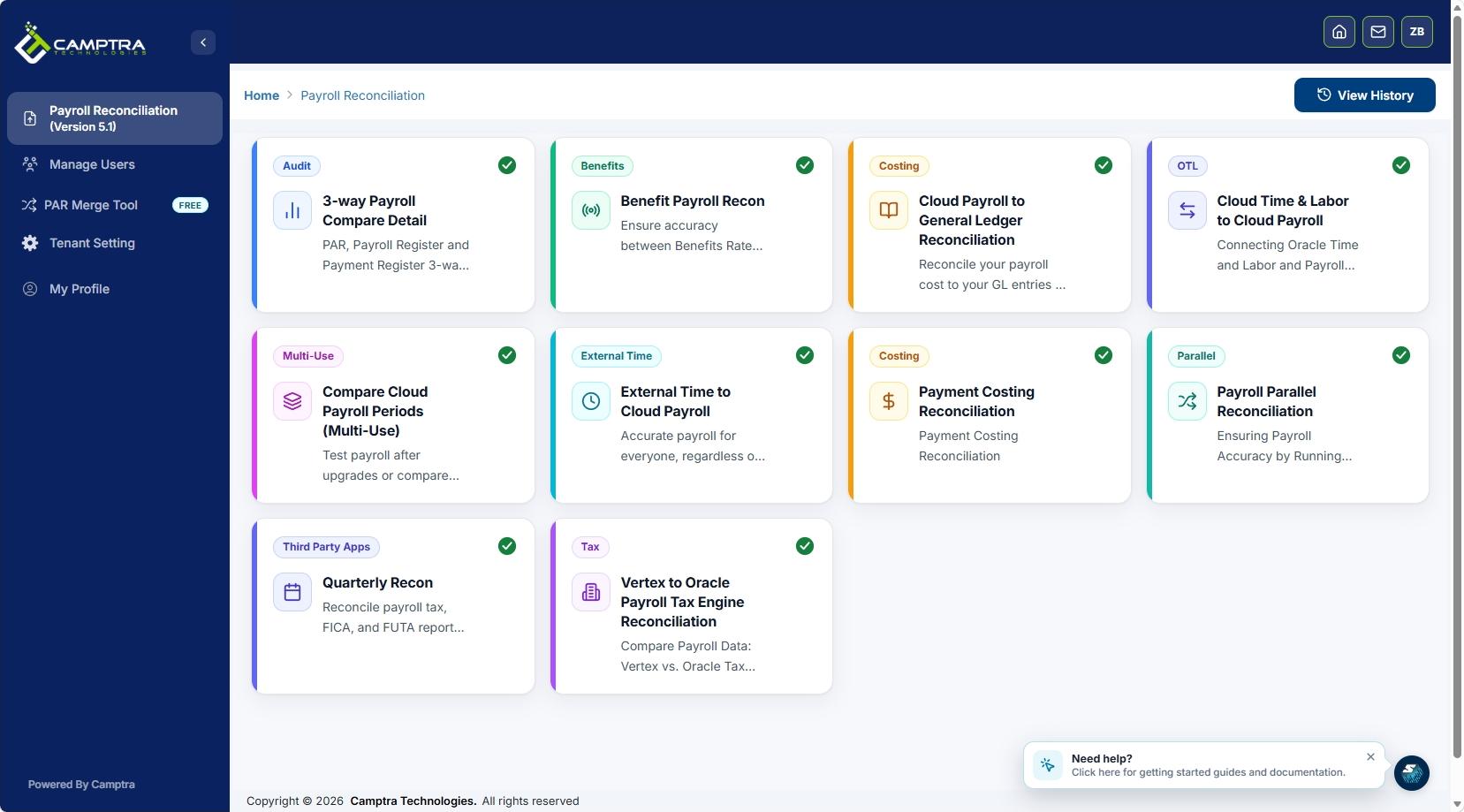
Camptra Technologies closes that gap with the Payroll Recon Toolset, purpose-built for Oracle Cloud Payroll teams that need to reconcile millions of records across payroll, benefits, costing, tax, and GL in a single workflow. The tool automates tie-outs, standardizes variance investigation, and generates audit-ready evidence exports without requiring teams to build and maintain complex spreadsheet models. For a healthcare system running Oracle and UKG payroll, eliminating 32-hour manual audit cycles was the direct outcome. For a 105,000-employee healthcare network, it meant the earliest financial close the organization had ever achieved.
If your team is evaluating whether an enterprise reconciliation tool fits your environment, the Camptra case studies show the outcomes in detail. If you are ready to see the tool against your own data, request sandbox access and run a pilot on a single entity before committing to a full deployment.
Authoritative sources and further reading
- NetSuite: Payroll Reconciliation Guidance: Covers cadence, materiality threshold recommendations, and the per-pay-period, quarterly, and annual reconciliation horizons. Useful for establishing your threshold policy and close cadence.
- Nebraska DAS: Reconciling the General Ledger to Your Payroll Register: A practical government-published example of the basic register-to-GL tie-out structure. Use it to validate your workpaper format against a real-world reference.
- Oracle Cloud Payroll: Payroll Run Analyst: The primary Oracle documentation for run-level variance detection. Use it to configure run-level validation before archiving.
- Oracle Cloud Payroll: Payroll Variance Report: Documents the report parameters for comparing balance values between runs and configuring variance thresholds. Essential for Oracle Cloud Payroll teams setting up automated exception detection.
- Oracle Cloud Payroll: Payment Reconciliation Setup: Covers GL account mirroring and reconciliation differences accounts for bank-vs-payment-file discrepancy tracking. Apply this before configuring your bank tie-out workflow.
- HRDecisionGuide: Payroll Accounting Reconciliation Operating Model: The source for the tie-out ladder and control matrix framework. Use it to build your reconciliation operating model from the ground up.
- HRDecisionGuide: Variance Investigation Playbook: Covers the six root-cause families and the time-boxed triage method. Use it to build your variance memo template and investigation runbook.
- Kurums: Payroll Reconciliation and Controls: Practical guidance on segregation of duties, approval workflows, and fraud-detection controls. Use it to design your control matrix and master-file audit cadence.
- Camptra Technologies: Payroll Recon Toolset: Product documentation and capability overview for Oracle Cloud Payroll teams evaluating enterprise reconciliation automation.
Keep US jurisdiction and federal filing context in view when applying any of these sources. Form 941 quarterly filing requirements, W-2 and W-3 annual validation, and FUTA/SUTA reconciliation are US-specific obligations that shape the quarterly and annual reconciliation cadence described throughout this article.
FAQ
What is the recommended materiality threshold for payroll-to-GL reconciliation?
The standard recommendation is $0.01 per item for investigation purposes. In SOX 404 environments, configure thresholds to match your worker population and control requirements rather than relying on system defaults.
How often should payroll-to-GL reconciliation run?
Reconciliation runs at four cadences: per-pay-period (register to bank and GL), monthly close (liability rollforwards and consolidated JE review), quarterly (Form 941 tie-out), and annually (W-2/W-3 validation).
What are the six root-cause families for payroll variances?
Timing differences, mapping drift, population differences, gross-to-net composition changes, corrections and reversals, and manual reclasses account for the large majority of payroll-to-GL variances, according to the HRDecisionGuide variance investigation playbook.
How does Camptra Technologies reduce reconciliation time?
Camptra’s Payroll Recon Toolset automates tie-outs across payroll, benefits, costing, tax, and GL within Oracle Cloud Payroll environments. Customers have reported significant reconciliation time reductions, replacing multi-hour manual reviews with automated exception surfacing and audit-ready evidence exports.
What evidence do auditors expect from a payroll-to-GL reconciliation?
Auditors expect a signed reconciliation summary, the payroll register tied to the posted JE and bank settlement, a liability rollforward schedule, and a variance memo for every item above the materiality threshold, all retained in an accessible close pack with consistent file naming.
