

Most financial errors that surface in your general ledger, tax filings, or audit findings did not start in the payroll engine. They started upstream, in the systems that feed payroll: time and attendance, Core HR, benefits administration, and workforce management. Payroll is where the damage becomes visible, not where it begins. Enterprise payroll accuracy averages around 80%, and most errors traced back to upstream systems such as time capture, Core HR, and benefits administration, rather than to calculation faults. Understanding why financial errors originate in payroll means understanding the data architecture that surrounds it.
The three immediate causes to inspect first: disconnected systems with no enforced system-of-record, manual data entry and spreadsheet-based corrections that bypass source systems, and inconsistent exception triage that lets the same error recur without a documented fix.
Before the next cutoff, take these steps:
- Stop fixing upstream data inside payroll. Correct time, identity, and benefits data at the source system, then re-process.
- Log every exception at the front door: who flagged it, what it is, and the decision made. No undocumented fixes.
- Enforce a single source of truth for employee identity, tax elections, and deduction values. Resolve conflicts between HCM and payroll before the archive run.
- Run a pre-cutoff variance report comparing this period’s Gross Pay and Net Pay to the prior period. Investigate anything outside your defined tolerance band.
- Assign ownership for each exception class. If no one owns it, it will recur.
Table of Contents
- What are payroll-originated financial errors?
- Common payroll error types and their downstream impact
- Why financial errors originate in payroll: the upstream mechanisms
- What does it cost when payroll errors reach finance and audit?
- How do you detect, investigate, and correct payroll errors?
- How do you prevent payroll errors at scale?
- How long does it take to detect and correct payroll errors?
- Controls checklist and KPIs to reduce payroll leakage
- How automated reconciliation reduces downstream financial errors
- Key Takeaways
- The prevention gap is a budget and governance problem
- Camptra’s Payroll Recon Toolset for Oracle Cloud teams
- Useful sources and further reading
- FAQ
What are payroll-originated financial errors?
A payroll-originated financial error is any mistake that enters the financial record because incorrect data was processed through payroll, regardless of where that data was created. The error class is defined by its entry point into accounting, not by where the bad data was born.
The input error chain typically looks like this: a wrong value enters a source system (time capture, Core HR, or benefits admin), that value flows into the payroll calculation, and the resulting pay, deduction, or tax figure posts to the general ledger, tax filing, or accounts payable record. By the time the error appears on a reconciliation report, it has already touched multiple systems and periods.
Payroll-originated financial errors are distinct from general accounting errors precisely because they compound. A single incorrect time entry can produce an overtime miscalculation, a costing variance, a tax withholding shortfall, and a benefits deduction mismatch — all from one upstream data point that was never corrected at its source.
Mapping where a single input error surfaces:
- Payroll register: Incorrect Gross Pay or Net Pay for the affected employee.
- General ledger / costing: Labor cost posts to the wrong cost center, project code, or account.
- Tax filings: Federal and state withholding amounts are understated or overstated; W-2 or 941 figures require amendment.
- Accounts payable: Employer benefit contributions or garnishment remittances are calculated on incorrect base pay.
A concrete example: a time-capture system fails to sync a shift differential rule change on the effective date. Payroll processes the old rate for two pay periods. The result is an overtime retro adjustment in period three, a payroll-to-costing mismatch across all three periods, and a tax withholding variance that requires a correcting journal entry and potentially an amended 941.
Common payroll error types and their downstream impact
Knowing the error class tells you which downstream system to check first and which team will likely discover it.
-
Worker misclassification (employee vs. contractor): Misclassifying a worker as a 1099 contractor instead of a W-2 employee means FICA taxes are never withheld, employer contributions are never posted, and benefits eligibility is wrong. Finance discovers it during a tax audit or benefits reconciliation. Impact: high. Regulatory exposure under IRS and DOL rules can include back taxes, penalties, and interest.
-
Payroll tax withholding errors: Wrong federal or state tax elections, stale W-4 data, or a missed state registration produce under- or over-withholding. The IRS failure-to-deposit penalty applies when employer tax deposits are late or short, starting at 2% for deposits 1–5 days late and scaling to 15% for amounts still unpaid after 10 days following an IRS notice. Discovered by: finance or the employee at year-end. Impact: high.
-
Missed or incorrect deductions: A benefits enrollment change that does not sync to payroll leaves the employee paying the wrong premium or missing a 401(k) contribution. The accounting entry posts an incorrect liability. Discovered by: employee or benefits admin. Impact: medium.
-
Timekeeping errors (missed punches, overtime miscalculation): Manual time and attendance errors can cost 1–8% of total Gross Payroll. Missed punches, unapproved overtime, or a rules-engine misconfiguration produce pay variances and FLSA exposure. The FLSA overtime rules require non-exempt employees to be paid 1.5x their regular rate for hours over 40 in a workweek. Discovered by: employee or manager. Impact: medium to high.
-
Terminated-employee pay issues: Paying a terminated employee after separation, or failing to issue a final check within the state-mandated window, creates both a payroll liability and a potential wage-and-hour violation. Discovered by: HR or finance during headcount reconciliation. Impact: medium.
-
Benefits and deduction mispostings: A deduction posts to the wrong GL account or the wrong benefit plan. The error is invisible in Net Pay but creates a reconciliation variance between payroll and the benefits carrier invoice. Discovered by: finance during monthly close. Impact: medium.
-
Pay-rate miskeys: A manual rate change entered incorrectly in the HCM system flows directly into Gross Pay. Retro corrections require off-cycle processing and correcting journal entries. Discovered by: employee or payroll audit. Impact: medium.
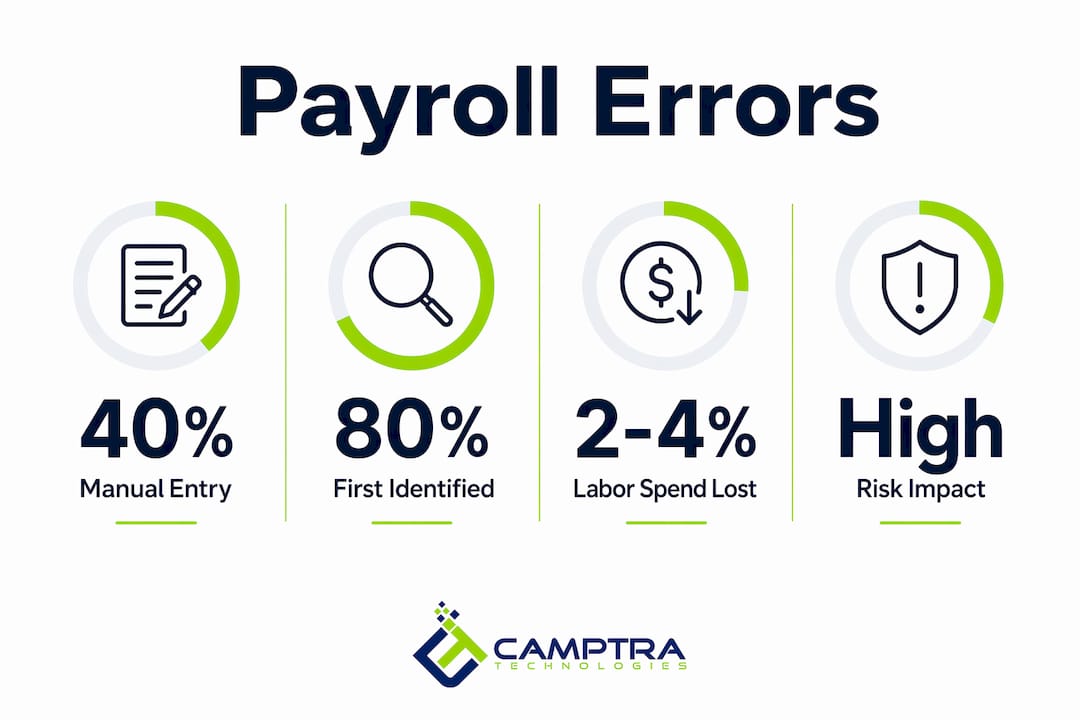
Forty percent of payroll errors originate from manual data entry, and eighty percent of known errors are first identified by employees rather than payroll or finance teams. That discovery gap is itself a control failure.
Why financial errors originate in payroll: the upstream mechanisms
Payroll does not generate most of its own errors. It inherits them. The payroll engine is a consumer and calculator: it takes inputs from Core HR (identity, tax elections, employment status), workforce management or WFM (time, rules, schedules), and benefits administration (deduction values, plan elections), then applies rules to produce pay results. When any upstream system sends wrong data, payroll faithfully calculates the wrong answer.

Data ownership gaps and fractured integrations
A large share of organizations store employee data across multiple, disconnected HCM databases and struggle to share it effectively. When employee data lives in multiple systems with no enforced system-of-record, the same employee can have conflicting tax elections in Core HR and payroll, a different hire date in the benefits system, or a cost-center assignment that has not propagated from HRIS to the costing module. Each conflict is a potential financial error waiting to be processed.
Even with integrations in place, mismatched effective dates or conflicting employee IDs create “shadow” data. A rate change effective on the 15th that arrives in payroll on the 17th produces two periods of incorrect pay and a retro adjustment that must be manually reconciled. Robust identity mapping and effective-date policies are not optional in a multi-system environment; they are the primary defense against this class of error.
Manual entry, spreadsheets, and the correction loop
Forty percent of payroll errors trace back to manual data entry. When payroll administrators key corrections directly into the payroll system rather than fixing the source record, they create a divergence between the system of record and the payroll result. The next integration run may overwrite the manual fix, reinstating the original error. This is the correction loop: fix payroll, integration overwrites, error returns, fix again. Without automated data flows, manual intervention and spreadsheets remain the unavoidable root cause of recurring errors.
Human fatigue under deadline pressure
Payroll administrators managing high volumes of changing data under strict cutoff deadlines experience fatigue that materially increases error risk. A payroll team processing thousands of exceptions in the 48 hours before archive is not in a position to verify every upstream data point. Deadline compression is a structural risk, not a personnel problem.

Inconsistent exception handling
When exceptions are handled ad hoc, without a documented decision and evidence trail, the same error type gets fixed differently by different team members. One administrator corrects the source system; another enters a balance adjustment directly in payroll. Both produce the correct Net Pay for that period, but only one produces a traceable, auditable correction. The other leaves a ghost variance in the reconciliation.
Pro Tip: Implement a “front door” for every exception: log it (what, who, when), assign it (which team owns the fix), and document the decision (correct at source, balance adjustment, or defer). This three-step triage, as outlined in exception handling best practices, produces the trend data you need to eliminate root causes rather than just fix symptoms.
What does it cost when payroll errors reach finance and audit?
The direct cost of a payroll error is rarely just the correction. The full exposure includes labor to investigate and reprocess, off-cycle check issuance, tax penalties, GL reconciliation time, and, in some cases, restatement risk.
Cost components by category:
- Per-correction labor: Identifying, documenting, and reprocessing a single error typically involves payroll, HRIS, and finance staff. Complex retro adjustments can consume hours per incident.
- Off-cycle check issuance: Each off-cycle run carries processing costs and, for direct deposit reversals, potential bank fees and employee friction.
- Tax penalties and interest: IRS failure-to-deposit penalties range from 2% to 15% depending on how late the deposit is. State penalties vary by jurisdiction and can stack independently.
- GL reconciliation and restatement exposure: A payroll error that posts to the wrong period or account requires a correcting journal entry. If the period is closed, the restatement process involves finance, external auditors, and potentially the audit committee.
- Audit remediation: Payroll errors discovered during an internal or external audit require documented root-cause analysis, corrective action plans, and evidence of remediation. Each finding adds hours to the audit cycle.
- Employee churn and morale: Payroll mistakes become people problems as well as financial ones. Employees who experience repeated pay errors lose trust in the organization, and the cost of that trust erosion shows up in turnover.
Organizations lose an estimated 2–4% of total labor spend to payroll leakage. Multi-location employers face multiplied exposure because each jurisdiction enforces penalties independently. For multi-location employers, exposure is multiplied because each jurisdiction enforces penalties independently. A company operating in 15 states with a single timekeeping misconfiguration can face 15 separate penalty calculations, each with its own cure period and interest rate. Inaccurate time records can significantly impact gross payroll costs, and manual timesheet errors may lead to substantial per-employee losses in some industries.
How do you detect, investigate, and correct payroll errors?
A structured correction workflow reduces rework, creates an audit trail, and prevents the same error from recurring in the next pay period.
- Identify and classify the error. Determine whether the error originated in time capture, Core HR, benefits admin, or the payroll engine itself. The origin determines where the fix must happen.
- Record evidence before touching anything. Document the before state: the incorrect value, the system it lives in, the employee(s) affected, the pay period(s) impacted, and who identified it. This is your audit anchor.
- Correct at the source system where possible. If the error is in a time record, fix it in the WFM system and re-interface. If it is a tax election, update it in Core HR. Fixing only in payroll without correcting the source guarantees recurrence.
- Process the correction. If the cutoff has passed, determine whether an off-cycle run is required or whether a retro adjustment in the next regular cycle is appropriate. Consider employee impact, regulatory requirements (e.g., state final-pay rules), and cost.
- Adjust the accounting entries. Post a correcting journal entry to reverse the incorrect GL posting and record the correct one. If the original period is closed, use a prior-period adjustment and document the materiality assessment.
- Communicate. Notify the employee with a clear explanation of what changed and why. Notify the manager if the error affected labor cost reporting. Document the communication for the audit file.
- Close the exception. Update the exception log with the resolution, the effective date, and the approver. Retain the before/after tie-out as minimum evidence.
Triage matrix: where to fix the error
| Error type | Time to cutoff | Fix location | Accounting action |
|---|---|---|---|
| Time capture error | > 2 days | WFM system, re-interface | None if caught pre-archive |
| Time capture error | < 2 days | Balance adjustment in payroll | Correcting JE if period closes |
| Tax election mismatch | Any | Core HR, re-sync | Correcting JE + amended filing if needed |
| Benefits deduction error | > 2 days | Benefits admin, re-interface | None if caught pre-archive |
| Benefits deduction error | < 2 days | Manual adjustment in payroll | Correcting JE; notify carrier |
| Rate/pay-rate miskey | Any | HCM system, re-sync | Retro adjustment + correcting JE |
| Terminated-employee pay | Post-separation | Off-cycle reversal | Reverse GL posting; document |
For payroll correction documentation, retain at minimum: the change description, the requester, the approver, the effective date, the impacted payroll runs, and a before/after tie-out. Without this evidence set, teams repeatedly fix pay without fixing the system.
How do you prevent payroll errors at scale?
Prevention is an architecture problem before it is an operations problem. The controls that matter most are the ones that stop bad data from reaching payroll in the first place.
Pre-cutoff validation gates
- Require manager approval for all time records before the payroll interface runs.
- Run automated variance reports comparing current-period Gross Pay to prior-period by employee, department, and cost center. Flag anything outside a defined tolerance (typically 5–10%).
- Validate that all new hires, terminations, and rate changes in Core HR have a corresponding payroll record update before the archive run.
- Check benefits deduction totals against the carrier invoice before the GL posts.
Integration and architecture best practices
Adopt a composable payroll value chain: each system owns its data, and payroll consumes it via monitored API integrations rather than manual file transfers or spreadsheet uploads. Automating overtime calculation at the time-capture layer prevents the most common and costly timekeeping errors before they ever reach payroll. Apply rules engines at time capture so that overtime, differentials, and scheduling rules are enforced at the point of entry, not corrected after the fact in payroll. Monitor every interface for failures, delays, and data-quality exceptions. A silent interface failure is worse than a visible one.
Exception management at scale
Implement a front-door exception log as a standing operational process, not a one-time fix. Every exception gets logged, assigned, and resolved with a documented decision. Standardize triage decisions: hold (do not process until resolved), defer (process this period, correct next), or correct (fix at source before cutoff). Retain minimum evidence for every correction. Teams that skip this step find themselves explaining the same variance to auditors year after year.
Pro Tip: Prioritize prevention investments by employer type. Hourly, high-turnover workforces get the fastest payback from automated time capture and rules-engine enforcement. Multi-jurisdiction employers should prioritize tax-election validation and state-specific compliance checks. Benefits-heavy organizations should focus on benefits-to-payroll interface monitoring and carrier invoice reconciliation.
KPIs to track payroll accuracy over time
| KPI | Formula | Owner | Frequency |
|---|---|---|---|
| Exception rate | Exceptions / total payroll transactions | Payroll operations | Per pay period |
| Corrections per pay period | Count of post-archive corrections | Payroll operations | Per pay period |
| Average correction cost | Total correction labor + off-cycle cost / corrections | Finance | Monthly |
| Reconciliation coverage | Accounts reconciled / total payroll GL accounts | Finance | Monthly close |
| Time-to-detect | Days from error occurrence to identification | Payroll / audit | Quarterly review |
| Off-cycle run rate | Off-cycle runs / total pay cycles | Payroll operations | Monthly |
Financial data integration challenges are a significant driver of reconciliation failures. Tracking interface error rates alongside payroll KPIs gives you early warning before errors compound across periods.
How long does it take to detect and correct payroll errors?
Detection and correction timelines vary significantly by error class. Setting realistic expectations helps teams allocate resources and prioritize controls.
-
Time-capture errors: Typically detected within 1–3 pay periods if variance reporting is in place; without it, they can persist for quarters. Correction requires a retro adjustment and, if multiple periods are affected, a multi-period correcting journal entry. Time-to-correct: 1–5 business days for a straightforward retro; longer if the WFM system requires a configuration change.
-
Tax withholding errors: Often not detected until quarterly 941 reconciliation or year-end W-2 preparation, meaning a January error may not surface until March or October. Correction requires amended filings and, if the IRS has already assessed a penalty, a penalty abatement request. Time-to-correct: 2–6 weeks including filing cycles.
-
Benefits deduction mismatches: Detected during monthly carrier invoice reconciliation if that process is running. Without it, mismatches can persist for the full plan year. Time-to-correct: 1–3 pay periods to sync systems and true up deductions.
-
Misclassification errors: Often not detected until an IRS audit, a DOL wage-and-hour investigation, or a worker complaint. Time-to-correct: months to years, including back-tax calculations, amended filings, and potential litigation.
Cost drivers that most influence total exposure:
- Frequency of errors per pay period (volume multiplier)
- Number of employees affected per error (scale multiplier)
- Jurisdictional complexity (each state adds independent penalty exposure)
- Off-cycle payment volume (direct processing and bank costs)
- Audit and regulatory exposure (legal, filing, and remediation costs)
For a rough exposure estimate: multiply your average correction labor cost by your corrections-per-period count, add off-cycle processing costs, and apply a 2–4% leakage factor to total labor spend as a ceiling check. If your actual correction cost exceeds the leakage floor, you have a measurable case for prevention investment.
Controls checklist and KPIs to reduce payroll leakage
Organize your controls across three stages. Each stage has a different owner and a different failure mode.
Pre-payroll controls
| Control | What to validate | Owner |
|---|---|---|
| Time record completeness | All employees have approved time for the period | WFM / manager |
| New hire / termination sync | HCM changes reflected in payroll before interface | HRIS |
| Benefits deduction values | Current-period deductions match enrollment records | Benefits admin |
| Tax election currency | W-4 and state withholding elections are current | Payroll |
| Rate change verification | All approved rate changes have effective dates in payroll | HRIS / payroll |
Payroll processing controls
| Control | What to validate | Owner |
|---|---|---|
| Gross Pay variance | Current vs. prior period by department (tolerance: 5–10%) | Payroll operations |
| Headcount reconciliation | Active employee count matches HCM headcount | Payroll / HRIS |
| Deduction totals | Total deductions reconcile to benefits and garnishment records | Payroll |
| Tax deposit calculation | Calculated tax liability matches expected deposit amount | Payroll / finance |
Post-payroll controls
| Control | What to validate | Owner |
|---|---|---|
| GL tie-out | Payroll journal entry totals match payroll register | Finance |
| Costing reconciliation | Labor costs post to correct cost centers and projects | Finance / payroll |
| Carrier invoice match | Benefits deductions remitted match carrier invoices | Benefits / finance |
| Exception log closure | All open exceptions from prior period are resolved or deferred with documentation | Payroll operations |
Quick wins (implement within 30 days): automated Gross Pay variance reporting, a front-door exception log, and a pre-cutoff headcount reconciliation. Long-term investments: API-based integrations replacing file transfers, rules-engine enforcement at time capture, and a monthly payroll steering review with HRIS, finance, and payroll represented.
How automated reconciliation reduces downstream financial errors
The controls described above work. They work faster and more reliably when the data preparation is automated rather than manual. The core reconciliation approach is straightforward: ingest payroll, time, benefits, costing, and GL data into a single environment; match records at scale; surface exceptions before the archive run; and automate the journal tie-out so finance does not spend close week rebuilding the same spreadsheet.
Camptra Technologies built the Payroll Recon Toolset specifically for this workflow in Oracle Cloud Payroll environments. The tool connects payroll-impacting data across time and attendance, benefits, costing, tax, and GL processes, then reconciles millions of records in minutes rather than hours. Exceptions surface pre-cutoff, where they are cheapest to fix, rather than post-archive, where corrections require off-cycle runs and correcting journal entries.
Camptra’s customers have reported reconciliation time reductions of up to 80%. For a team that previously spent two days preparing data for a manual review, that reduction means the same review happens in hours, with more coverage and a documented exception trail that holds up in an audit.
The operational outcomes from this approach are consistent across enterprise deployments: fewer off-cycle corrections because exceptions are caught before archive, stronger audit evidence because every variance has a logged decision, and a faster financial close because the GL tie-out is automated rather than manual. For a healthcare network managing 105,000 employees, automated reconciliation produced measurable reductions in payroll audit time and the organization’s earliest financial close on record.
The payroll-to-costing reconciliation piece is where many enterprise teams still rely on spreadsheets. Automating that tie-out removes the single largest manual step in the post-payroll close and produces the audit evidence that finance and external auditors need without a week of data preparation.
Key Takeaways
Payroll-originated financial errors are fundamentally a data-architecture problem: fixing them requires correcting upstream systems, not just payroll outputs.
| Point | Details |
|---|---|
| Errors start upstream | Enterprise payroll accuracy averages around 80%, and most errors traced back to upstream systems such as time capture, Core HR, and benefits administration, rather than to calculation faults. |
| Manual entry is the top cause | Forty percent of payroll errors trace back to manual data entry; fix at the source system, not inside payroll. |
| Cost compounds quickly | Organizations lose an estimated 2–4% of total labor spend to payroll leakage; multi-jurisdiction employers face multiplied penalty exposure. |
| Exception triage is the control lever | A front-door exception log (log, assign, decide) prevents inconsistent fixes and produces the trend data needed to eliminate root causes. |
| Camptra Technologies | Camptra’s Payroll Recon Toolset automates reconciliation for Oracle Cloud Payroll teams, with customers reporting up to 80% reductions in reconciliation time. |
The prevention gap is a budget and governance problem
Most payroll teams know exactly what is causing their recurring errors. They can name the integration that drops records, the spreadsheet that gets manually keyed every period, the exception that gets fixed differently by different administrators. The knowledge is not the gap. The budget and governance to fix it are.
Prevention investments get deprioritized for a predictable set of reasons. Payroll errors feel like operational noise rather than financial risk until an audit finding or a regulatory penalty makes the cost visible. Budget cycles reward projects with clear ROI, and “we will have fewer off-cycle runs” is harder to sell than a new feature. Ownership is distributed: the time-capture problem belongs to IT or operations, the integration failure belongs to HRIS, and the GL variance belongs to finance. Payroll sits in the middle, fixing symptoms from all directions without authority over any of the sources.
The governance fix is a cross-functional payroll steering committee with representation from payroll, HRIS, finance, and IT, meeting monthly to review exception trends, assign root-cause owners, and track KPI progress. This is not a large investment. It is a standing agenda item and a shared dashboard. What it produces is accountability: when the exception rate for time-capture errors is on a shared report, the WFM team has a reason to fix the rules engine rather than wait for payroll to work around it.
The business case is straightforward. If your organization spends $500,000 annually on payroll correction labor, off-cycle processing, and reconciliation rework, and a prevention investment reduces that by half, the payback period on most tooling and integration projects is under 12 months. The harder argument is getting leadership to see payroll accuracy as a data-architecture problem that requires a capital investment, not an operations problem that requires more headcount. HR and payroll collaboration at the governance level is what makes that reframe possible.
Camptra’s Payroll Recon Toolset for Oracle Cloud teams
If your team is managing high-volume payroll in Oracle Cloud and still relying on spreadsheet-heavy reviews to catch variances before cutoff, the gap between what you can see and what is actually in the data is where financial errors live. Camptra Technologies closes that gap with the Payroll Recon Toolset, purpose-built for Oracle Cloud Payroll environments.
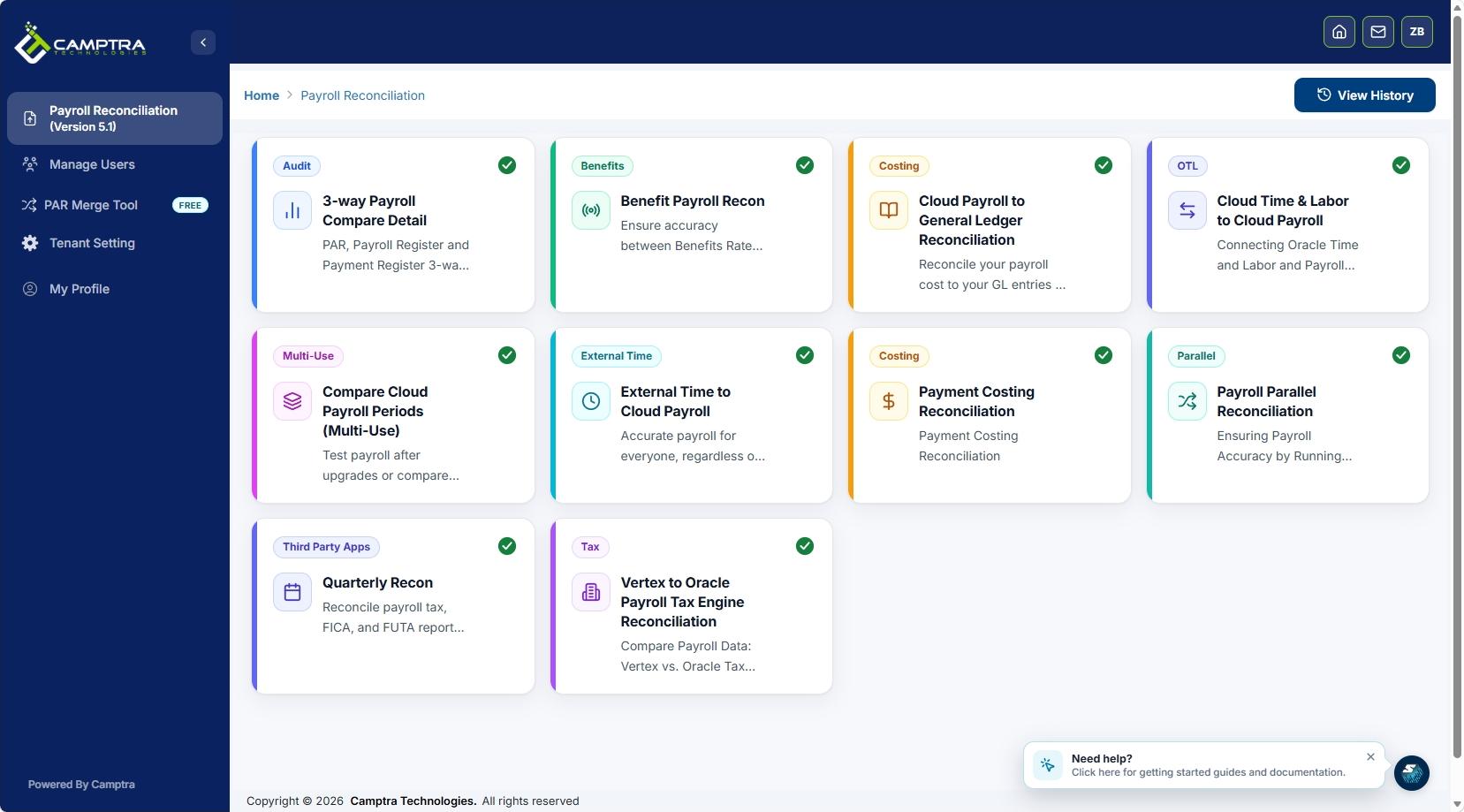
The tool ingests data across time and attendance, payroll, benefits, costing, tax, and GL, then reconciles millions of records in minutes and surfaces exceptions pre-cutoff, where they cost the least to fix. Customers have reported reconciliation time reductions of up to 80%. For teams preparing for audit or working toward a faster financial close, that time savings translates directly into earlier close dates and a stronger evidence trail. You can review real deployment outcomes across healthcare, nonprofit, and enterprise environments in Camptra’s case study library.
The fastest way to evaluate fit is a hands-on trial. Request sandbox access to run the Payroll Recon Toolset against your own data, or schedule a demo to see the exception-surfacing and reconciliation workflows in a guided session.
Useful sources and further reading
These sources support the claims in this article and provide authoritative guidance for audit evidence, implementation planning, and regulatory compliance.
- IRS Failure-to-Deposit Penalty: Official IRS guidance on penalty rates and cure periods for late or short payroll tax deposits.
- DOL FLSA Overtime Rules: Department of Labor elaws advisor on FLSA overtime requirements for non-exempt employees.
- DOL Overtime Overview: WHD overview of federal overtime requirements and enforcement.
- DOL State Minimum Wage Laws: Current state-by-state minimum wage table for multi-jurisdiction compliance.
- IRS Publication 525: Taxable and Nontaxable Income: IRS guidance on taxable compensation, fringe benefits, and reporting requirements.
- Employer.gov: Federal resource for employer compliance guidance across wage, hour, and benefits requirements.
- Payroll Errors: Why Data Architecture Is the Real Problem: Industry analysis of upstream error origins and the case for treating payroll accuracy as a data-architecture problem.
- Payroll Exception Handling SOP: Operational guidance on front-door exception triage, evidence retention, and corrective decision documentation.
- Camptra Case Studies: Enterprise deployment outcomes for automated Oracle Cloud Payroll reconciliation, including healthcare and nonprofit environments.
- Camptra: Oracle Cloud Benefits Payroll Reconciliation Tool: Technical rationale and use cases for automated benefits-to-payroll reconciliation.
This article provides general informational guidance on payroll accuracy and financial controls. It is not legal, tax, or accounting advice. Confirm current regulatory requirements with the IRS, DOL, or a qualified professional for your specific situation.
FAQ
What causes most payroll errors?
Forty percent of payroll errors trace back to manual data entry; eighty percent of known errors are first discovered by employees. The remainder arise in disconnected upstream systems in time capture, Core HR, and benefits administration. The payroll engine itself is rarely the source.
Who is responsible for payroll mistakes?
Responsibility is distributed: HRIS owns identity and tax data, workforce management owns time records, benefits administration owns deduction values, and payroll owns the calculation and archive. When errors occur, the owning team for the source system is responsible for the correction at that source.
How does payroll affect financial statements?
Payroll errors post directly to the general ledger through the payroll journal entry, affecting labor cost accounts, tax liability accounts, and benefits payable. Uncorrected errors can misstate period expenses, require prior-period adjustments, and create restatement risk if material.
How long does an employer have to correct a payroll mistake?
Federal law does not set a single universal deadline, but state wage-and-hour laws often require correction within one or two pay periods. For tax withholding errors, the IRS allows corrections on the same-quarter 941 without penalty; corrections after the quarter require an amended 941-X. Consult the DOL and your state labor agency for jurisdiction-specific requirements.
How does automated reconciliation reduce payroll-originated financial errors?
Automated reconciliation tools like Camptra’s Payroll Recon Toolset ingest data from time, benefits, costing, and GL systems, match records at scale, and surface exceptions before the payroll archive runs. Catching variances pre-cutoff eliminates the off-cycle corrections and correcting journal entries that drive most of the downstream financial error cost.
