

The best Oracle Cloud Payroll compliance approach for US enterprises combines automated Legislative Data Updates, Vertex-powered tax calculations, and continuous parallel reconciliation across time and attendance, benefits, and the general ledger, with a documented owner for every control.
Three components are non-negotiable:
- Automated legislative and tax update handling: Oracle’s monthly on-cycle and off-cycle Legislative Data Updates, paired with Vertex for federal, state, and local tax routines, keep wage and withholding calculations current without manual intervention.
- Parallel reconciliation across all payroll-impacting data: Reconciling time and attendance, payroll register, benefits, costing, and GL before cutoff catches variances before they reach Form 941 filings or financial close.
- Assigned owners and a system-generated audit trail: Every control, from legislative update sign-off to quarter-end reconciliation, needs a named owner and documented evidence.
Customers who automate this workflow have reported significant reductions in reconciliation time, which frees payroll teams to focus on exception resolution rather than data preparation.
Table of Contents
- What failure modes most often break Oracle Payroll compliance?
- What does a mandatory Oracle Payroll compliance program include?
- How do you manage Oracle configuration and legislative data updates?
- How should you structure enterprise reconciliation to minimize errors?
- How do you implement and test legislative updates safely?
- What should you look for in a payroll reconciliation tool for Oracle?
- Key Takeaways
- The gap between “configured correctly” and “compliant continuously”
- Camptra’s Payroll Recon Toolset cuts reconciliation time for Oracle teams
- Useful sources
- FAQ
What failure modes most often break Oracle Payroll compliance?
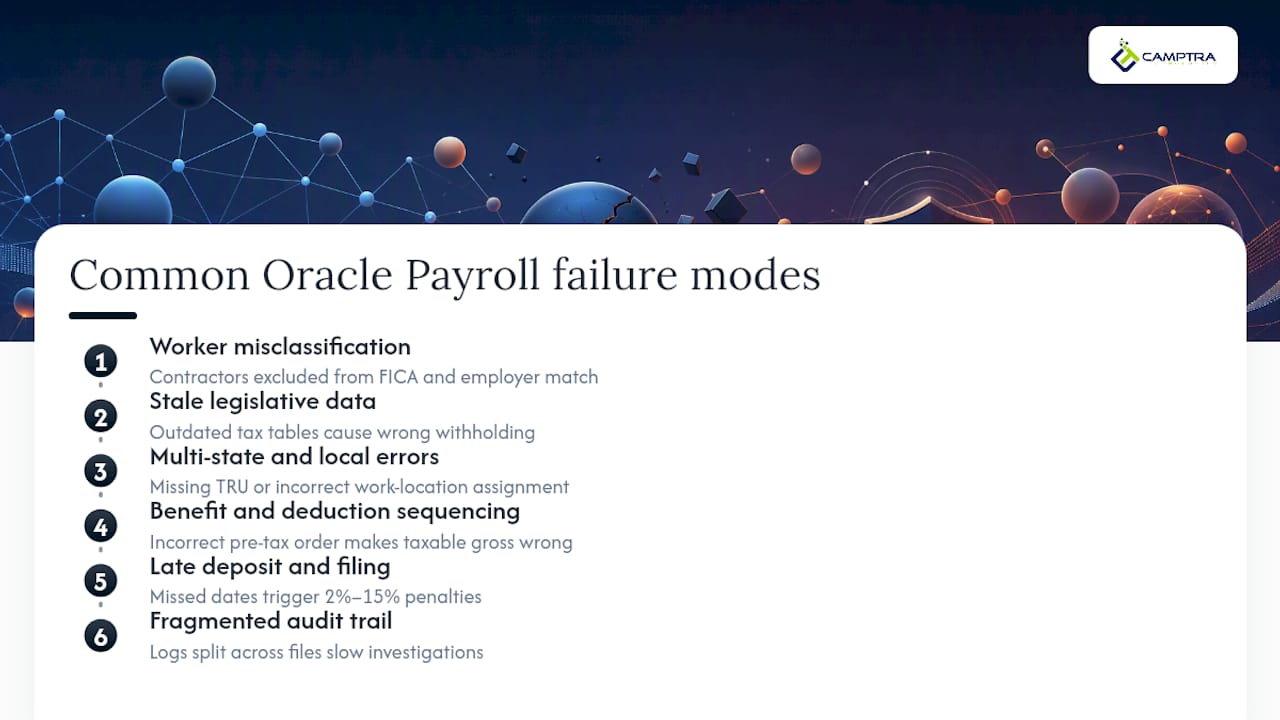
Six root causes account for the majority of compliance breakdowns in enterprise Oracle Cloud Payroll environments.
Worker misclassification is the most expensive. When employees are coded as independent contractors at the Legal Employer or Payroll Relationship level, Oracle excludes them from FICA withholding and employer tax matching. The IRS can assess back taxes, interest, and penalties going back three years.
Stale legislative data is the second most common trigger. Oracle releases planned monthly on-cycle updates and unplanned off-cycle fixes; teams that defer or skip updates without a documented rationale run calculations on outdated tax tables. The consequence is systematic under- or over-withholding that surfaces at W-2 time.
Multi-state and local withholding errors compound quickly in distributed workforces. Oracle calculates state and local taxes at the Tax Reporting Unit (TRU) level; a missing TRU registration or an incorrect work-location assignment produces the wrong withholding for every affected employee in every pay period.
Benefit and deduction sequencing errors occur when pre-tax deductions (Section 125, HSA, 401(k)) are ordered incorrectly in the element entry priority stack. The result is taxable wages calculated on the wrong gross, which cascades into incorrect employer tax liabilities and W-2 Box 1 amounts.
Late deposit and filing carries automatic penalties. Form 941 is due April 30, July 31, October 31, and January 31; a deposit shortfall or a missed filing date triggers a failure-to-deposit penalty that starts at 2% and scales to 15% depending on how late the deposit arrives.
Fragmented audit trail is the failure mode that turns a manageable error into a prolonged IRS or DOL inquiry. When run history, balance adjustments, and reconciliation outputs live in separate spreadsheets rather than a single system-generated log, reconstructing what happened and when becomes a weeks-long project.
Pro Tip: Set up Oracle’s predefined Legislative Data Update alerts so your team receives a notification the moment an update runs or fails. That single control creates a timestamped log entry and eliminates the “we didn’t know it failed” defense during an audit.
What does a mandatory Oracle Payroll compliance program include?
Payroll compliance best practices require automated tax updates, jurisdiction-specific calculations, integrated filing workflows, and exception detection with audit trails. For Oracle Cloud Payroll, those principles map to five operational requirements.
- Employee classification policy: — Maintain a written classification standard and map it to Oracle’s worker type and payroll relationship attributes. Review the policy whenever a new worker category is onboarded.
- Recordkeeping and audit trail: — Preserve run history, balance adjustment logs, and reconciliation outputs in exportable, audit-ready formats. The DOL requires payroll records for at least three years; the IRS recommends four.
Pro Tip: Build a one-page control matrix that maps each compliance requirement to its Oracle screen, the owner’s role, the evidence produced, and the review frequency. Hand it to your auditor at the start of any inquiry and you cut the information-gathering phase by days.
How do you manage Oracle configuration and legislative data updates?
The three Oracle controls that most directly affect tax accuracy are Legislative Data Updates, the LDG/PSU/TRU enterprise structure, and Vertex integration.
Oracle’s Legislative Data Updates guide documents the full workflow: filtering available updates, running them via the Run Now action, opting out or deferring with a documented reason, and the two functional security privileges required: PAY_MANAGE_PAYROLL_LEGISLATIVE_UPDATES_PRIV to run updates and PAY_VIEW_PAYROLL_LEGISLATIVE_UPDATES to review them. Assign these privileges deliberately; they should not sit with the same person who approves payroll.
- Validate Vertex tax code adoption after each update. Oracle Payroll integrates Vertex for federal, state, and local calculations; confirm that new Vertex tax codes are active at the GRE level before the next live payroll run.
- Verify LDG and PSU alignment. Implementing Global Payroll requires that each Legal Data Group partitions payroll data by country and that each Payroll Statutory Unit maps correctly to the legal entities filing payroll taxes. A misaligned PSU produces incorrect statutory reporting.
Pro Tip: Use Oracle’s run history log as your audit evidence. Export it after every Legislative Data Update cycle and store it alongside your Form 941 workpapers. A timestamped, system-generated record of what ran and when is far more defensible than a spreadsheet note.
How should you structure enterprise reconciliation to minimize errors?
Parallel validation running before payroll cutoff is the single most effective control for catching errors before they reach filings or financial close. The table below maps each reconciliation dimension to its validation check and expected output.
| Dimension | Validation Check | Expected Output |
|---|---|---|
| Time & Attendance | Hours and earnings match payroll register | Zero unresolved variances before archive |
| Payroll Register | Gross Pay, deductions, Net Pay tie to prior period + changes | Signed-off register with exception log |
| Benefits & Deductions | Pre-tax deduction amounts match benefits system feed | Reconciled deduction report, no sequencing gaps |
| Tax Withholdings | Federal, state, local withholdings tie to Vertex calculations | Tax liability report matching 941 deposit schedule |
| GL Costing | Payroll cost distributions match GL journal entries | Balanced costing output, no unallocated amounts |
Run this reconciliation on a daily basis for high-volume populations, weekly for standard cycles, and as a full period-end close before each Form 941 filing. When an exception surfaces, tag it with a root cause category (data entry, feed timing, configuration, classification) and route it to the appropriate owner within 24 hours.
Oracle’s Activity Center and external reconciliation tools work best together: Oracle surfaces the payroll register and run results; a dedicated recon toolset like Camptra’s connects those outputs to time and attendance, benefits, costing, and GL data in a single pass. Camptra’s Payroll Recon Toolset reconciles millions of records in minutes and surfaces exceptions before cutoff, a capability that directly addresses the benefits-to-payroll mismatch that causes the most downstream audit issues.
How do you implement and test legislative updates safely?
A structured rollout prevents a configuration change from corrupting a live pay cycle.
- Rollback protocol: — If the parallel run reveals an unresolvable variance, defer the update using Oracle’s opt-out function, document the deferral reason and planned resolution date, and preserve all test logs. Never delete a failed test run; the attempt itself is audit evidence.
Allow two weeks for sandbox testing, one week for parallel-run validation, and one day for production promotion and sign-off. The minimum evidence to move to production: a signed parallel-run comparison report, a documented exception disposition log, and a stakeholder approval record.
Pro Tip: Review how to identify payroll discrepancies before your next legislative update cycle. Knowing which report to pull and in what order cuts parallel-run review time significantly.
What should you look for in a payroll reconciliation tool for Oracle?
Prioritize tools that automate legislative update mapping, support multi-jurisdiction calculations, integrate natively with Oracle and Vertex, and offer exception detection at scale. The table below maps each selection dimension to what it means operationally.
| Selection Dimension | What to Evaluate | Why It Matters |
|---|---|---|
| Automated legislative/tax update handling | Does the tool ingest Oracle LDU changes and remap tax codes without manual intervention? | Prevents stale-data errors after each Oracle update cycle |
| Multi-jurisdiction support | Can it validate federal, state, and local withholdings simultaneously across all TRUs? | Required for distributed workforces with employees in multiple states |
| Integration depth | Does it connect time & attendance, HRIS, benefits, costing, tax, and GL in a single pass? | Eliminates the need for separate reconciliation workstreams |
| Exception detection & throughput | How many records per minute can it process? What exception categories does it flag? | High-volume payrolls need sub-minute processing to meet cutoff windows |
| Audit-ready reporting | Does it export in formats acceptable to IRS and DOL reviewers (PDF, Excel, structured data)? | Reduces evidence-preparation time during inquiries |
| Implementation & support | Does the vendor provide runbooks, privilege configuration guidance, and parallel-run support? | Determines how quickly your team reaches operational confidence |
When evaluating vendors, request a sample audit export, a documented ingest limit (records per minute), and a runbook for the first parallel-run cycle. A vendor who cannot produce those three artifacts in a pre-sales conversation is unlikely to support a smooth go-live.
Pro Tip: Ask vendors for a Vertex-to-Oracle migration case study as a proof point. That scenario tests integration depth, exception detection, and audit output quality simultaneously, which is the hardest combination to fake in a demo.
Key Takeaways
Oracle Cloud Payroll compliance requires automated Legislative Data Updates, Vertex-powered tax calculations, parallel reconciliation across all payroll data sources, and a documented owner for every control.
| Point | Details |
|---|---|
| Run Legislative Data Updates weekly | Review and apply Oracle’s on-cycle and off-cycle updates in a sandbox before promoting to production. |
| Reconcile before cutoff, not after | Parallel validation across time, benefits, tax, and GL catches errors before they reach Form 941 filings. |
| Assign named owners to every control | Segregation of duties across Payroll Manager, Tax Filing Owner, and IT/Release Owner prevents both errors and fraud. |
| Preserve system-generated audit evidence | Export run history and reconciliation outputs after every cycle; the DOL requires payroll records for at least three years. |
| Camptra Technologies accelerates recon at scale | Camptra’s Payroll Recon Toolset connects Oracle payroll data to time, benefits, costing, and GL, with customers reporting up to 80% reductions in reconciliation time. |
The gap between “configured correctly” and “compliant continuously”
Most Oracle Cloud Payroll implementations are configured correctly at go-live. The compliance risk accumulates afterward, in the space between quarterly Legislative Data Updates, annual benefit renewals, and the steady churn of worker classification changes, new state registrations, and local tax rule amendments.
The teams that maintain compliance without constant firefighting share one trait: they treat reconciliation as a continuous control, not a period-end cleanup. They run parallel validation before every cutoff, not just before audits. They assign a named owner to every Oracle privilege and every filing deadline. And they use tooling that surfaces exceptions in minutes rather than hours, because the window between payroll calculation and cutoff is rarely long enough for a spreadsheet review.
Software reduces manual calculation risk materially. But it does not replace data governance. A tool that flags a variance is only as useful as the process that routes that variance to the right person and closes it before archive. The organizations that get the most out of Oracle Cloud Payroll compliance programs are the ones that pair the technical controls with clear ownership, documented evidence, and a reconciliation cadence that runs whether or not an audit is on the horizon.
Camptra’s Payroll Recon Toolset cuts reconciliation time for Oracle teams
Enterprise payroll teams running Oracle Cloud Payroll at scale need more than a well-configured system. They need a way to validate millions of records across time and attendance, benefits, costing, tax, and GL before cutoff, without rebuilding that process in spreadsheets every pay period.
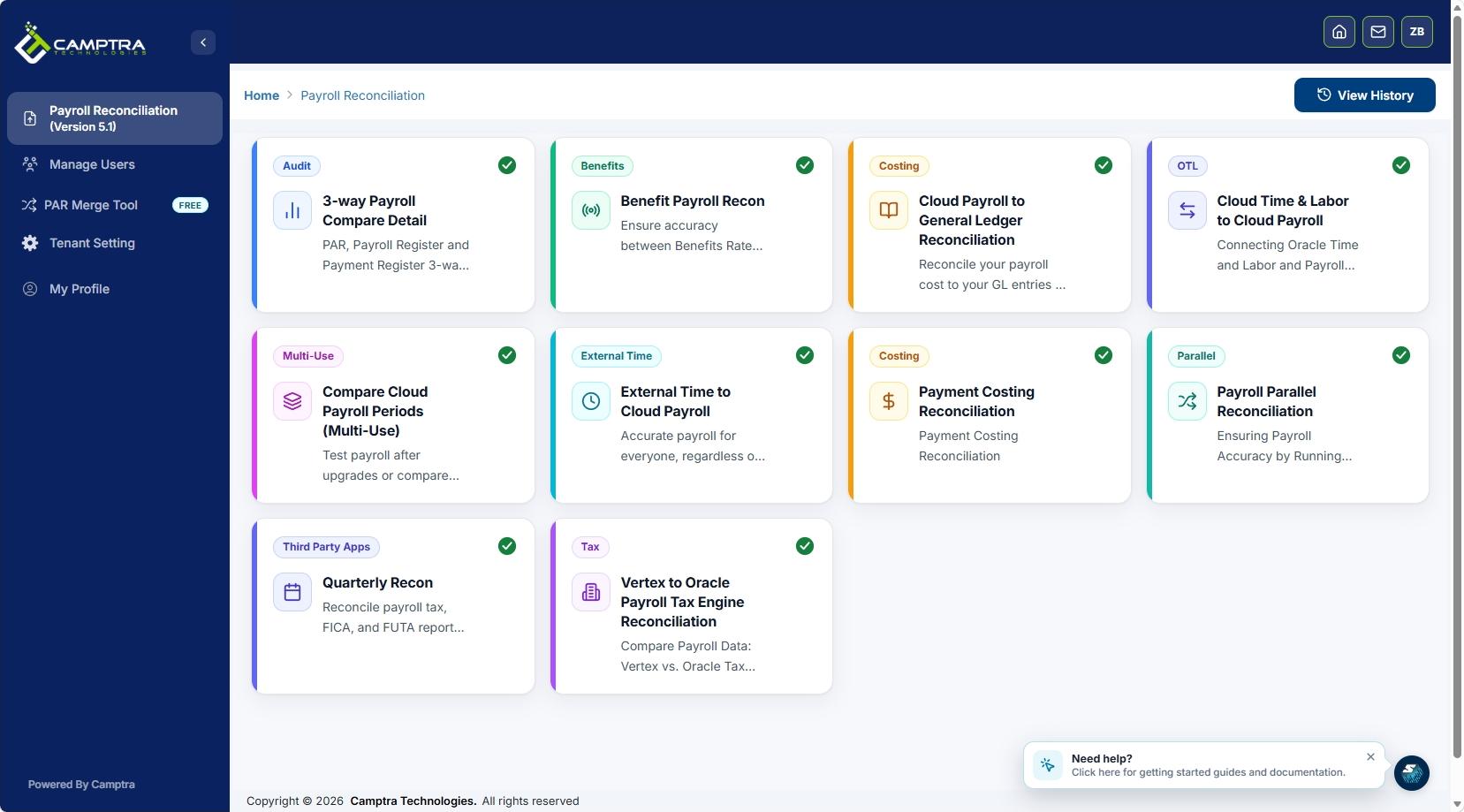
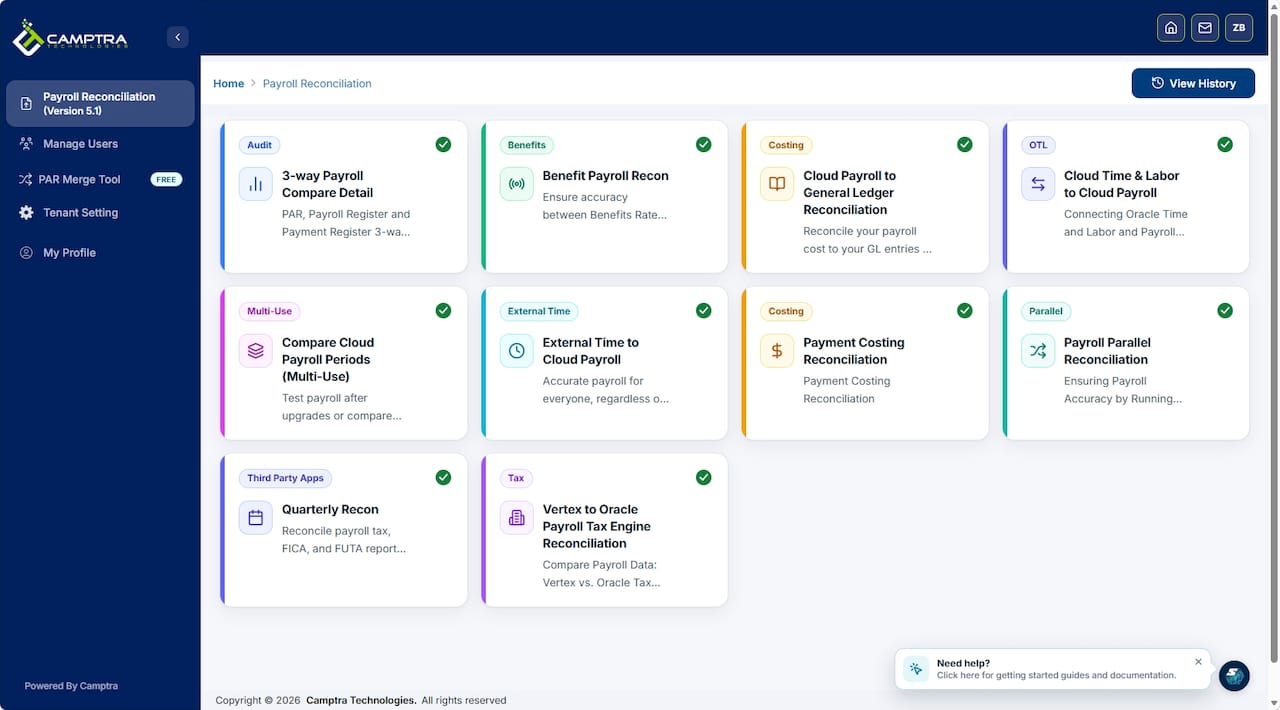
Camptra’s Payroll Recon Toolset is built for exactly that environment. It connects Oracle Cloud HCM payroll data to every upstream and downstream source, runs automated exception detection, and produces audit-ready outputs that satisfy IRS and DOL reviewers. Customers have reported significant reductions in reconciliation time.
- Reconciles millions of records in minutes across all payroll-impacting data sources
- Flags exceptions by category with root-cause tagging before payroll archive
- Produces exportable, audit-ready reports aligned to Form 941 and year-end close requirements
- Supports parallel payroll validation for Oracle upgrades, migrations, and Vertex transitions
See how a healthcare system achieved its earliest financial close using Camptra’s toolset, or request sandbox access to run a proof-of-concept against your own Oracle payroll data.
Useful sources
The following primary references belong in every Oracle Cloud Payroll compliance team’s bookmarks.
- Oracle Cloud Human Resources documentation index
- About Form 941 | Internal Revenue Service
- Payroll compliance best practices | TechRepublic
FAQ
What are the most critical Oracle Payroll compliance controls for US enterprises?
The three highest-impact controls are current Legislative Data Updates, correct LDG/PSU/TRU configuration, and parallel reconciliation across time, benefits, tax, and GL before each payroll cutoff.
How often should you apply Oracle Legislative Data Updates?
Oracle releases planned monthly on-cycle updates and unplanned off-cycle fixes; review available updates weekly and apply them in a sandbox before promoting to production.
What privileges does Oracle require to manage Legislative Data Updates?
Running updates requires PAY_MANAGE_PAYROLL_LEGISLATIVE_UPDATES_PRIV; reviewing update status requires PAY_VIEW_PAYROLL_LEGISLATIVE_UPDATES. Assign these to separate roles to maintain segregation of duties.
How does Camptra Technologies support Oracle Payroll reconciliation?
Camptra’s Payroll Recon Toolset connects Oracle Cloud HCM data to time and attendance, benefits, costing, and GL, reconciles millions of records in minutes, and produces audit-ready outputs. Customers have reported reconciliation time reductions of up to 80%.
When are Form 941 filings due for US employers?
Form 941 is due quarterly: April 30, July 31, October 31, and January 31. Reconcile your payroll register to the 941 before each submission to prevent filing mismatches.
Recommended
- Enterprise Payroll Controls Checklist for Oracle Cloud Teams | Camptra Technologies
- Oracle Payroll Activity Center and Multiuse Reconciliation: A Complementary Approach for Modern Payroll Teams | Camptra Technologies
- Payroll Reconciliation Steps for Oracle Teams: 2026 Guide | Camptra Technologies
- From Uncertainty to Confidence: Why We Built the Oracle Cloud Benefits Payroll Reconciliation Tool | Camptra Technologies
