

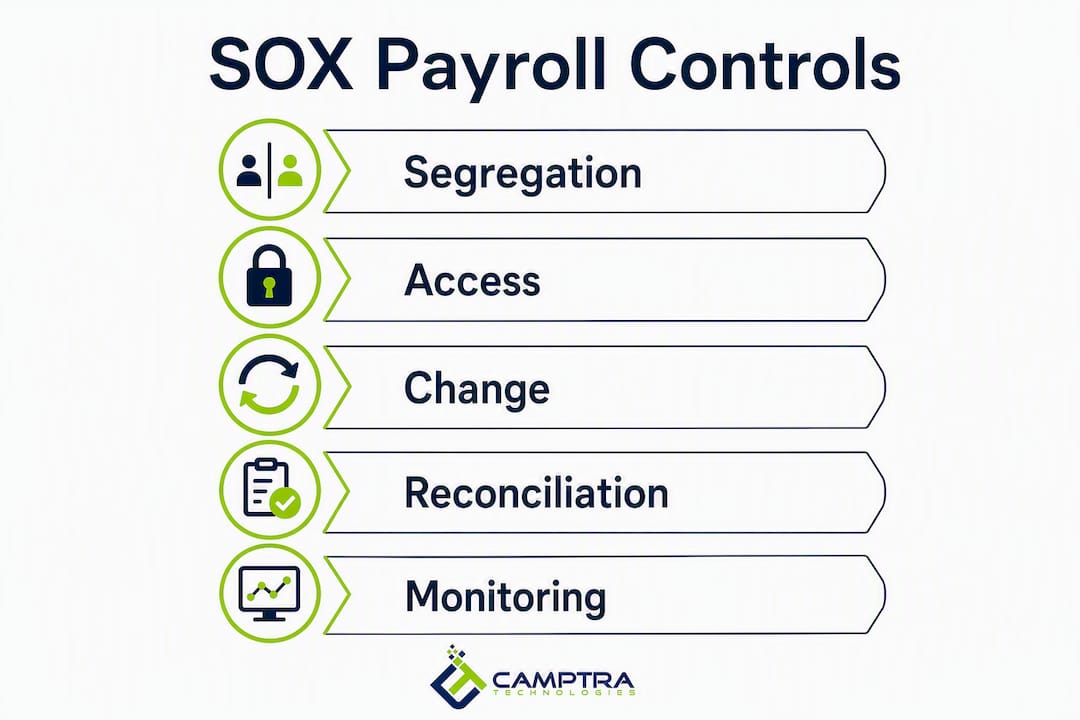
The payroll controls that satisfy SOX are segregation of duties, strict access management, formal change management, and continuous reconciliation. Implement these four pillars first, document proof for every control, and you will cover the ground auditors examine most closely. Everything else in your payroll control environment builds on this foundation.
Your immediate 72-hour action list:
- Pull a current user access report from your payroll system and flag any accounts that belong to terminated employees or users with conflicting roles.
- Run a payroll-to-general-ledger reconciliation for the most recent pay period and save the output with a timestamp.
- Locate signed authorizations for the last three pay-rate changes processed. If any are missing, open a remediation ticket today.
- Request your payroll vendor’s most recent SOC 1 Type II report if you do not already have it on file.
Evidence auditors want to see (TL;DR):
- Signed authorization forms for pay-rate changes, new hires, and terminations
- System-generated audit trails showing who changed what and when
- Payroll-to-HR and payroll-to-GL reconciliation reports, dated and signed off
- Quarterly access review sign-offs with documented approvals
- Vendor SOC 1 Type II report plus your completed User Control Considerations (UCC) mapping
- Bank reconciliation tied to net payroll disbursements
- Change management tickets with approvals, testing evidence, and deployment records
Table of Contents
- What does SOX actually require for payroll?
- What payroll risks create the most SOX exposure?
- What are the essential SOX payroll controls?
- A sample control matrix you can copy
- How do you implement payroll controls: owners, timeline, and costs?
- How do you test payroll controls and what evidence do auditors want?
- What are your SOX responsibilities when payroll is outsourced?
- How does automation reduce SOX payroll risk?
- What are the most common payroll audit findings and how do you fix them?
- Key Takeaways
- Why payroll, finance, and audit need to own SOX controls together
- Camptra Technologies helps you close the reconciliation gap
- Useful sources and further reading
- FAQ
What does SOX actually require for payroll?
The Sarbanes-Oxley Act, signed into law in 2002, requires public companies registered with the SEC to maintain and attest to the effectiveness of internal controls over financial reporting. Payroll is not named explicitly in the statute, but Sections 302, 404, and 802 make it squarely in scope.
Section 302 requires the CEO and CFO to certify that financial statements are accurate and that disclosure controls are effective. Section 404 requires management to assess and report on internal controls over financial reporting, with external auditor attestation for large accelerated filers. Section 802 sets record retention requirements, including payroll-related records that support financial statement line items.
Who must comply:
- U.S. public companies listed on national exchanges (NYSE, Nasdaq)
- Foreign private issuers listed on U.S. markets
- Companies that have filed an IPO registration with the SEC
- Subsidiaries whose payroll processes materially affect the parent’s consolidated financial statements
Payroll feeds financial statements in ways that make it almost universally material. Payroll expense flows directly to the income statement. Accrued wages, payroll tax liabilities, and benefit obligations appear on the balance sheet. Executive compensation disclosures are required under SEC rules. Tax withholdings and remittances create regulatory exposure if misstated. Given that transaction volume and dollar value, auditors will expect evidence for core payroll processes even when a third-party provider performs the work.
What payroll risks create the most SOX exposure?
Auditors do not test every payroll transaction. They look for the conditions that make misstatements likely. These are the risk types that consistently drive findings:
- Ghost employees: A terminated employee remains active in the payroll system, generating fraudulent payments. Root cause is almost always a weak or missing termination workflow between HR and payroll.
- Stale or orphaned access: Former employees or contractors retain system access after separation. This creates both fraud risk and a segregation-of-duties failure.
- Undocumented pay-rate changes: A pay rate is updated in the system without a signed authorization or change ticket. Unauthorized changes to pay rates or job status in HRIS directly jeopardize payroll accuracy and SOX compliance.
- Reconciliation gaps: Payroll totals are never reconciled to the GL, or reconciliations are performed but not retained. Auditors treat a missing reconciliation as a missing control.
- Spreadsheet dependence: Manual spreadsheets used for reconciliation or exception tracking introduce version control failures, formula errors, and gaps in audit trail.
- Inadequate vendor oversight: Payroll is outsourced but the client never maps vendor controls to their own SOX requirements, leaving UCC gaps that auditors flag.
Payroll misstatements rarely start with fraud. They start with a process gap: a termination not processed in time, a pay-rate change approved verbally but never documented, a reconciliation skipped because the team was short-staffed. Each gap is small. Together, they create a material weakness that can affect your financial statements and trigger SEC scrutiny.
LegalClarity notes that payroll-related processes that are not documented, tested, and backed by evidence can lead to material weaknesses with real market consequences, including restatements and auditor adverse opinions.
What are the essential SOX payroll controls?
Segregation of duties
No single employee should be able to add a new hire, approve a pay-rate change, process payroll, and release the bank file. Auditors look for documented role separation across at least these four functions: HR master data entry, payroll processing, payment release, and reconciliation. In smaller teams where full separation is not possible, compensating controls such as manager review of payroll registers before release and independent reconciliation by finance are acceptable, but they must be documented.
Access management
Role-based access controls (RBAC) limit what each user can do in the payroll system. Quarterly access reviews confirm that active users still need their current permissions and that no terminated employees retain access. Evidence: a dated access review log signed by the system owner, showing each user reviewed, the decision made, and any accounts removed.

Change management
Every change to pay rates, deductions, garnishments, direct deposit accounts, or system configuration must follow a formal change management process. That means a submitted change request, documented approval from an authorized manager, testing in a non-production environment where applicable, and a deployment record. Audit trails and version-controlled documentation showing who changed what, when, and why are the primary evidence auditors request when testing payroll system changes and pay-rate updates.

Continuous reconciliation
Reconciliation is the control that catches everything else. At minimum, your payroll control environment should include:
- Payroll-to-HR reconciliation: — Headcount and compensation in the payroll system matches the HRIS.
Sub-controls and the evidence auditors accept
| Sub-control | Evidence auditors accept |
|---|---|
| New hire setup | Signed onboarding form, HR approval, system entry timestamp |
| Pay-rate change | Signed authorization, manager approval email, system audit trail |
| Termination processing | HR termination notice, payroll deactivation timestamp, access removal log |
| Off-cycle payment | Written business justification, dual approval, payment register |
| Garnishment setup | Court order or agency notice, setup confirmation, deduction register |
| Direct deposit change | Employee-signed form, dual-approval log, effective date confirmation |
| Benefit deduction change | Benefits enrollment record, payroll deduction register, reconciliation |
Pro Tip: Set up automated exception reports in your payroll system to flag any pay-rate change, new direct deposit account, or off-cycle payment that lacks a corresponding approved change ticket. Reviewing these exceptions before each payroll run catches documentation gaps before they become audit findings, and the exception log itself becomes audit evidence.
A sample control matrix you can copy
A control matrix that maps each payroll step to an owner, frequency, and evidence field is the single most effective document for coordinating finance, payroll, HR, IT, and audit during testing. The table below gives you a ready-to-use starting point. Export it as a CSV, add a “Status” column for each testing cycle, and maintain it as a living document updated quarterly.
For Oracle Cloud Payroll teams, the enterprise payroll controls checklist provides a more detailed version of this matrix tailored to Oracle-specific workflows.
| Control area | Control description | Owner | Frequency | Evidence | Test steps |
|---|---|---|---|---|---|
| Segregation of duties | No single user can enter, approve, and release payroll | Payroll Manager / IT | Quarterly | Role matrix, access report | Review user roles; confirm no conflicting access |
| Access management | Quarterly review of all payroll system users | IT / Payroll Manager | Quarterly | Signed access review log | Pull user list; confirm active employment; document removals |
| Pay-rate changes | All rate changes require dual approval and a change ticket | HR / Payroll Ops | Per change | Signed authorization, system audit trail | Sample changes; verify approval exists for each |
| New hire setup | New employees added only after signed onboarding form | HR | Per hire | Onboarding form, system timestamp | Sample new hires; verify form on file |
| Termination processing | Terminated employees deactivated within one business day | HR / Payroll Ops | Per termination | Termination notice, deactivation log | Sample terminations; verify timely deactivation |
| Payroll-to-GL reconciliation | Payroll register reconciled to GL each pay period | Finance | Per pay period | Signed reconciliation report | Inspect 3 months of reconciliations; verify sign-off |
| Bank reconciliation | Net pay disbursement reconciled to bank statement | Finance | Monthly | Bank reconciliation report | Inspect 3 months; verify no unreconciled items |
| Change management | System config changes follow formal change management | IT / Payroll Ops | Per change | Change ticket, approval, test evidence | Sample 10 changes; verify full approval chain |
| Vendor SOC review | Annual review of vendor SOC 1 Type II and UCC mapping | Internal Audit / Vendor Liaison | Annual | SOC report, completed UCC mapping | Confirm report obtained; verify UCCs are met |
CSV template fields to include: Control ID, Control Area, Control Description, Control Owner, Secondary Owner, Frequency, Evidence Type, Evidence Location, Last Test Date, Test Result, Remediation Owner, Remediation Due Date, Status.
Assign each row a unique Control ID (e.g., PAY-001 through PAY-009) so you can reference controls by ID in audit workpapers and remediation tickets without ambiguity.
How do you implement payroll controls: owners, timeline, and costs?
Implementation works best in four phases. Trying to build everything at once usually results in incomplete controls across the board; sequencing by risk lets you reduce exposure quickly.
- Assess (Weeks 1–2): Map your current payroll process end-to-end. Identify where approvals are missing, where access has not been reviewed, and where reconciliations are manual or absent. Assign a risk rating (high/medium/low) to each gap. HR, payroll ops, and internal audit should all participate.
- Quick fixes (Weeks 3–4): Close the highest-risk gaps with compensating controls. Revoke orphaned access. Implement dual-approval for pay-rate changes if it is not already in place. Start retaining reconciliation outputs with timestamps. These steps cost almost nothing and reduce audit exposure immediately.
- System controls (Weeks 5–10): Configure RBAC in your payroll system. Build formal change management workflows. Integrate your HRIS and payroll system so that terminations and pay-rate changes flow through a controlled approval path rather than manual entry. For timekeeping and payroll integration, this phase is where you establish the data handoff controls that prevent time data from being altered without an audit trail.
- Automation (Weeks 11+): Replace spreadsheet-based reconciliation with automated workflows. Automate exception reporting. Schedule recurring access reviews with system-generated user lists. Automation reduces human error, cuts cycle time, and produces the time-stamped evidence auditors prefer.
Role assignments:
- HR: Owns new hire setup, termination processing, pay-rate change initiation, and HRIS data integrity.
- Payroll Ops: Owns payroll processing, off-cycle payments, garnishment setup, and direct deposit changes.
- Finance: Owns payroll-to-GL reconciliation, bank reconciliation, and tax reconciliation.
- IT: Owns access management, RBAC configuration, system change management, and audit log retention.
- Internal Audit: Owns control testing, evidence review, and finding remediation tracking.
- Vendor Liaison: Owns SOC report collection, UCC mapping, and vendor change management oversight.
Cost considerations: Manual compensating controls (dual approval via email, spreadsheet reconciliations) are low-cost to implement but high-cost to sustain. They require staff time every pay period and produce inconsistent evidence. Automated controls require upfront configuration and licensing but reduce ongoing effort significantly. For high-volume payroll environments, the labor cost of manual reconciliation alone typically exceeds the cost of automation within the first year.
How do you test payroll controls and what evidence do auditors want?
Testing is not a once-a-year event. Auditors expect a monitoring cadence that demonstrates controls operate continuously, not just when an audit is scheduled.
- Monthly: Run and retain payroll-to-GL and bank reconciliations. Review exception reports for unauthorized changes. Document sign-off by the responsible owner.
- Quarterly: Conduct access reviews for all payroll system users. Pull a user access report, confirm active employment status for each user, document any removals, and obtain manager sign-off. Also review a sample of pay-rate changes and new hire setups for completeness of documentation.
- Annually: Perform full control testing across all controls in your matrix. Obtain the vendor’s SOC 1 Type II report and complete UCC mapping. Update the control matrix for any process changes.
Sampling guidance: Auditors often use sampling when testing payroll controls, typically selecting a sample of employee files or transactions per quarter. Missing documentation for even a small number of items in that sample can escalate a finding into a control deficiency or material weakness. Auditors often select a reasonable sample size per control per quarter for testing, adjusting for risk level.
Building your evidence binder:
- Payroll register snapshots (pre- and post-archive) for each pay period
- Signed reconciliation reports (payroll-to-HR, payroll-to-GL, bank)
- Access review logs with sign-offs
- Pay-rate change authorizations with approval chain
- Change management tickets with approval, test evidence, and deployment records
- Vendor SOC 1 Type II report and completed UCC mapping
- Exception reports showing items reviewed and resolved
Auditors typically request this evidence during fieldwork in a structured request list (PBC list). Having a pre-organized evidence binder cuts your response time and signals a mature control environment. For a step-by-step walkthrough of the payroll reconciliation process, including what to retain at each stage, that guide covers the full workflow.
What are your SOX responsibilities when payroll is outsourced?
Outsourcing payroll to a third-party provider does not transfer your SOX liability. The IRS is explicit on this point: the client entity remains responsible for the accuracy of payroll data and the effectiveness of controls, regardless of who processes the transactions.
Your retained responsibilities when payroll is outsourced:
- Validating the accuracy of data sent to the vendor (headcount, pay rates, deductions)
- Reviewing and approving payroll output before disbursement
- Maintaining user access controls for your own staff in the vendor’s system
- Reconciling vendor-produced payroll reports to your GL and bank statements
- Completing UCC mapping annually and confirming your internal procedures meet each UCC
Vendor evidence checklist:
- SOC 1 Type II report (covering the period under audit)
- SOC 2 report where relevant (for data security controls)
- Completed UCC mapping document
- Change management evidence for any system changes affecting your payroll
- File transfer logs showing data integrity between your systems and the vendor’s
- Incident and exception reports for the audit period
ADP’s guidance on SOX for payroll, HRIS, and benefits notes that service providers often provide audited SOC reports that can reduce client testing burden when mapped correctly. The key word is “mapped”: a SOC report sitting in a folder without a completed UCC mapping provides no audit coverage.
When relying on a vendor’s SOC report, map each UCC to your internal procedure and retain evidence that you meet it. If you cannot demonstrate that a UCC is met, the vendor’s control assertion does not cover your gap.
| Responsibility | Client | Vendor | Shared |
|---|---|---|---|
| Data accuracy (pay rates, headcount) | ✓ | ||
| Payroll processing and calculation | ✓ | ||
| User access management (client staff) | ✓ | ||
| System security and infrastructure | ✓ | ||
| Payroll-to-GL reconciliation | ✓ | ||
| SOC report issuance | ✓ | ||
| UCC mapping and compliance | ✓ | ||
| Change management (system config) | ✓ | ||
| Change management (client data) | ✓ | ||
| File transfer integrity | ✓ |
For organizations using external payroll services, this division of responsibility should be formalized in your vendor agreement and reviewed annually alongside the SOC report.
How does automation reduce SOX payroll risk?
Spreadsheet-based reconciliation is the single most common root cause of payroll audit findings. Spreadsheets have no inherent audit trail, no version control, and no automated exception flagging. A formula error in a reconciliation spreadsheet can go undetected for multiple pay periods, and when an auditor asks who reviewed it and when, the answer is often a file name and a date stamp that proves nothing.
Automated reconciliation tools address this directly. They connect payroll-impacting data across time and attendance, payroll, benefits, costing, tax, and GL systems, then produce time-stamped exception reports and match-rate outputs that auditors can inspect directly. The evidence is system-generated, not manually assembled, which eliminates the version-control problem and reduces the risk of human error in the reconciliation itself.
The shift from spreadsheet reconciliation to automated workflows does more than save time. It changes the nature of the evidence. A system-generated exception log with a timestamp and a resolution record is categorically stronger audit evidence than a spreadsheet with a “reviewed by” cell. Auditors know the difference.
Camptra’s Payroll Recon Toolset connects and analyzes payroll-impacting data across Oracle Cloud Payroll environments, reconciling millions of records in minutes and surfacing variances before payroll cutoff. The outputs, including exception logs, match rates, and time-stamped audit trails, are the formats auditors accept as evidence of a functioning reconciliation control. Camptra’s case studies show that enterprises standardizing on automated reconciliation workflows produce more consistent audit evidence and resolve payroll discrepancies faster than teams relying on manual processes. Customers have reported significant reconciliation time reductions with the tool.
For teams evaluating whether automation is the right investment, the payroll reconciliation and financial risk reduction guide covers the risk calculus in detail.
Pro Tip: When you implement automated reconciliation, configure the tool to retain exception reports with the original run timestamp and the name of the user who reviewed and resolved each item. That combination, a system-generated report plus a documented human review, is the evidence package that satisfies both the control operation and the monitoring requirements auditors test.
What are the most common payroll audit findings and how do you fix them?
Missing evidence for pay-rate changes
Why auditors flag it: A pay-rate change in the system with no corresponding authorization is an undocumented control failure. Even if the change was legitimate, the absence of evidence means the control did not operate.
Remediation:
- Pull an audit trail of all pay-rate changes for the period under review.
- Match each change to a signed authorization. Document any gaps.
- For missing authorizations, obtain retroactive sign-off from the approving manager with a note explaining the gap.
- Implement a system-enforced workflow that blocks pay-rate changes without an approved ticket going forward.
- Owner: Payroll Manager. Timeline: 5 business days for retroactive documentation; workflow configuration within 30 days.
Orphaned access
Why auditors flag it: A terminated employee or contractor with active payroll system access is a segregation-of-duties failure and a fraud risk. Auditors will sample terminations and check access removal dates.
Remediation:
- Run a full user access report and cross-reference against HR termination records.
- Immediately revoke access for any account belonging to a terminated individual.
- Document the date of revocation and the reviewer’s name.
- Implement a formal offboarding checklist that includes payroll system access removal as a required step.
- Owner: IT / HR. Timeline: Revocation within 24 hours of identification; process update within 2 weeks.
Before: Terminated employee account active 47 days post-separation, no access review log on file.
After: Access revoked same day as HR termination notice; quarterly access review log signed by IT manager and Payroll Manager.
Late or missing reconciliations
Why auditors flag it: A reconciliation that was never run, or run but not retained, is treated as a missing control. Auditors will request reconciliations for every pay period in the audit window.
Remediation:
- Reconstruct any missing reconciliations using payroll register data and GL transaction reports where possible.
- Document the reconstruction process and have it reviewed by Finance management.
- Implement a recurring calendar reminder or automated workflow to run and save reconciliations immediately after each payroll run.
- Owner: Finance. Timeline: Reconstruction within 10 business days; automated workflow within 30 days.
Undocumented system configuration changes
Why auditors flag it: A change to payroll system configuration (tax tables, deduction codes, pay rules) without a change ticket and approval is a change management failure. It also raises questions about whether the change was authorized and tested.
Remediation:
- Identify all system changes in the audit period using the system’s change log.
- For each change without a ticket, document the business justification and obtain retroactive approval.
- Implement a formal change management process requiring a ticket, approval, and test evidence before any configuration change is deployed.
- Owner: IT / Payroll Ops. Timeline: Retroactive documentation within 10 business days; process implementation within 30 days.
Key Takeaways
Effective SOX payroll controls require segregation of duties, access management, change management, and continuous reconciliation, each supported by documented, time-stamped evidence that auditors can inspect and test.
| Point | Details |
|---|---|
| Four control pillars | Segregation of duties, access management, change management, and reconciliation form the audit-required foundation. |
| Evidence is the control | Signed authorizations, system audit trails, and reconciliation reports are what auditors test — not the process itself. |
| Outsourcing retains liability | The IRS confirms that outsourcing payroll does not transfer SOX responsibility; UCC mapping is required. |
| Automation strengthens evidence | Automated reconciliation produces time-stamped, system-generated outputs that are categorically stronger than spreadsheet records. |
| Camptra Technologies | Camptra’s Payroll Recon Toolset automates reconciliation across Oracle Cloud Payroll, producing audit-ready exception logs and cutting reconciliation time by up to 80%. |
Why payroll, finance, and audit need to own SOX controls together
The most persistent SOX payroll failures share a structural cause: each team assumes someone else owns the control. HR thinks payroll handles the reconciliation. Payroll thinks finance owns the GL tie-out. Finance thinks IT manages access. Internal audit finds out during fieldwork that no one documented the quarterly review.
Cross-functional ownership is not a soft recommendation. It is the only model that works. A shared control matrix, reviewed in a standing monthly meeting with representatives from HR, payroll ops, finance, IT, and internal audit, closes the accountability gap before auditors arrive. Each control has a named owner and a named backup. Escalation paths for deficiencies are documented in the matrix itself, not improvised when a finding surfaces.
Governance should be explicit: the Controller or CFO signs off on the control matrix annually. Control deficiencies are escalated to the Audit Committee if they rise to the level of a significant deficiency or material weakness. Remediation owners have documented due dates, and closure is confirmed in writing before the next audit cycle begins.
The teams that pass SOX payroll audits consistently are not the ones with the most sophisticated systems. They are the ones where finance, payroll, and audit speak the same language about controls, share the same evidence, and review it together before the auditors ask.
Camptra Technologies helps you close the reconciliation gap
If your payroll team is still reconciling in spreadsheets, you are carrying audit risk that compounds every pay period. Camptra’s Payroll Recon Toolset replaces that manual process with automated reconciliation across Oracle Cloud Payroll, connecting time and attendance, payroll, benefits, costing, tax, and GL data in a single workflow.
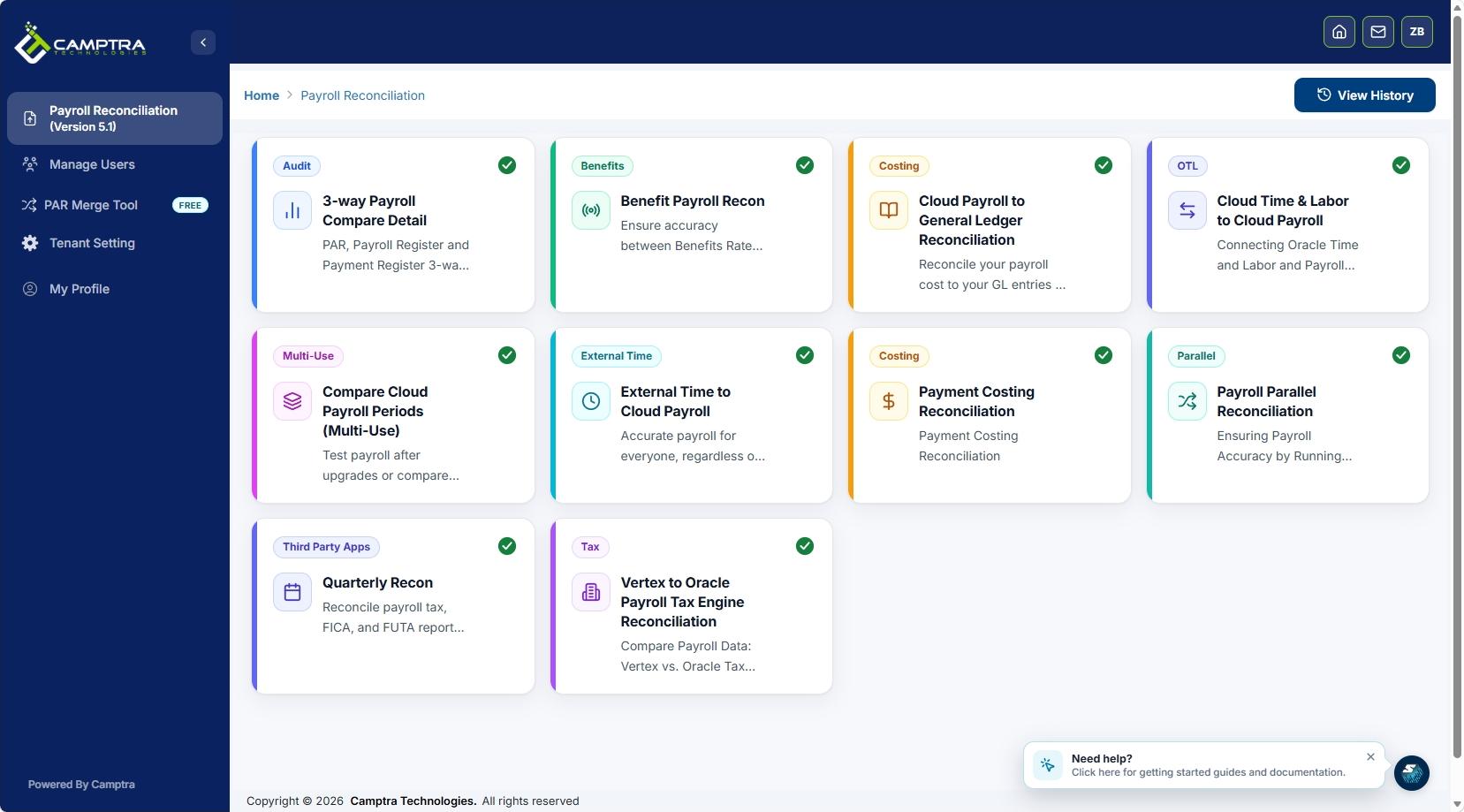
The outputs are audit-ready: time-stamped exception logs, match-rate reports, and variance summaries that satisfy the evidence requirements auditors test against. Customers have reported reconciliation time reductions of up to 80%, which means your team spends less time preparing data and more time resolving the exceptions that actually matter. For a closer look at what that means in practice, the healthcare system case study shows measurable audit-time improvements and earlier financial close in a high-volume payroll environment. Request a demo at camptratech.com to see how the Payroll Recon Toolset fits your Oracle Cloud environment.
Useful sources and further reading
The sources below support the guidance in this article. Each links directly to the primary or authoritative document.
- Sarbanes-Oxley Act full text (GovInfo) — Primary statutory text for Sections 302, 404, and 802; use for scope and compliance obligation questions.
- SEC official site — Authoritative source for registrant requirements, filing obligations, and enforcement actions related to SOX compliance.
- IRS: Outsourcing payroll duties — IRS guidance confirming that outsourcing does not transfer SOX liability; supports the vendor management and UCC mapping sections.
- DOL: SOX whistleblower provisions (Section 806) — Statutory text for employee protections; relevant for compliance program governance.
FAQ
What are the four SOX controls for payroll?
The four core SOX payroll controls are segregation of duties, access management, change management, and continuous reconciliation. Each must be documented, tested, and supported by evidence auditors can inspect.
Is SOX compliance mandatory in the United States?
SOX compliance is mandatory for all public companies registered with the SEC, including foreign private issuers listed on U.S. exchanges. Private companies are not subject to SOX, though many adopt its control frameworks voluntarily.
What are SOX payment controls?
SOX payment controls for payroll include dual approval for off-cycle payments, formal authorization for direct deposit changes, bank reconciliation of net pay disbursements, and system-enforced change management for any modification to payment instructions.
What is an example of a SOX payroll control?
A quarterly access review is a clear example: the payroll system owner pulls a full user list, confirms each user is still actively employed and needs their current permissions, documents any accounts removed, and obtains manager sign-off. That signed log is the evidence auditors test.
Does outsourcing payroll eliminate SOX obligations?
No. The IRS confirms that outsourcing payroll does not transfer SOX liability. The client must still review the vendor’s SOC 1 Type II report, complete UCC mapping, and maintain its own reconciliation and access controls.
Recommended
- Enterprise Payroll Controls Checklist for Oracle Cloud Teams | Camptra Technologies
- Payroll Control Environment: A Guide for HR Teams | Camptra Technologies
- How HR Managers Monitor Payroll Status Effectively | Camptra Technologies
- How to Identify Payroll Discrepancies: Audit Process Guide | Camptra Technologies
